
Hiking Terms: The Complete Trail & Gear Glossary
Every trail, gear and footwear term you will actually hear, in plain English. Search for a word, or browse the categories below.
Terms are grouped by topic and listed A to Z within each group. The specs that appear in our review tables (stack height, drop, lug depth and the rest) are defined exactly as we report them on the footwear leaderboard, where every model is scored against the same 20+ factors described in how we test.
No terms match that search. Try a shorter word or a different spelling, or to browse all categories.
Boot & Shoe Anatomy
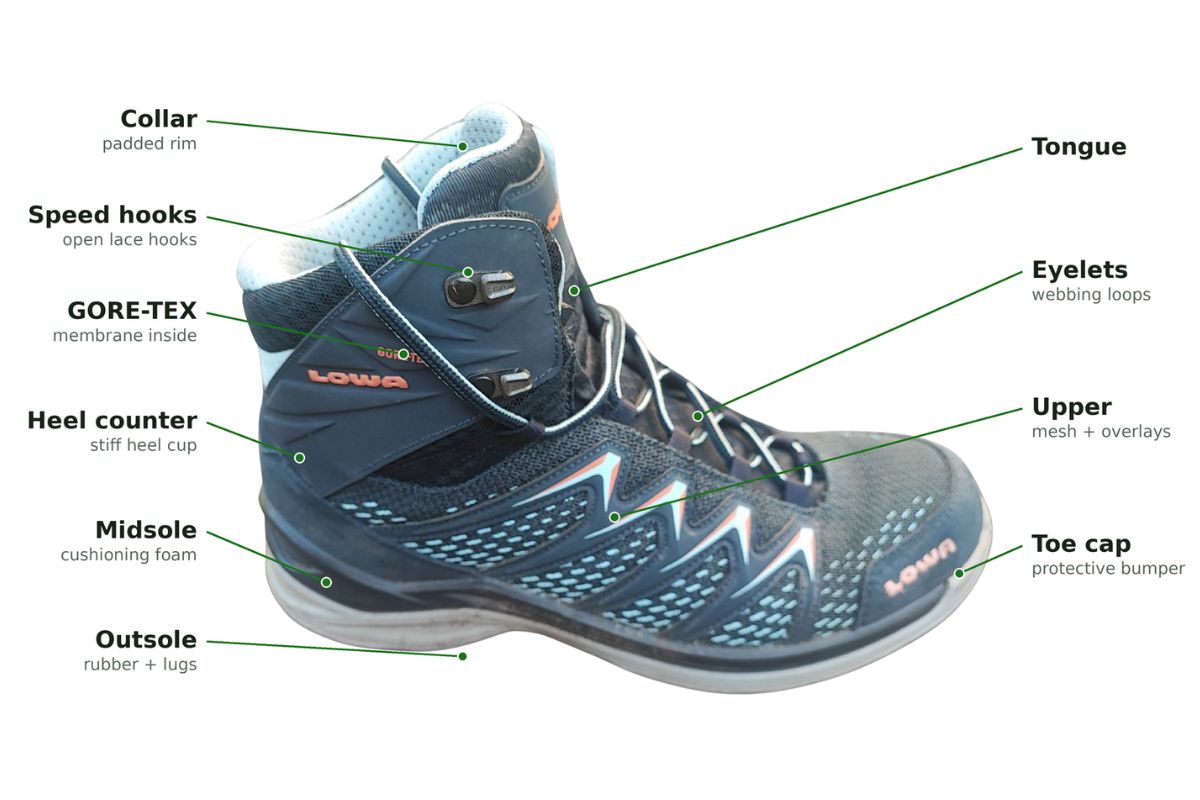
The parts every piece of hiking footwear is built from, working roughly from top to bottom.
Chassis
A brand’s name for a molded stability insert that wraps or cradles part of the midsole, such as Salomon’s Advanced Chassis. It controls torsional flex (twisting) so the shoe stays flat under your foot on off-camber ground, without making the forefoot stiff.
Related: Torsional rigidity · Shank
Collar (and scree collar)
The padded rim around the ankle opening. Its height defines the shoe’s cut (low, mid or high), and its padding seals out grit; a soft gasket-like version is called a scree collar. A taller collar adds ankle coverage but does not automatically prevent sprains, a distinction we unpack in our ankle support guide.
Related: Hiking shoes vs boots · Scree
Eyelets & speed hooks
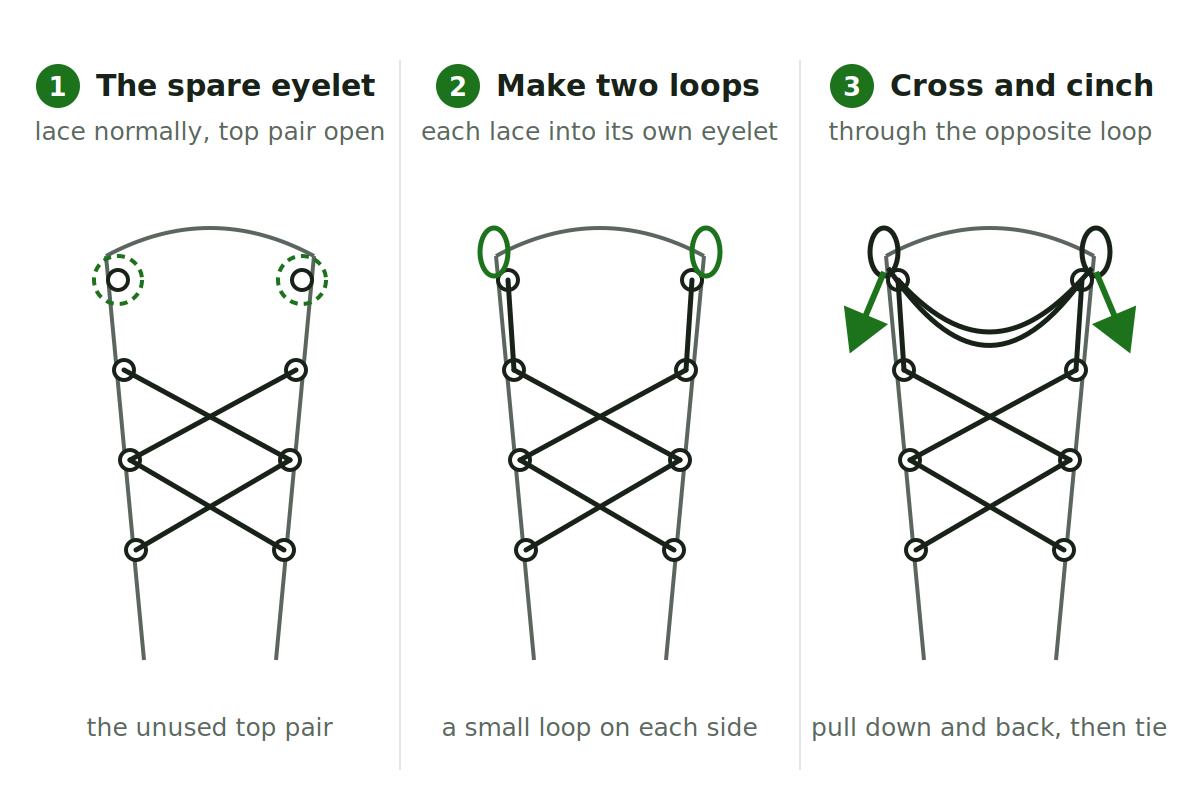
The lacing hardware. Eyelets are closed holes or fabric loops; speed hooks are the open hooks on a boot’s upper section that let you lace fast; locking eyelets grip the lace so tension does not bleed between zones. The extra top eyelet on many shoes exists for the heel-lock technique.
Related: Heel-lock lacing · Quicklace
Gusseted tongue
A tongue stitched to the upper along its sides, so there is no open gap for trail debris and water to fall through. A full gusset seals to the top of the lacing; a semi-gusset stops partway. On waterproof footwear a full gusset is what keeps shallow puddles from flooding in over the tongue.
Related: Waterproof membrane
Heel counter
The stiff cup built into the back of the shoe that holds your heel vertical and centered. A firm heel counter reduces heel lift and side-to-side wobble; a soft one lets the heel collapse inward or outward on uneven ground.
Heel cup
The shaped depression in the insole or midsole that seats the heel. A deep heel cup cradles the fat pad under your heel bone and adds a locked-in feeling; a shallow one lets the heel slide, which matters on descents.
Related: Heel counter · Insole
Insole (sockliner, footbed)
The removable liner your foot rests on inside the shoe. Stock insoles are usually thin foam with modest support, which is why swapping them is the most common first upgrade. We rank the replacements worth buying in our hiking insoles guide.
Related: Aftermarket insole · Arch support
Last
The foot-shaped form a shoe is built around, and the reason two shoes with the same printed size fit completely differently. A brand’s last determines heel width, instep height, toe-box shape and overall volume. When people say a brand “runs narrow,” they are describing its last.
From our test fleet: Our fit matrix tracks last character across every brand we have tested: about a third consistently run narrow, about a quarter run roomy, and the rest vary by model.
Related: Foot volume · Width sizes · Brannock Device
Lugs & lug depth
The rubber teeth on the outsole. Deeper, widely spaced lugs bite into mud and shed it between steps; shorter, denser lugs run smoother on hardpack and rock. Road shoes sit around 2 mm, most hiking footwear at 3 to 5 mm, and mud-focused designs deeper still. Every review on our leaderboard lists lug depth in millimeters, so you can compare models directly.
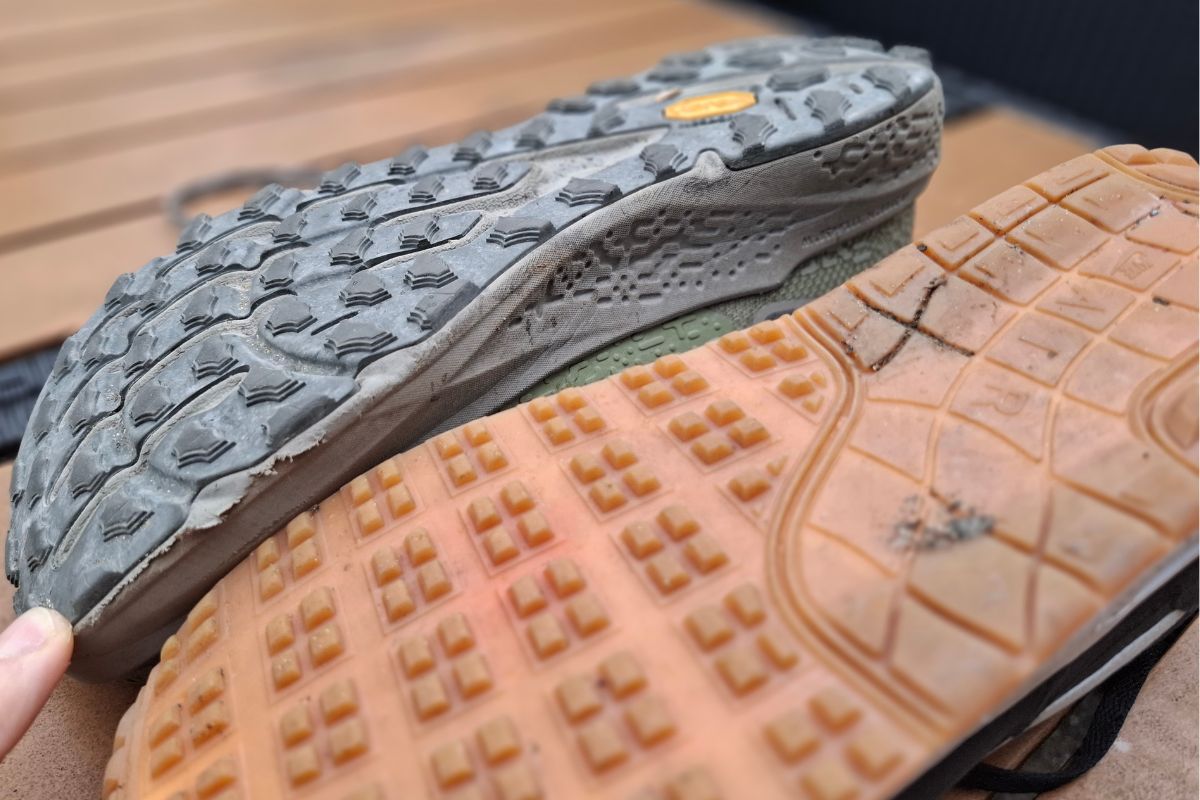
From our test fleet: Measured specs are the new standard in our reviews: the Salomon X Ultra 5 GTX in our fleet runs 3.5 mm multi-directional lugs.
Related: Outsole · Traction devices
Midsole
The cushioning layer between the outsole and your foot, usually a foam such as EVA or polyurethane. The midsole does most of the shock absorption and defines how a shoe rides: soft or firm, low or tall, flexible or stable.
Related: EVA · PU · Stack height · Cushioning
Outsole
The rubber layer that touches the ground. Its rubber compound decides how well it sticks to rock, and its lug pattern decides how it bites into soft ground. Big brands often buy outsoles from specialists such as Vibram; others, like Salomon’s Contagrip, are made in-house.
Related: Lugs & lug depth · Vibram · Contagrip
Rand
A band of rubber wrapped around the lower edge of the upper, sometimes the full circumference of the shoe. Common on approach shoes and mountaineering boots, it armors the upper against sharp rock. A full rand adds real durability on talus and scrambles, at the cost of weight and breathability.
Related: Approach shoe · Scrambling
Rock plate
A thin, flexible sheet of plastic or woven material inside a trail runner’s forefoot that spreads out point impacts, so sharp stones do not bruise your foot through the soft foam. It protects like a shank but preserves a running shoe’s flexibility. We cover which shoes have one in our rock plates explainer.
Related: Shank · Trail runner
Shank
A stiff insert, usually nylon, TPU or steel, buried between midsole and outsole under the arch. It resists flex under load, which saves your feet when carrying a heavy pack or standing on edges and ladder rungs. Backpacking and mountaineering boots have substantial shanks; trail runners usually have none.
Related: Rock plate · Flex · Backpacking boot
Toe box
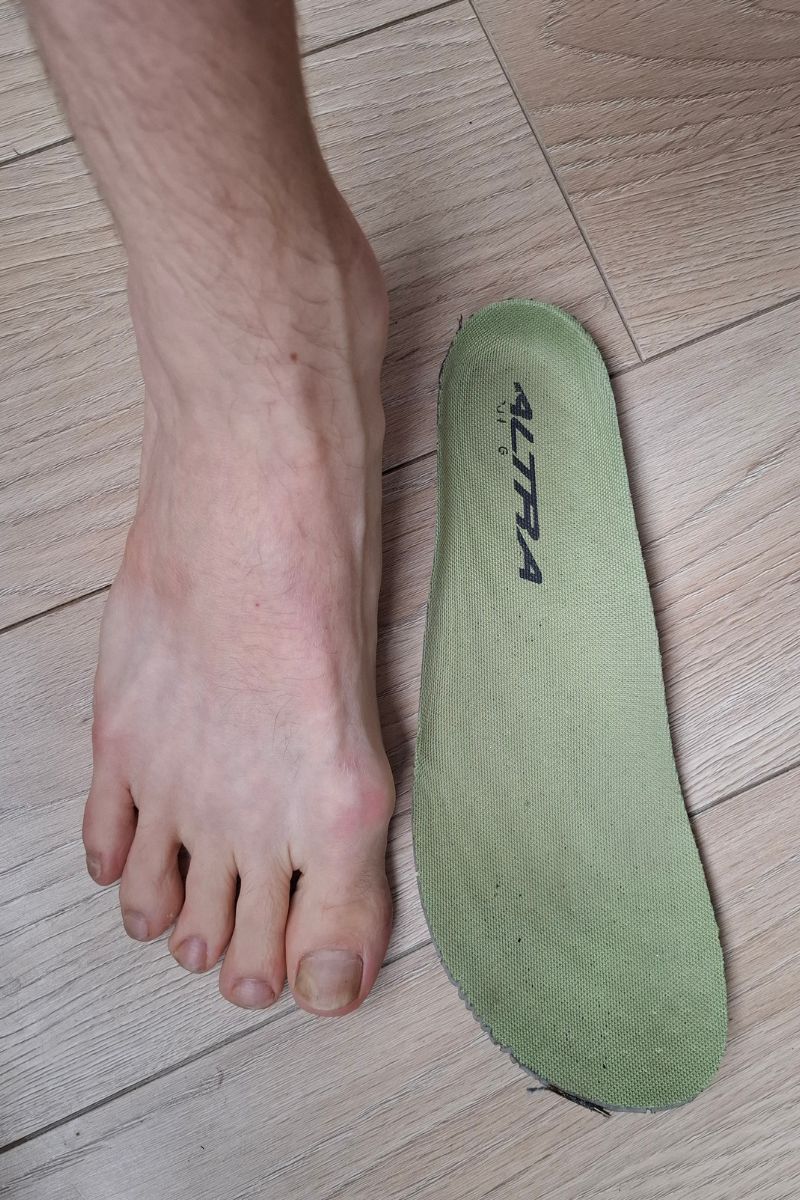
The front section of the shoe that houses your toes. Its width and height (not just the shoe’s length) determine whether toes can sit flat and spread naturally. A cramped toe box is behind many black toenails and blisters; our guides cover stretching a tight toe box and the best boots for wide feet.
Related: Toe splay · Width sizes · Toe room
Toe cap (toe bumper)
The reinforced rubber or synthetic shield over the front of the toe box that protects toes from rock strikes and keeps the upper from abrading. Toe protection is one of the scored factors in our reviews: we check whether the cap takes hits without peeling away from the upper.
Related: Rand
Upper
Everything above the sole: the body of the shoe that wraps your foot, including the tongue, collar and lacing area. The upper’s material (leather, mesh, knit or a woven synthetic) largely decides a shoe’s weight, breathability, durability and break-in time.
Related: Mesh upper · Full-grain leather · Break-in
Welt (welted construction)
A strip of leather or synthetic stitched around the shoe joining upper, insole board and outsole, as in classic Goodyear-welted boots. Welted footwear is heavy and needs a long break-in, but it can be resoled again and again, which is why some welted designs outlive several pairs of cemented boots. The survivors are in our classic hiking boots feature.
Related: Full-grain leather · Delamination
Fit & Foot Health
The vocabulary of getting footwear to actually fit, and what goes wrong when it does not.
Aftermarket insole
A supportive replacement for the thin stock insole, from trim-to-fit foam to semi-rigid structured footbeds. It is the cheapest way to change how a shoe supports your arch and seats your heel without changing the shoe. The models that earned a place in our packs are ranked in the insoles guide.
Related: Insole · Arch support
Arch support
The structure under the midfoot that shares load with the arch of your foot. How much you need depends on your arch and mileage, not on marketing: flat-footed hikers often need firm, structured support, while neutral feet do fine with little. Start with our guides to hiking with flat feet and the boots with real arch support.
Related: Pronation & overpronation · Aftermarket insole · Plantar fasciitis
Black toenail
Bruising under the nail (subungual hematoma) from the toe hitting the front of the shoe step after step, usually on descents. It is a fit message, not bad luck: too little toe room, or a heel that is not locked down and lets the foot slide forward. Check length against our too-small checklist before blaming the trail.
Blister
A fluid-filled pocket that forms when friction, heat and moisture separate the upper layers of skin. Prevention is about removing one of those three ingredients: footwear that fits without rubbing, moisture-wicking socks, and taping known trouble spots before they flare. Our hiking socks guide covers the sock half of the equation.
Brannock Device
The metal foot-measuring plate used in shoe stores since the 1920s. It reads three numbers: heel-to-toe length, width, and arch length (heel to ball), and the largest of the three should drive your size. Measure both feet, late in the day, standing; feet are rarely identical. Our shoe size converter translates the result across US, UK and EU sizing.
Related: Width sizes · Sizing up
Break-in
The period during which a shoe’s materials soften and mold to your foot. Full-leather boots may need 20 to 40 mi30 to 65 km; most modern synthetic footwear needs far less, and trail runners close to none. Break-in fixes stiffness, not fit: a shoe that is the wrong shape on day one will still be the wrong shape after it.
Foot volume
The total three-dimensional space your foot occupies: height through the instep and midfoot, not just length and width. A high-volume foot feels pinched in shoes that fit fine on paper; a low-volume foot swims in them. Lacing can fine-tune volume, but the last sets the limits.
Related: Last · Width sizes
Heel lift (heel slip)
Your heel rising off the footbed with each step. A few millimeters in a brand-new stiff boot can disappear after break-in, but persistent lift grinds skin into hot spots and blisters. First fixes are the heel-lock lacing technique and a thicker sock; if those fail, the boot is likely too big or the wrong last for your heel.
Related: Heel-lock lacing · Heel counter · Hot spot
Heel-lock lacing (runner’s loop)
A lacing technique that uses the extra top eyelet to form two loops, through which the laces cross and cinch the ankle back into the heel cup. It is the standard first remedy for heel lift and works on most shoes with a spare eyelet. More fit fixes are in how hiking boots should fit.
Related: Heel lift · Eyelets & speed hooks
Hot spot
A warm, tender patch of skin where friction is building: the warning stage before a blister. The rule experienced hikers follow is to stop at the first sign and tape the spot immediately, because a hot spot costs two minutes and a blister can cost the rest of the trip.
Plantar fasciitis
Inflammation of the plantar fascia, the band of tissue running from heel to toes, felt as stabbing heel or arch pain, worst on the first steps of the morning. It is one of the most common hiking overuse injuries. Footwear with firm arch support and a cushioned, stable heel helps; our recovery guide and boot picks for plantar fasciitis go deeper.
Related: Arch support · Aftermarket insole
Pronation & overpronation
Pronation is the foot’s natural inward roll after landing, part of normal shock absorption. Overpronation is that roll continuing too far, collapsing the arch inward, which over long miles can feed knee, shin and plantar-fascia complaints. Flat or flexible arches overpronate most often; structured support and stable footwear are the usual counters.
Related: Supination · Arch support
Shin splints
Pain along the inner edge of the shinbone from overloading the muscles and bone lining that control your foot’s descent, classically after ramping up mileage or long hard downhills. Rest, gradual progression and calf strength fix the cause; footwear changes help less than people hope. Our shin splints treatment guide covers the full protocol.
Related: Hiker’s knee · Cushioning
Sizing up
Buying hiking footwear a half or full size larger than your street shoes. It compensates for thicker socks, downhill braking and the swelling feet undergo over a long day, which we cover in swollen feet after hiking. Size up in length only; going up to gain width usually just creates heel lift.
From our test fleet: Our reviews flag size-up advice for about half of the brands in our fit matrix, so check the model’s review before defaulting to a half size.
Related: Toe room · Width sizes · Heel lift
Supination (underpronation)
The opposite of overpronation: the foot stays rolled outward and does not pronate enough, so the outer edge takes the load. Common with high, rigid arches, and visible as heavy wear on the outer edge of an outsole. Cushioned, neutral footwear typically works better for supinators than stability designs.
Related: Pronation & overpronation · Cushioning
Toe room
The space between your longest toe and the front of the shoe, with your heel seated back. Our fit guidance is one to two fingers’ width of space, enough that toes never hit the front on descents, which is how toenails go black. How to check it, including the wall test, is in our toe room guide.
Toe splay
The natural spreading of your toes when the foot loads and balances. Conventional tapered toe boxes compress splay; anatomical and barefoot-style toe boxes are shaped to allow it. Hikers who switch to wide toe boxes often do it for exactly this reason.
Width sizes (D, 2E, 4E)
Letter codes for a shoe’s width at the ball of the foot. D is standard for men’s shoes and B for women’s; 2E (EE) is wide, 4E (EEEE) extra wide, and widths run narrower down the alphabet. Not every model comes in widths, which is why our wide feet guide leans on models that do, or on brands whose standard last runs wide.
Related: Last · Toe box · Brannock Device
Geometry & Ride
The measurable numbers behind how a shoe feels underfoot. These are the specs on every review we publish.
Cushioning
How much impact the midsole absorbs, set by foam thickness and firmness. More is not automatically better: plush foam is comfortable on hardpack but vague and wobbly on rocky, uneven ground, where a firmer platform gives better control. Comfort is one of the scored factors in every review we run.
Related: Stack height · EVA · Ground feel
Energy return
The share of impact energy a midsole foam gives back as rebound rather than absorbing as heat. Real differences exist between foams, but the term is heavily marketed; for hiking pace, durability and stability matter more than the last few percent of bounce.
Related: Cushioning · EVA
Flex
How easily the shoe bends fore-and-aft at the ball of the foot. Trail runners flex freely, hiking boots resist, and mountaineering boots barely flex at all so they can hold a crampon and edge on small holds. Stiffer flex saves energy under heavy loads; softer flex walks more naturally when the pack is light.
Related: Shank · Boot stiffness ratings
Footstrike (heel, midfoot, forefoot)
Which part of the foot touches down first. Heel striking is normal at walking pace; midfoot and forefoot patterns show up at speed and in low-drop footwear, which tilts the platform flatter. There is no morally correct footstrike for hiking: terrain, pace and the shoe’s drop shape it more than willpower does.
Related: Heel-to-toe drop · Zero drop · Cushioning
Ground feel
How much of the terrain’s texture you can sense through the sole. Thin, flexible soles transmit a lot (the entire point of barefoot footwear); tall cushioned stacks transmit almost nothing. More ground feel improves foot placement and balance feedback at the price of comfort on sharp rock.
Related: Stack height · Barefoot
Heel-to-toe drop
The difference between heel and forefoot stack height, in millimeters. A shoe with a 33 mm heel and 22 mm forefoot has an 11 mm drop. Traditional boots sit around 10 to 12 mm, most trail runners at 4 to 8 mm, and zero-drop shoes at 0 mm. Lower drop loads the calves and Achilles more, so transitions should be gradual.
From our test fleet: Worked example from our spec tables: the Salomon X Ultra 5 GTX runs a drop of 11 mm, squarely in traditional hiking-shoe territory.
Related: Stack height · Zero drop
Listed weight (per shoe vs per pair)
Footwear weight as published, usually for a single shoe in a men’s US 9, which catches people out when comparing against per-pair figures. Our spec tables state weight per shoe. Rule of thumb on the trail: weight on your feet costs several times its equivalent in the pack, which is why the boot weight guide is worth ten minutes.
Related: Ultralight · Trail runner
Rocker
A sole curved upward at toe and sometimes heel, like the runner of a rocking chair, so your foot rolls forward through the stride instead of bending the shoe. Common in max-cushion designs, where the stack is too tall to flex. A pronounced rocker smooths hiking on graded trail but can feel less precise on technical ground.
Related: Stack height · Flex
Stack height
The total thickness of material between your foot and the ground, measured in millimeters at heel and forefoot. Barefoot models sit under 15 mm; max-cushion designs top 30 mm. More stack means more insulation from impact but less ground feel and a higher, potentially more tippy platform, a tradeoff we explored in our piece on sole thickness and stamina.
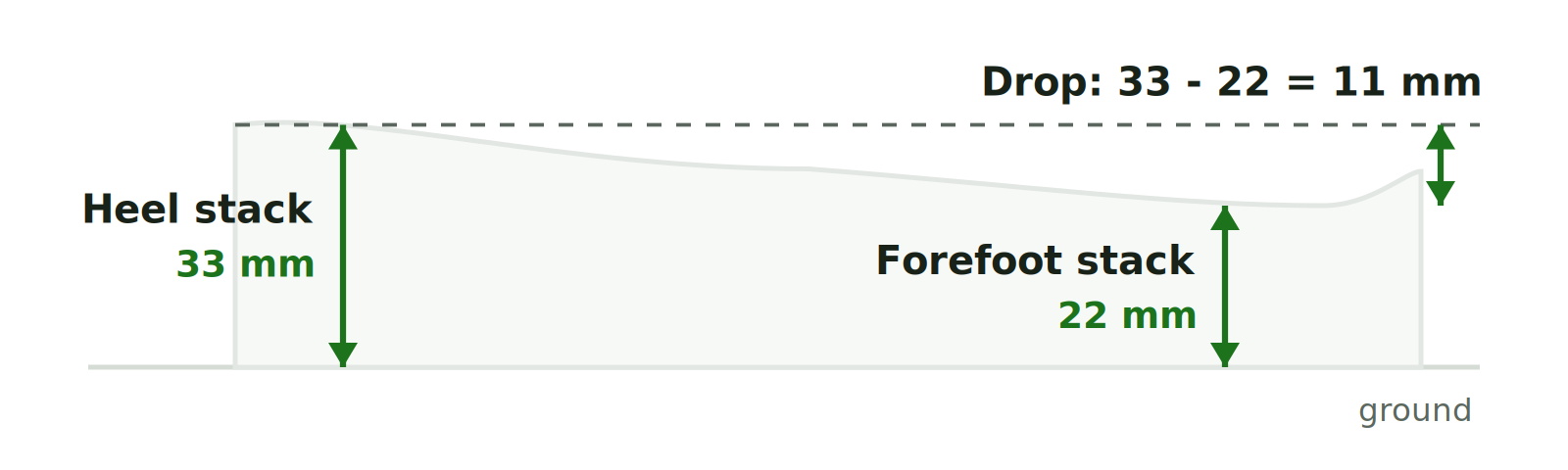
From our test fleet: From our spec tables: the Salomon X Ultra 5 GTX stacks 33 mm at the heel and 22 mm at the forefoot.
Related: Heel-to-toe drop · Ground feel · Cushioning
Torsional rigidity
A shoe’s resistance to twisting along its length, the motion of wringing a towel. You can test it in your hands: grab heel and toe and twist. High torsional rigidity keeps the platform flat under your foot on off-camber slopes and rocky steps; low rigidity lets the shoe follow the terrain, which ankle-stable hikers may prefer.
Zero drop
A sole with identical stack height at heel and forefoot: 0 mm of drop, the geometry of a bare foot on flat ground. Popularized by Altra and standard in barefoot footwear, it encourages a flatter, more natural footstrike. It says nothing about cushioning: zero-drop shoes range from razor-thin to plush. See our zero-drop and barefoot boots guide.
From our test fleet: Every zero-drop model on our leaderboard is an Altra or a Xero.
Related: Heel-to-toe drop · Barefoot · Toe splay
Uppers, Leather & Waterproofing
What uppers are made of, and what the waterproofing claims on the box actually mean.
Breathability
How fast water vapor from sweat can escape the shoe. Poor breathability means damp socks even in dry weather, and damp skin blisters faster. It is one of the factors we score in testing, because it is where waterproof models give up the most: the same membrane that blocks rain slows vapor on warm days.
Related: Waterproof membrane · Wicking · Mesh upper
DWR (durable water repellent)
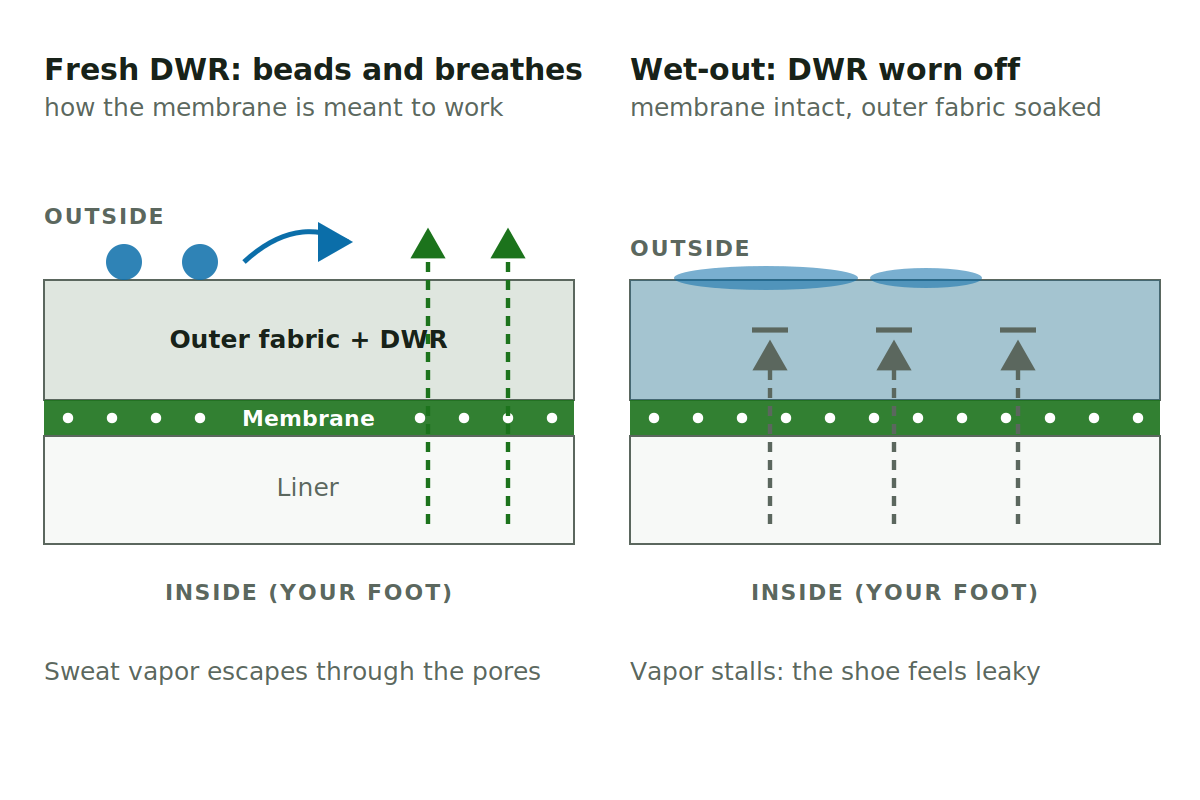
The factory coating on an upper’s outer fabric that makes water bead and roll off. DWR is not what makes a shoe waterproof (that is the membrane); it keeps the outer fabric from soaking up water, or wetting out, which would smother breathability. DWR wears off with miles and washing and can be restored with a spray-on treatment, part of the routine in cleaning and waterproofing your boots.
Related: Waterproof membrane · Breathability
eVent
GORE-TEX’s main membrane competitor. Its “direct venting” construction leaves the PTFE membrane unlined by a polyurethane layer, which generally makes it more breathable, at some cost in contamination resistance. Found in footwear and rain shells alike.
Related: Waterproof membrane · GORE-TEX
Full-grain leather
Leather that keeps the hide’s tough outer layer intact: the densest, most durable and most water-resistant grade, standard on traditional and heavy-duty hiking boots. It needs real break-in and regular conditioning, weighs more than synthetics, and outlasts them by years. The boots built on it fill our classic boots feature.
GORE-TEX (GTX)
The dominant waterproof-breathable membrane brand, built on expanded PTFE; the GTX suffix on a shoe name means it is fitted with a GORE-TEX bootie. Newer versions are PFC-free. It reliably keeps water out, at a price in breathability and drying time, a tradeoff we weigh model by model in our waterproof hiking boots guide.
From our test fleet: About a fifth of the models on our leaderboard are GORE-TEX editions. Read nothing into the rest: many models sell a GTX variant alongside the version we happened to test.
Related: Waterproof membrane · Breathability
Knit upper
An upper knitted as one continuous sock-like piece instead of stitched from panels. Fewer seams mean fewer rub points, and the fit is forgiving over bunions and wide spots. The tradeoff is structure: knits hold the foot less firmly on technical terrain.
Related: Mesh upper · Toe box
Matryx
A woven upper fabric that embeds high-strength yarns such as Kevlar in a thin matrix, used by Salomon among others. It delivers leather-like abrasion resistance at mesh-like weight, with very little stretch, so fit out of the box is fit forever. It is the upper on the Salomon X Ultra 5, which we tested in our X Ultra 5 GTX review.
Related: Ripstop & Cordura · Mesh upper
Mesh upper
Open-weave synthetic fabric that dominates trail runner and summer footwear uppers. It is light, breathes well and dries fast after a soaking, but abrades faster than leather and lets fine dust through. Non-waterproof mesh shoes plus quick drying is a combination many long-distance hikers prefer over membranes.
Related: Breathability · Trail runner · Knit upper
Nubuck
Full-grain leather with the surface lightly sanded to a velvety nap. It keeps most of full-grain’s strength while hiding scuffs and scratches far better than smooth leather, which is why so many mid-range hiking boots use it.
Related: Full-grain leather · Suede
Ripstop & Cordura
Two reinforcement fabrics that migrated from packs to footwear. Ripstop is woven with a grid of thicker threads so a small tear cannot run; Cordura is a high-tenacity nylon known for abrasion resistance. On shoes they show up in high-wear panels where mesh alone would shred.
Related: Mesh upper · Matryx
Seam-sealed
Seams whose stitch holes are covered with waterproof tape or liquid sealant on the inside. Every needle hole is a leak path, so a garment or bootie is only as waterproof as its seam sealing. “Fully seam-sealed” means every seam is taped, not just the major ones.
Related: Waterproof membrane · Waterproof vs water-resistant
Suede (split-grain leather)
Leather cut from the inner layers of the hide after the tough outer grain is split off. Lighter, softer and cheaper than full-grain, but less durable and less water-resistant. Most commonly seen as panels in leather-and-mesh hybrid uppers.
Related: Nubuck · Mesh upper
Waterproof membrane
A micro-porous film (GORE-TEX and eVent are the best known) laminated inside the upper. Its pores are too small for liquid water drops to pass inward but large enough for water vapor from sweat to escape outward. That is the theory; in practice every membrane trades away some breathability, and once water gets in over the collar, a membrane also keeps it in.
Related: GORE-TEX · eVent · Breathability · DWR
Waterproof vs water-resistant
Waterproof footwear has a sealed membrane bootie and taped or gusseted entry points, and holds out standing water for hours. Water-resistant footwear relies on coatings and tightly woven fabric: fine in drizzle, done in a downpour. Neither survives water arriving over the collar, which is what actually happens in deep puddles and stream crossings.
Related: Waterproof membrane · DWR · Water crossing
Wet-out
What happens when a worn DWR coating stops beading water and the outer fabric saturates. The membrane underneath still blocks liquid, but breathability collapses and the shoe turns heavy and cold, which is why wet-out feels exactly like leaking. The fix is cleaning and re-treating the DWR, not replacing the shoe.
Related: DWR · Waterproof membrane · Breathability
Midsole & Outsole Technologies
The foams, rubbers and brand names that appear in every spec sheet, decoded.
Contagrip
Salomon’s in-house outsole rubber family, tuned per model with different compounds and lug geometry (All Terrain Contagrip is the common hiking variant). Keeping rubber in-house lets Salomon match compound to shoe, which is why Contagrip grip differs noticeably between models.
From our test fleet: Every Salomon model on our leaderboard runs Contagrip; grip scores still differ between them, which is the compound point in practice.
Delamination
Sole layers separating from each other or from the upper, from adhesive failure, heat (a campfire or a car trunk in summer) or PU hydrolysis in aged midsoles. A peeling toe or flapping sole is a replacement signal, not a repair project, for anything not welted. The full checklist is in when to replace hiking boots.
EVA
Ethylene-vinyl acetate: the light, springy foam used in most hiking and running midsoles. It cushions well for its weight and cost, but it compresses permanently with miles (packing out), which is usually what dies first in a shoe. Firmness varies by recipe, so “EVA” alone tells you little about ride.
Related: PU · Cushioning · Delamination
FriXion
La Sportiva’s rubber compound family, carried over from its climbing-shoe heritage. The stickier FriXion variants are a big part of why La Sportiva approach shoes edge and smear so well on rock; harder variants trade some grip for lifespan on trail models.
From our test fleet: Every model in our test fleet running FriXion rubber is a La Sportiva.
Related: Approach shoe · Vibram Megagrip
OrthoLite
A brand of open-cell foam used for the stock insoles in many hiking shoes. Open-cell structure resists packing out, sheds heat and moisture better than closed foam, and carries an antimicrobial treatment. An OrthoLite sockliner is a decent stock insole, though still a cushioning layer rather than structured support.
From our test fleet: OrthoLite sockliners ship stock in about one in six of the models we have reviewed.
Related: Insole · Aftermarket insole
PU (polyurethane) midsole
A denser, heavier midsole foam that keeps its cushioning and support several times longer than EVA, which is why traditional backpacking boots use it. Its weakness is hydrolysis: PU degrades chemically with age even in a closet, so a decade-old boot can shed its sole on the first hike out. If you store boots for years, that is the failure to check for.
Related: EVA · Delamination
Quicklace (speed lacing)
A single thin Kevlar-cored lace with a spring-loaded cinch, pulled tight in one motion and tucked into a garage pocket on the tongue; Salomon’s version is the best known. It is fast and never comes undone, but offers less zone-by-zone tension control than eyelet lacing, and a field repair is harder than knotting a broken conventional lace.
From our test fleet: A handful of models on our leaderboard use quick-pull lacing, and our reviews score how each one trades speed against fine-tuning.
Related: Eyelets & speed hooks · Heel-lock lacing
TPU
Thermoplastic polyurethane: a material between plastic and rubber that can be molded stiff or slightly flexible. In footwear it appears as chassis and shank inserts, toe caps, heel counters and overlay films, anywhere structure is needed without metal weight.
Vibram
The Italian company whose yellow octagon marks the outsoles of a huge share of hiking footwear across many brands. Vibram is a family of dozens of compounds and lug designs, not one rubber, so “Vibram outsole” alone is not a grip guarantee; the compound name matters.
From our test fleet: Vibram rubber sits under about a quarter of the models we have ranked, on brands from Altra to Scarpa.
Related: Vibram Megagrip · Outsole
Vibram Megagrip
Vibram’s flagship sticky compound, and the one worth looking for by name: unusually strong wet-rock grip for a rubber that still wears at an acceptable rate. Softer, grippier rubber normally wears faster; Megagrip’s reputation comes from balancing that tradeoff better than most.
From our test fleet: Megagrip shows up all through our fleet: our field notes record it on approach shoes, hiking boots and trail runners alike.
Types of Outdoor Footwear
The categories on the shelf, and the lines between them that actually matter.
Approach shoe
A hybrid between hiking shoe and climbing shoe, built for the walk to a climb and easy climbing itself: sticky rubber, a flat “climbing zone” at the toe, a protective rand, and precise lace-to-toe fit. On rock slabs and scrambles nothing else grips like one; on soft muddy trail the shallow lugs give the advantage back. Our picks are in the approach shoes guide.
From our test fleet: Our leaderboard ranks approach shoes alongside the boots, sandals and trail runners, scored on the same field factors.
Related: Rand · FriXion · Scrambling
Backpacking boot
A boot built for carrying multi-day loads: stiffer shank, more supportive chassis, burlier upper and outsole than a day-hiking boot. The stiffness that feels wooden on an unloaded stroll is exactly what saves feet and ankles under a heavy pack. We map the differences in hiking vs backpacking boots.
Barefoot (minimalist) shoe
Footwear designed to interfere with the foot as little as possible: zero drop, thin flexible sole, wide anatomical toe box, no arch structure. Advocates value the strength and ground feel it builds; the transition works the calves and foot muscles hard and should be gradual. Trail-worthy options are in our barefoot hiking boots guide.
Related: Zero drop · Ground feel · Toe splay
Boot stiffness ratings (B0 to B3)
A shorthand for sole stiffness that pairs boots with crampons. B0 boots are flexible hiking boots (strap-on traction only), B1 stiff hikers that accept flexible C1 crampons, B2 semi-rigid mountaineering boots with a heel welt for C2 semi-step crampons, and B3 fully rigid boots for step-in C3 and technical climbing. Matching matters: a stiff crampon on a soft boot pops off. See attaching crampons to hiking boots.
Related: Mountaineering boot · Crampons · Flex
Camp shoe
The light second pair carried on overnight trips, put on the moment camp is made: foam clogs, sandals or ultralight slip-ons. The job is to let wet boots dry and compressed feet recover. Grams count, so many backpackers agonize over camp shoes more than seems sane to outsiders.
Related: Hiking sandal · Base weight
Hiking sandal
An open sandal with a grippy outsole and an adjustable strap harness that actually locks the foot down, which is what separates it from a beach sandal. Unbeatable in hot weather and wet canyons, exposed to stubbed toes and sunburn everywhere else. We compare the field in the hiking sandals guide.
From our test fleet: Hiking sandals make up about a fifth of the models on our leaderboard, each scored on the same field factors as the boots.
Related: Water shoe · Camp shoe
Hiking shoes vs boots (low, mid, high cut)
Cut describes where the collar ends: low cut below the ankle (hiking shoes), mid cut at the ankle bone, high cut above it. Higher cuts add debris protection, warmth and a supported feeling at the cost of weight and freedom of movement; the protection is real, the sprain-proofing is smaller than assumed. The full comparison is in hiking boots vs hiking shoes.
Related: Collar · Trail runner
Mountaineering boot
A rigid, insulated boot built for snow, ice and technical alpine terrain: near-zero flex for cramponing and edging, full rand, and warmth ratings hiking boots never attempt. Overkill on a trail, mandatory on a glacier. Where the line runs is covered in mountaineering vs hiking boots.
Related: Boot stiffness ratings · Crampons · Flex
Trail runner (trail running shoe)
A running shoe adapted for trails: aggressive lugs, tougher upper, often a rock plate, still light and flexible. Trail runners have become the default for thru-hikers and many day hikers because they are light, need no break-in and dry fast; the price is durability and underfoot protection. The debate is settled per use case in boots vs trail runners.
From our test fleet: Trail runners are the largest single group on our leaderboard, ahead of hiking boots, hiking sandals and approach shoes.
Related: Rock plate · Mesh upper · Thru-hike
Water shoe
A closed or semi-closed shoe built to be soaked: drainage ports that dump water, fast-drying materials, and rubber compounded for wet grip. The closed toe is the difference from a sandal, and it matters in rocky rivers. Our tested picks are in the water shoes guide.
Related: Hiking sandal · Water crossing
Winter (insulated) hiking boot
A hiking boot with built-in synthetic insulation, rated in grams per square meter: 200 g suits active winter hiking, 400 g cold-and-slow days, and 600 g and up mostly standing around in serious cold. More insulation while moving mainly produces sweat, which then freezes. Tested picks live in the winter boots guide.
Related: Waterproof membrane · Microspikes
Trail & Terrain
Words for what is under your feet and ahead of you on the map.
Backcountry (and frontcountry)
Backcountry is terrain beyond roads and services, reached and left on foot, where you handle your own water, navigation and emergencies. Frontcountry is the developed opposite: campgrounds, trailhead loops, cell coverage. The line matters because gear lists and margins for error are written for one or the other.
Related: The Ten Essentials · Dispersed camping
Belay
Managing the rope for a climber so a slip becomes a short, held fall instead of a long one. Hikers meet belays on guided scrambles, via ferratas and steep snow courses. The rope work behind it is covered in our rope skills and knots guide.
Related: Via ferrata · Scrambling · Crux
Blaze
A trail marker painted or nailed on trees and rocks, its color and shape identifying the route; the Appalachian Trail’s white blaze is the most famous. A double blaze warns of a turn. Losing the blazes is the first sign you have lost the trail.
Bushwhacking
Travel where there is no trail at all, navigating cross-country through brush and deadfall. Progress can drop below 1 mph1.6 km/h, and navigation skill becomes safety equipment rather than a nice-to-have. Long pants and a thick skin required.
Related: Bearing · Topographic map
Cairn
A deliberate stack of rocks marking a route where there is no tread to follow, above tree line or across slickrock. Navigate by them, but do not build your own: unofficial cairns send strangers off-route, and rearranging rocks is its own Leave No Trace violation.
Related: Blaze · Tree line · Leave No Trace
Class ratings (YDS)
The Yosemite Decimal System’s difficulty scale for terrain. Class 1 is walking on trail; Class 2 rough cross-country with occasional hands; Class 3 scrambling with constant hands and real fall consequences; Class 4 exposed climbing where a fall is likely fatal; Class 5 technical roped climbing, subdivided as 5.x. The classes are subjective at the edges, which is where accidents happen.
Related: Scrambling · Exposure
Couloir
A steep, narrow gully running down a mountain face, often snow-filled into summer. Couloirs are natural ascent lines for mountaineers and natural funnels for everything falling from above: rockfall and avalanches follow the same channel. Timing (frozen and early) is the classic risk management.
Related: Glissade · Self-arrest
Crevasse
A deep crack in a glacier, often hidden under a skin of snow (a snow bridge) that may or may not hold your weight. Crevassed terrain is why glacier travel happens roped, in teams, with rescue skills practiced beforehand; see our mountaineering beginners guide for where that training starts.
Related: Mountaineering boot · Belay · Self-arrest
Crux
The hardest section of a route: the move, pitch or stretch that sets the grade and decides whether the day goes forward. Knowing where the crux sits, and what retreat looks like if it shuts you down, is the difference between a plan and a hope.
Related: Scrambling · Class ratings · Exposure
Elevation gain
The total vertical distance climbed over a route, counting every rise, not just the difference between start and summit. It predicts effort better than mileage: a flat 10 mi16 km is a stroll, and the same distance with 4,000 ft1,200 m of gain is a serious day. Our elevation grade calculator and hiking time calculator turn gain into realistic plans.
Related: Switchback · False summit
Exposure
The presence of a long fall next to where you are moving: a narrow ridge, a ledge above a cliff. Exposure is about consequence, not difficulty; easy moves become serious when a stumble is unrecoverable. Angels Landing is the textbook case, which is why our trail guide spends so long on it.
Related: Scrambling · Ridgeline · Class ratings
False summit
A high point that looks like the top from below but reveals more mountain behind it once reached. The morale cost is real enough that experienced hikers study the route profile beforehand, so the third “summit” is an expectation rather than a heartbreak.
Related: Ridgeline · Elevation gain
Permit (wilderness, day-use)
Advance authorization required for popular trails and protected areas, managed through quotas, lotteries or first-come registration, sometimes months ahead. Permits are how land managers keep fragile places walkable; famous cases include Angels Landing and the long-trail permits in our PCT guide.
Related: Trailhead · Thru-hike · Leave No Trace
Ridgeline
The crest where two slopes meet, often carrying a trail with views both ways. Ridgelines concentrate everything: wind, exposure, and above all lightning risk; they are the wrong place to be in a building storm, as our thunderstorm safety guide spells out.
Saddle (col, pass)
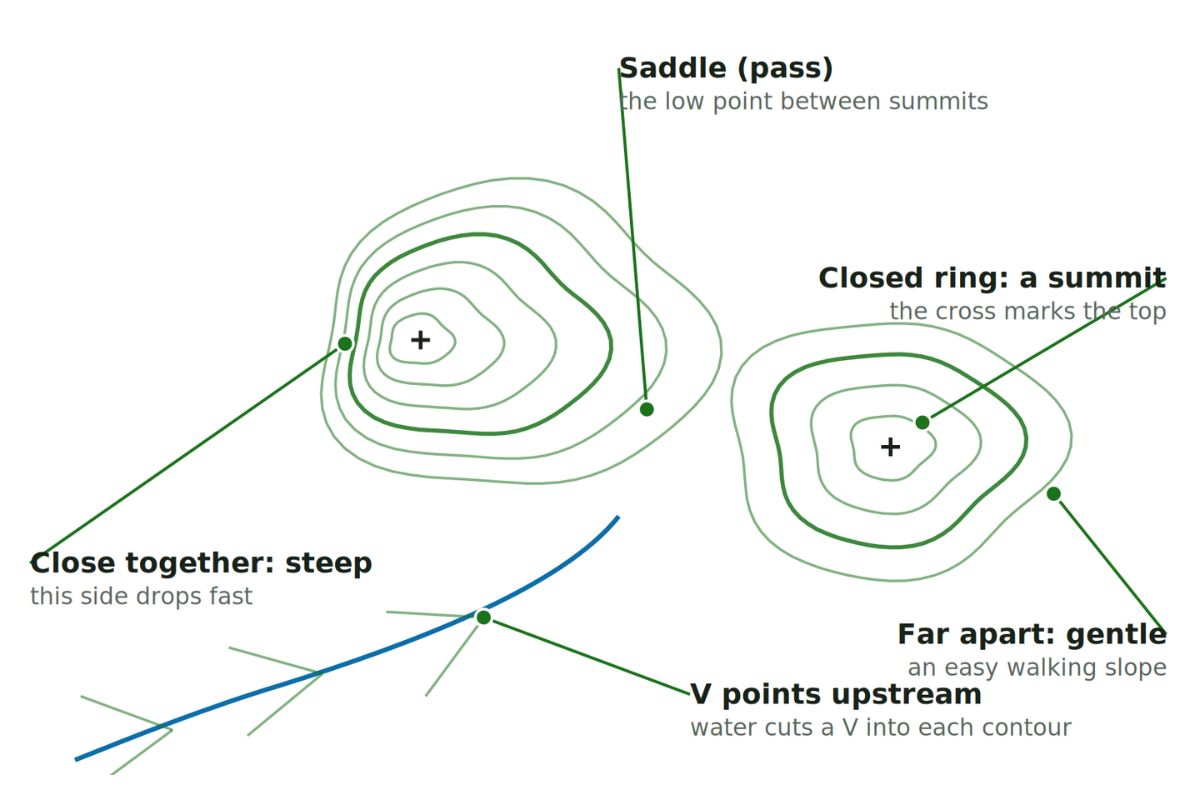
The low point on a ridge between two summits, shaped like a riding saddle; col is the mountaineering term, pass the everyday one. Trails cross ranges at saddles because they are the cheapest way over, and on a topo map their hourglass-shaped contours are easy to spot.
Related: Ridgeline · Contour line
Scrambling
Terrain between hiking and climbing: steep enough that hands come out of pockets and onto rock, not steep enough to rope up, typically Class 2 to 3. Judgment matters more than strength, because what scrambles up must eventually climb down. Our scrambling guide covers technique and when to turn around.
Related: Class ratings · Exposure · Approach shoe
Scree
Slopes of small loose rock, gravel to fist-sized, that slide underfoot. Ascending scree is two steps up, one step back; descending it, practiced hikers “scree-ski” with plunging heel steps. Gaiters and a scree collar keep the shards out of your shoes.
Switchback
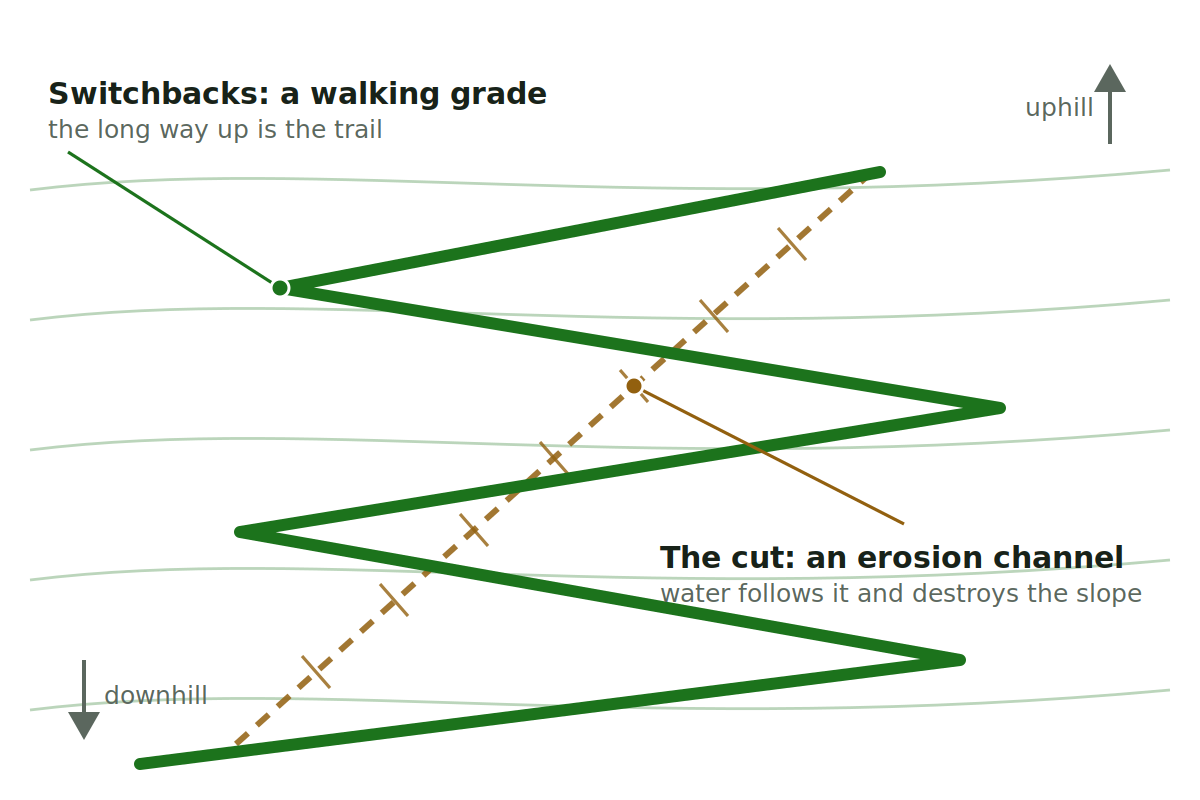
A zigzag turn that carries a trail up a slope too steep to climb straight. Cutting switchbacks (shortcutting the corners) is a cardinal trail sin: it gouges erosion channels that destroy the slope and eventually the trail itself.
Related: Elevation gain · Leave No Trace
Talus
Fields of rock too large to slide underfoot: boulder-sized blocks you step between or scramble over, common below cliffs and on high routes. Talus rewards stiff, protective footwear and punishes fatigue; a leg between two shifting blocks is a classic backcountry injury.
Related: Scree · Scrambling · Torsional rigidity
Trailhead
The official starting point of a trail, usually with parking, signage and sometimes a register or permit station. Trailhead elevation matters as much as its location: it sets how much climbing stands between you and the destination.
Related: Elevation gain · Blaze
Tree line (timberline)
The elevation above which trees no longer grow, set by climate and latitude. Crossing it changes the rules: no shelter from sun, wind or lightning, navigation by cairn instead of tread, and weather that arrives with nothing to slow it down.
Via ferrata
A protected climbing route, Italian for “iron path”: a steel cable bolted along rock with rungs and ladders, climbed while clipped in with a special energy-absorbing lanyard. It puts non-climbers on terrain otherwise reserved for climbers, with gear and rules of its own; ordinary hiking gear is not enough.
Related: Exposure · Scrambling
Water crossing (ford)
Crossing a stream or river without a bridge. The rules that keep it boring: unbuckle the pack’s hip belt, face upstream and use poles, cross at wide shallow sections rather than narrow fast ones, and keep footwear on. Above-the-knee fast water is a turn-around, not a challenge.
Related: Water shoe · Trekking poles
Long-Distance & Trail Culture
The language of thru-hiking, born on the big trails and now spoken everywhere.
Base weight
The weight of a loaded pack minus consumables (food, water, fuel), the standard yardstick for comparing setups because consumables vary by trip. Worn clothing and items in pockets are also excluded. Run your own numbers with the backpack weight calculator.
Related: Ultralight · The big three
The big three
The three heaviest gear systems: pack, shelter and sleep system. Together they dominate base weight, so upgrading them saves more than optimizing everything else combined; ultralighters address the big three first and the titanium spork last.
Related: Base weight · Ultralight
Cathole
The hole you dig for human waste in the backcountry: 6 to 8 in15 to 20 cm deep, at least 200 ft60 m from water, camps and trails, refilled and disguised afterwards. The complete etiquette, trowel included, is in how to poop in the woods.
Related: Leave No Trace · Dispersed camping
Cowboy camping
Sleeping under the open sky with no tent or tarp: pad, bag, stars. Thru-hikers love it for the zero setup time and the views; dew, bugs and surprise weather are the tax. Check the sky and know your forecast before committing.
Related: Dispersed camping · The big three
Dispersed camping
Camping outside developed campgrounds on public land where it is allowed: free, unserviced, and governed by stricter Leave No Trace expectations precisely because nobody maintains the site. Durable surfaces, existing fire rings and distance from water are the core rules; our camping beginners guide covers the basics first.
Related: Backcountry · Leave No Trace · Cathole
Flip-flop
A thru-hike done out of order: start in the middle or hike one half, then travel (“flip”) to hike the other half from the far end. Flip-floppers dodge weather windows and starting-line crowds while still completing every mile within the year.
Related: NOBO & SOBO · Thru-hike
Hiker midnight
Nine p.m., the hour by which most exhausted long-distance hikers are asleep, a joke that is also a hard social norm in shelters and busy campsites. Arriving loud after hiker midnight is a reliable way to become unpopular.
Related: Thru-hike · Zero & nero
HYOH (hike your own hike)
The trail community’s core etiquette: hike at your pace, with your gear, by your goals, and extend others the same courtesy. Quoted both sincerely and, occasionally, as a polite end to an argument about someone’s base weight.
Related: Ultralight · Trail name
LASH
Long-Ass Section Hike: a section hike big enough to feel like a thru-hike, weeks or months on trail, without covering the whole thing. The acronym is affectionate, and the logistics are thru-hiker logistics.
Related: Section hike · Thru-hike
Leave No Trace (LNT)
Seven principles for minimizing your impact outdoors: plan ahead, travel and camp on durable surfaces, dispose of waste properly, leave what you find, minimize campfire impact, respect wildlife, and be considerate of others. It is the shared ethic under all trail etiquette, from switchback cutting to how to poop in the woods; our mountain tourism code of ethics extends it further.
Related: Switchback · Cairn · Trail magic
NOBO & SOBO
Northbound and southbound: the direction of a thru-hike attempt. On the big US trails NOBO is the social mainstream with the crowded start windows; SOBO starts later, quieter and often harder early. The choice shapes weather windows, resupply and the entire social experience.
Resupply
Restocking food and consumables during a long hike, either by buying in trail towns or mailing boxes ahead to post offices and hostels. Resupply strategy dictates pack weight between stops, and mastering it is half of what separates comfortable thru-hikers from suffering ones.
Related: Zero & nero · Base weight
Section hike
Completing a long trail in separate pieces over months or decades instead of one push. Section hikers trade the single epic for compatibility with jobs and families, and many finish trails that defeat time-limited thru-hikers.
Shakedown
A short trial hike, or a gear-list review by an experienced hiker, that exposes what you carry and never use, what you lack, and what breaks, before a long trip does it for you. Standard pre-thru-hike ritual, humbling by design.
Related: Base weight · Thru-hike
Thru-hike
Hiking a long-distance trail end to end in one continuous journey, typically within a year: the Appalachian Trail, the Pacific Crest Trail, or any of their siblings worldwide. It is as much logistics as walking; our PCT guide and thru-hiking in Europe show what planning one takes.
Related: Section hike · Triple Crown · Resupply
Trail angel
Someone who helps long-distance hikers expecting nothing back: rides to town, a yard to camp in, cold drinks at a road crossing. Around the big trails, some trail angels have hosted thousands of hikers and become institutions in their own right.
Related: Trail magic · Zero & nero
Trail magic
Unexpected kindness encountered on trail, classically a cooler of drinks at a dusty road crossing or a surprise cookout. The etiquette: take what is offered gratefully, leave some for the hikers behind you, and pack out your trash.
Related: Trail angel · Leave No Trace
Trail name
The nickname a long-distance hiker goes by on trail, traditionally given by other hikers after some memorable incident rather than chosen. On a thru-hike, many people never learn their friends’ legal names.
Related: Thru-hike · Trail angel
Triple Crown
Completing the three great US long trails: the Appalachian Trail, the Pacific Crest Trail and the Continental Divide Trail, roughly 7,900 mi12,700 km combined. A few hundred people have finished all three; it is thru-hiking’s grand slam.
Related: Thru-hike · NOBO & SOBO
Ultralight (UL)
A backpacking philosophy that cuts pack weight aggressively, conventionally to a base weight under 10 lb4.5 kg, through multi-use gear, minimalist shelters and disciplined choices. Done well it makes miles easier and injuries rarer; done badly it becomes “stupid light,” the theme of our 2026 ultralight industry report.
Related: Base weight · The big three
Zero & nero
A zero is a day with zero trail miles, usually in town for rest, laundry and eating; a nero is a near-zero, a short mileage day that ends or begins in town. Zeros restore bodies and morale, and budgets die by them: town days cost more than trail weeks.
Related: Resupply · Trail angel
Gear, Clothing & Layers
The equipment vocabulary beyond footwear, from layering theory to winter traction.
Base layer
The layer against your skin, whose job is moving sweat outward, not warmth. Merino wool or synthetic; never cotton. If your base layer is soaked and cold, everything above it is fighting a lost battle.
Related: Wicking · Merino wool · “Cotton kills”
Bear canister
A hard, bear-proof container for food and every scented item, required by regulation in parts of the Sierra Nevada, Adirondacks and elsewhere. Heavy and bulky, and non-negotiable where required: a bear that gets human food is usually a dead bear later. Check requirements when planning any overnight in bear country.
Related: Leave No Trace · Resupply
Crampons
Rigid metal frames with long points, including forward-facing front points, that attach to stiff boots for steep snow and ice. They demand boot compatibility (the B and C rating system) and technique to match; the differences from microspikes are laid out in crampons vs microspikes and our crampon picks.
Related: Boot stiffness ratings · Microspikes · Self-arrest
Gaiters
Fabric sleeves worn over the boot top and lower leg, sealing the gap where debris, snow and water get in. Low trail gaiters keep grit out of trail runners; tall waterproof ones handle deep snow and brush. Cheap insurance against emptying your shoes every mile on scree.
Related: Scree · Postholing
Hydration bladder (reservoir)
A soft water bag carried inside the pack with a drink hose over the shoulder. Sipping without stopping means most people drink more, and it frees pockets; against that, refills are clumsier than with bottles, mold needs managing, and you cannot see how much is left. Many hikers run a bladder plus one bottle as a gauge.
Related: The Ten Essentials
Layering
Dressing in independent layers (base for moisture, mid for warmth, shell for weather) that you add and shed as effort and conditions change, instead of one heavy garment that is always wrong. The skill is anticipating: shed before you sweat, add before you chill. Our Hiking Gear Planner builds a layering system for your conditions.
Related: Base layer · Midlayer · Shell
Merino wool
Fine-fibered wool from Merino sheep, the natural fiber of choice for base layers and hiking socks: it insulates when damp, wicks well and resists odor for days, though it wears out faster than synthetics. Nearly every top pick in our hiking socks guide is a merino blend for exactly these reasons.
Related: Base layer · Wicking
Microspikes
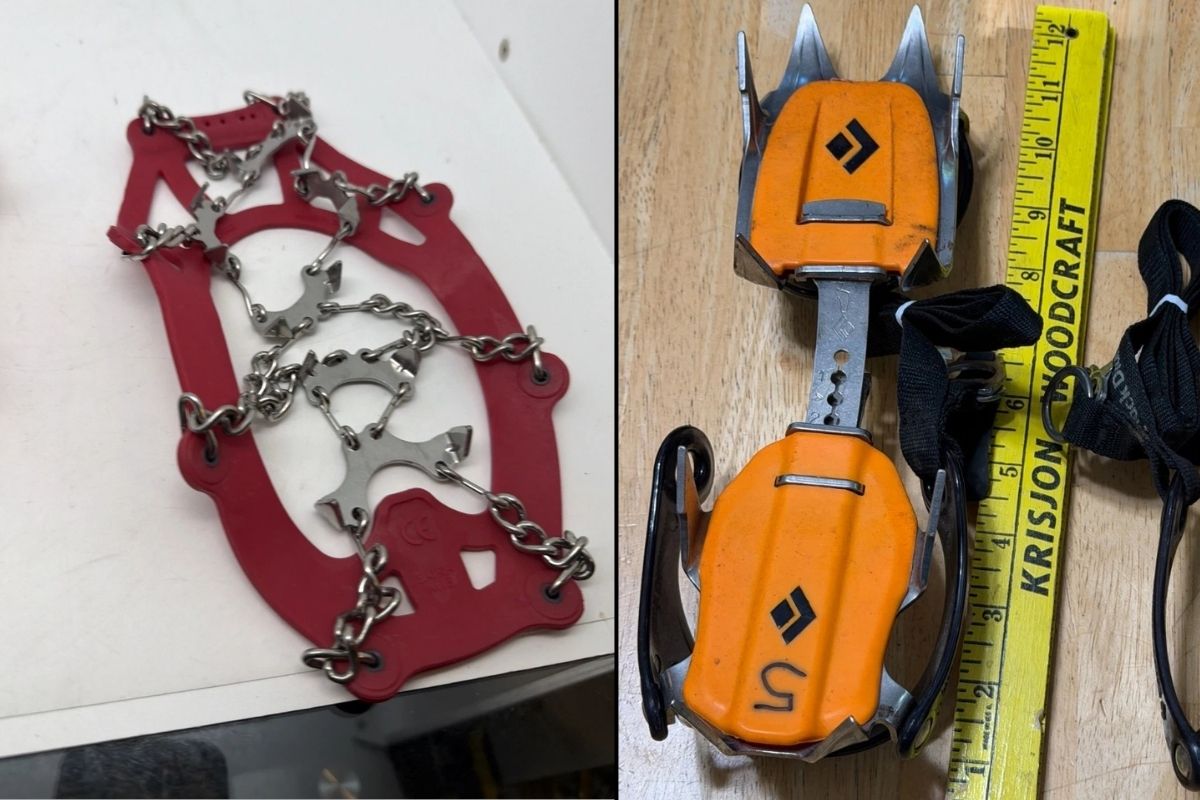
A rubber harness stretched over your existing footwear, carrying chains and small spikes of roughly 0.25 to 0.5 in6 to 12 mm, like tire chains for feet. They transform packed snow and icy trails, and they are not crampons: on steep ice or technical terrain they are the wrong tool. Tested picks are in our microspikes guide.
Related: Crampons · Traction devices
Midlayer
The insulation between base layer and shell: fleece, a light synthetic puffy, or wool. It traps warm air while letting the base layer’s moisture keep moving outward. On most hikes the midlayer is what goes on and off all day.
Moleskin
Thick adhesive-backed padding cut to cover hot spots and shield forming blisters from further rubbing. A palm-sized sheet weighs nothing and belongs in every first aid kit; applied at the hot-spot stage it usually ends the problem on the spot.
Puffy
Trail slang for an insulated jacket filled with down or synthetic fill. Down gives the most warmth per gram but collapses when soaked; synthetic keeps insulating damp and costs less, for more bulk. The puffy goes on at every stop and off at every start.
Shell (hardshell vs softshell)
The outermost layer against wind and precipitation. A hardshell is a waterproof-breathable membrane jacket: full weather protection, least breathable. A softshell is stretchy woven fabric: highly breathable, wind-resistant, only shower-proof. Many hikers carry a hardshell and wear a softshell.
Related: Waterproof membrane · DWR · Layering
The Ten Essentials
The classic checklist of systems to carry on any hike: navigation, sun protection, insulation, illumination, first aid, fire, repair tools, nutrition, hydration and emergency shelter. The point is not ten objects but ten problems you can answer when a day hike stops going to plan; our day-hike packing guide turns the list into a real loadout.
Related: Layering · Topographic map
Traction devices
The umbrella term for everything that adds grip to footwear on snow and ice: microspikes, lighter chain and coil systems, studded soles, and crampons at the technical end. Choosing within the spectrum is about terrain angle and hardness of the ice, not brand.
Related: Microspikes · Crampons · Winter
Trekking poles
Adjustable walking poles that turn hiking partly into four-limbed travel: they take real load off knees on descents, add balance at crossings and on rough ground, and set a rhythm on climbs. Length matters, and most people set it wrong; use our technique guide and pole height calculator.
Related: Water crossing · Hiker’s knee
Water treatment
Making backcountry water safe: squeeze and pump filters for bacteria and protozoa like giardia, chemical drops and UV for viruses too, boiling as the fallback that always works. Clear mountain streams carry invisible risks, which is why treatment is standard practice; the methods are compared in how to purify water on the trail.
Related: Hydration bladder · The Ten Essentials
Wicking
A fabric’s ability to pull liquid sweat off your skin and spread it to evaporate, the property that keeps you dry from the inside. Synthetics and merino wick; cotton does the opposite, absorbing and holding water. It is the first thing to check on anything sold as summer hiking clothing.
Related: Base layer · “Cotton kills” · Breathability
Navigation, Weather & Safety
The terms that matter when conditions turn or the trail disappears.
Acclimatization
The body’s gradual adaptation to altitude: more red blood cells, deeper breathing, better oxygen use. It cannot be rushed, only scheduled: ascend gradually, sleep lower than the day’s high point (“climb high, sleep low”), and build rest days into any itinerary above 10,000 ft3,000 m.
Related: Altitude sickness
Altitude sickness (AMS)
Acute mountain sickness: headache, nausea, fatigue and poor sleep from ascending faster than your body can adapt to thinner air, common above 8,000 ft2,400 m. Mild AMS means stop ascending; worsening symptoms mean descend, the one reliable cure. Severe forms (HAPE, HACE) are emergencies. Symptoms and prevention are covered in our altitude sickness guide.
Related: Acclimatization
Avalanche safety gear
The inseparable trio for travel in avalanche terrain: transceiver (beacon) to be findable and to find, probe to pinpoint a burial, shovel to dig. All three, on every person, with practice; owning them without training is a rescue fantasy. Terrain judgment comes first, and it is the heart of our avalanche safety guide.
Related: Couloir · Postholing
Bearing
A direction of travel expressed in degrees from north, taken from a map or sighted on a landmark with a compass. Following a bearing keeps you on line when fog, forest or featureless terrain hides the target. The skill sounds antique until the one afternoon it is not.
Related: Declination · Bushwhacking
Contour line
A line on a topo map connecting points of equal elevation, usually with a fixed interval such as 40 ft12 m between lines. Lines close together mean steep ground; far apart, gentle. Closed circles are summits, and V-shapes point upstream where lines cross drainages.
Related: Topographic map · Saddle · Elevation gain
“Cotton kills”
The old instructor’s maxim: cotton absorbs many times its weight in water, dries slowly, and loses all insulating value when wet, a hypothermia recipe in cold, wet or windy conditions. Jeans and cotton hoodies are the classic search-and-rescue wardrobe. Wool and synthetics fail gracefully; cotton does not.
Related: Wicking · Base layer · Layering
Declination
The angle between magnetic north (where the needle points) and true north (how maps are drawn), which varies by location and drifts over years. Ignoring it can send you degrees off course, which compounds over distance. Setting it on your compass is step one in our compass guide.
Related: Bearing · Topographic map
Glissade
A controlled slide down a snow slope, usually seated, using an ice axe as the brake. Fast, fun and only appropriate with a safe runout, soft snow, no crampons on your feet (points catch and snap ankles) and self-arrest skills ready.
Related: Self-arrest · Couloir
GPX file
The standard file format for sharing GPS tracks, routes and waypoints; the digital version of someone else’s completed hike, loadable into any navigation app or GPS watch. Treat downloaded tracks as a guide rather than gospel: they record where someone went, including their mistakes.
Related: Topographic map · Bearing
Hiker’s knee
The blanket term for the knee pain that shows up on long descents, when quads brake step after step and the kneecap takes the load. Poles, shorter downhill strides and strength work are the proven levers; the full picture, reviewed by a physical therapist, is in strengthening knees for hiking and knee pain hiking downhill.
Related: Trekking poles · Elevation gain
Hypothermia
Core body temperature dropping faster than you can produce heat, and it does not need freezing weather: wet clothing plus wind above freezing is the classic recipe. Early signs are the umbles (stumbling, mumbling, fumbling) and fierce shivering; the response is dry layers, shelter, sugar and warmth before judgment degrades further.
Related: “Cotton kills” · Layering · Shell
Ice axe
The mountaineer’s tool for steep snow: a pick and adze on a shaft, used as a walking support, an anchor, a step-cutter and above all the brake in a self-arrest. A general mountaineering axe is sized so it reaches your ankle held at your side. It belongs with the skills to use it; on trails it is decoration.
Related: Self-arrest · Mountaineering boot · Boot stiffness ratings
Postholing
Sinking to your shin, knee or deeper with each step in soft snow, leaving holes like fence posts. It is exhausting, soaks you, and wrecks the trail for everyone after. The fixes are timing (travel on frozen morning crust) and flotation, which is what our snowshoe guide exists for.
Related: Gaiters · Microspikes
Satellite messenger & PLB
Devices that reach help beyond cell coverage. Two-way satellite messengers (subscription-based) send SOS plus ordinary check-in texts; a PLB is a registered, subscription-free beacon that does one thing: SOS. Either one only shortens a rescue that your trip plan started, which is why telling someone your trail and return time still comes first.
Related: The Ten Essentials
Self-arrest
Stopping your own slide on steep snow by rolling onto an ice axe and driving its pick into the surface, a skill that must be drilled on safe slopes until it is reflex, because a real slide gives you a second or two. If a slope is steep enough to slide on, it is steep enough to carry an axe you know how to use.
Topographic map
A map that shows the shape of the land through contour lines, so you can read slope, cliffs, valleys and passes from paper. It works with a compass when batteries die, which is why it remains the navigation backbone. Learning to read one takes an afternoon with our topo map guide.
Related: Contour line · Declination · Bearing
Whiteout
Snow or fog conditions where sky and ground merge into one white field: no horizon, no depth, no tracks. Above the tree line a whiteout removes every navigation cue at once, which is when a compass bearing and a pre-marked route stop being old-fashioned.
Related: Bearing · Topographic map · Tree line
Missing a term, or think a definition does not match what you hear on the trail? Tell us: this page is maintained by the same editors who write the guides.
Trail tips, news and giveaways
One email a month: hiking tips, gear news, giveaways, fresh footwear verdicts and more. No spam, unsubscribe anytime.