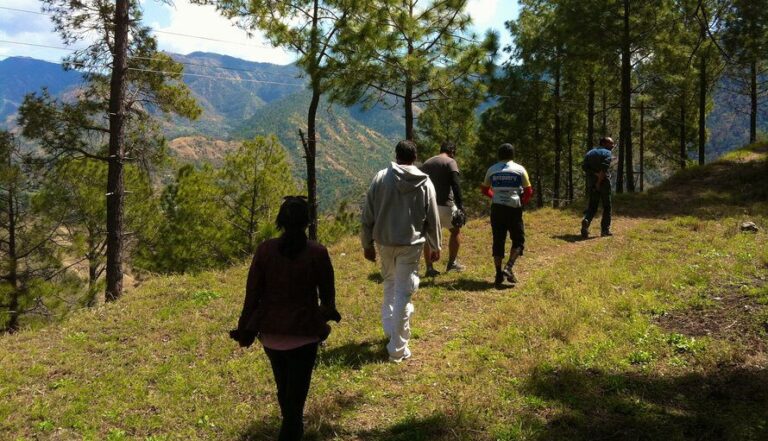
Hiking with flat feet often becomes a problem only when the miles go up, and the pain starts. That pain may show up in the arch, along the inside of the ankle, in the shin, or even higher up the chain.
Some hikers were born with flat feet. Others develop them later after pregnancy, menopause, injury, or progressive tendon dysfunction.
I’d already been talking with Dr. Ashley Katzenback, a physical therapist with 20 years of clinical experience, about shin splints. When the conversation turned to flat feet, she had a lot to say. In her experience, so much of the advice people get focuses on the wrong thing. Footwear, insoles, supports. Not enough on the muscles that actually hold the arch up.
In this guide, you’ll learn:
- What actually causes flat feet, and why yours may have changed
- How flat feet affect your body when you hike
- A simple way to check if you have them using your phone
- Exercises that build a stronger arch, from beginner to advanced
- The orthotics debate: when they help, when they don’t, and why two experts disagree
- How to prepare your flat feet for a big hike
If your pain came on suddenly, affects only one foot, or keeps getting worse, see a doctor before anything else. Everything in this guide is written for flexible flat feet, not structural deformities that might need surgery.

DR. ASHLEY KATZENBACK
Owner Cape Concierge Physical Therapy
PT, DPT, CMTPT
Ashley Katzenback, PT, DPT, CMTPT is a Doctor of Physical Therapy who has been treating patients on Cape Cod since 2006. As a working mom, athlete, and lacrosse coach, she understands the real-life demands on the body—and the cost of being sidelined by pain.
Through her concierge physical therapy practice, Ashley helps patients identify and treat the root cause of pain rather than chasing symptoms. She is on a mission to help people avoid unnecessary surgeries, pain medications, and injections by delivering highly personalized, efficient care that respects both their health and their time. Ashley believes time is our most valuable resource, and her approach to care is built around maximizing results without wasting a minute.
What Causes Flat Feet
About 20% to 37% of adults have flat feet. Most of them walk around just fine and never think twice about it. Problems show up when the muscles and tendons supporting the arch can’t handle the demands you’re putting on them.
Anatomy of the Arch
Your foot is built from 26 bones held together by hundreds of collagen-based ligaments. Those ligaments give the arch its shape and let it function like a spring, absorbing shock at the heel and returning energy through the forefoot with every step.
When the collagen in those ligaments weakens or stretches, the bones spread apart and the arch drops. The spring loses tension. Your foot still works, but now it depends much more heavily on muscle to do what the ligaments used to manage on their own.

Born With It (Congenital)
Some people are born with flat feet. Their arches never fully developed, or they developed low. This isn’t necessarily a problem. For many people, it’s simply a structural variation their body has adapted to over time.
I asked Ashley whether being born with flat feet puts you at a disadvantage compared to someone who developed them later. She clarified that it’s the muscle strength underneath the arch that determines whether you can hike, not the arch shape itself.
“There are plenty of collegiate professional athletes out there that have perfectly flat feet that were born with flat feet that are running, sprinting, ice skating, performing. They’ve just trained their feet to be stronger.”
— Dr. Ashley Katzenback
Flat Feet That Develop Later (Hormonal)
This is the part most people don’t know about. You can develop flat feet as an adult, and one of the most common causes in women is hormonal.
Estrogen helps support collagen strength in the ligaments that hold the arch up. As estrogen drops during perimenopause and menopause, those ligaments can become less supportive, which may allow the arch to flatten gradually over time. Many people only notice once pain starts.
Pregnancy does something similar but faster. Your body releases relaxin and elastin to stretch the pelvic ligaments for delivery, but those hormones circulate everywhere, including your feet. That “my feet grew a size during pregnancy” thing that everyone talks about? It’s not just swelling. Your arch literally flattens, and your foot takes up more space in your shoes.
A 2024 scoping review of foot biomechanics during pregnancy confirmed that these changes in arch height and foot length persist well beyond delivery. For 60 to 70 percent of women in one study, the change was permanent, with first pregnancies accounting for most of the effect.
Posterior Tibial Tendon Dysfunction (PTTD)
The posterior tibial tendon sits just behind your inner ankle bone and helps hold the arch up from below. When it gets overloaded or starts to fray, that support weakens. The foot rolls inward, the arch drops, and the tendon ends up working even harder to hold things together.
It’s also heavily skewed by sex. Women get PTTD three times more often, and researchers traced part of that back to how estrogen receptors in the tendon respond during menopause. Peak onset is 40 to 60. Same window, same hormones, same mechanism that’s flattening the arch through the ligaments.
The frustrating part is that early strengthening tends to help a lot, but most people brush it off until the pain is already well established. If your arch looks lower than it used to and you’re getting worsening pain behind the inner ankle, get it looked at.
Between hormonal changes and PTTD, those two explain most cases where someone’s arches fall as an adult. Injuries and gradual weight gain play a role too, but less often as the primary cause.
Why Flat Feet Hurt More on the Trail

On pavement, flat feet might not give you much trouble. On trail, it’s a different story. Uneven ground, climbs, descents, a loaded pack, all of that asks more from your feet than a sidewalk ever will. I’ve talked to hikers who had zero foot issues for years and only started noticing pain once they added a heavier pack or started doing longer days.
A flatter foot absorbs less shock on its own, and if the muscles underneath aren’t strong enough to pick up the slack, the impact just travels upward through your ankles, knees, and hips. You’re “landing on your bones,” as Ashley puts it. Nothing between the ground and your skeleton to soften the hit.
Feet Pronation and the Chain Reaction
Over pronated feet overload the posterior tibial tendon and set off a chain up the leg. Ankle drops in, knee follows, hip tightens to compensate. Give it enough miles, and the lower back starts picking up the work.
Flat feet and plantar fasciitis show up together for the same reason. And the demographics line up, too. Plantar fasciitis is most common in patients aged 45 to 64, with women nearly twice as likely to develop it as men. That’s the same window as the menopausal transition, which is probably not a coincidence given what estrogen does to the ligaments that support the arch.
When the arch drops too far on every step, the plantar fascia gets stretched past its comfortable range again and again until the irritation turns into real pain. Flat feet, shin splints, plantar fasciitis, they’re all different points along the same chain.
Trail tips, news and giveaways
One email a month: hiking tips, gear news, giveaways, fresh footwear verdicts and more. No spam, unsubscribe anytime.
How to Know If You Have Flat Feet
There are a few ways to check, ranging from the simple to the surprisingly high-tech.

The Wet Footprint Test
The classic test is the wet footprint. Step on a piece of paper with a wet foot and look at the shape. If you can see your entire sole without a curve on the inside, you likely have a flat arch. It works for a rough check, but when I asked Ashley whether a footprint could show improvement from strengthening, she wasn’t optimistic. Any changes would be very subtle, she said, and hard to see that way.
Phone Metrics
A better way to track progress may be through walking metrics on your phone or smartwatch. Apple’s Health app measures double support time and walking asymmetry using the phone’s built-in motion sensors.
Double support time is the percentage of each stride where both feet are on the ground. It goes up when someone is less confident on their feet or compensating for weakness. Walking asymmetry tracks whether you’re relying more heavily on one leg.
Ashley uses both of these with her patients. As foot strength improves, double support time tends to drop, and single-leg stance time goes up. That shift can be a more useful progress marker than trying to spot subtle changes in a footprint.
Professional Assessment
If pain is persistent, getting worse, or significantly different between feet, see a podiatrist or physical therapist for a proper assessment.
How to Strengthen Flat Feet for Hiking

Whether your flat feet are congenital or acquired, the practical goal is similar: build the muscles that support the arch so your feet can handle load more efficiently. If the arch changed because ligaments became less supportive, strength work helps the surrounding muscles take on more of that job.
I was curious why the exercises target the hips and outer leg and not just the foot itself. Ashley explained that the arch isn’t held up by one muscle. The posterior tibialis on the inside of your lower leg and the peroneal muscles on the outside work together like a sling, supporting the arch from both sides.
That’s why the program below hits the whole chain, not just your toes.
Beginner Flat-Foot Exercises
These are where Ashley starts most of her flat-foot patients. No equipment needed, and you can do all of them at home.
Walking Barefoot on Soft Surfaces
- Start on carpet or soft grass and just walk around
- Your feet need to feel the ground and start reacting to it
- This is the simplest possible way to wake up the small muscles that have been dormant inside shoes
Single Leg Balance
- Stand on one foot and hold it for as long as you can
- Once that feels easy, try playing catch with someone while balancing
- The reactive adjustments your foot makes to stay upright are exactly the kind of training your arch muscles need
- Start with 30 seconds per foot and build from there
Towel Curls
- Sit down barefoot with a towel on the floor in front of you
- Use your toes to scrunch the towel toward you, then push it back out
- You should feel a tightening sensation along the bottom of your foot and under your arch
- Aim for 2 to 3 sets of 10 to 15 scrunches
Sand Raking
- If you have access to a beach or a sandbox, drag your toes through the sand like you’re raking it
- The resistance trains toe flexion and arch activation at the same time
- Even a few minutes adds up
Toe Yoga
- Lift your big toe while keeping the other four toes on the ground
- Then press the big toe down and lift the other four
- Most people can’t isolate their toes at all when they first try, and that’s the point
- You’re building motor control that your feet never learned because shoes did the work for them
- Relax into the movement instead of tensing up
- Work toward 5 to 10 lifts on each side, holding for about 5 seconds
Toe Spacers
- Silicone spacers worn around the house give your toes room to spread and strengthen independently
- Not a substitute for exercises, but a useful complement during your evening routine
- Over time they help your toes develop the independent movement patterns that cramped shoes prevent
Advanced Flat-Foot Exercises from Ashley’s Program
These four exercises come from the structured program Ashley uses with her patients. They target the intrinsic foot muscles and the hip stabilizers that influence arch mechanics.
Side Step with Band Around Forefoot
- Band around the front of both feet
- Drop into a mini squat and side step, keeping your arches lifted the entire time
- The band tries to pull your feet inward and collapse your arch. Your job is to not let it
- You should feel your hip muscles and the muscles on the outside of your shins and calves working
- Don’t let your arches drop or your feet turn inward
A 2024 randomized trial confirmed that adding hip abduction work to foot exercises improved navicular drop more than foot exercises alone, which supports Ashley’s emphasis on working the hip and foot together.
Big Toe Flexion with Band
- Sit down, resistance band around your big toe
- Push the band down using only the toe while your ankle stays completely still
- You should feel the muscles under your arch engage, not your calf
- Don’t let your ankle move up and down. Only allow motion at the big toe
Ashley demonstrates this exercise on her Instagram:
Isolated Toe Extension
- Barefoot, foot flat on the ground
- Lift your big toe while keeping the smaller toes relaxed and down
- Then lower the big toe and lift the smaller toes with the big one relaxed
- You should feel your foot muscles working to control the motion
- Ashley warns this one is frustrating at first because your foot will want to tense up and do everything at once. Her advice is to try less rather than more. Relax into it
- Avoid the urge to excessively curl the toes that are supposed to be resting
Another demonstration from Ashley:
Rocker Drills
- Stand on one foot on a slightly unstable surface (a rolled towel works)
- Rock forward onto your toes, then back onto your heels, controlling the movement with your arch muscles
- Progress by adding a resistance band or a ball under your foot
- You should feel your calf and foot intrinsic muscles working to control the shift in your center of gravity
- Doing them with your toes elevated can increase strength gains by up to four times.
See how Ashley demonstrates rocker drill variations on her Instagram:
The Orthotics Debate

This is where things get interesting. Two experts I’ve spoken with for this series of articles have genuinely different views on orthotics, and both make good points. If you’ve been told you need orthotics for flat feet, it’s worth hearing both perspectives before you spend the money.
The Podiatrist’s View
In our plantar fasciitis guide, podiatrist Maurice Verhagen compared orthotics to eyeglasses. You wouldn’t tell someone with poor vision to just squint harder. Glasses correct a functional defect. Custom orthotics do the same for feet. They’re molded to your specific foot, they correct your biomechanics, and for some people they provide lasting relief that exercises alone don’t achieve. They run around $700 for a custom pair.
There’s logic to this approach. If your arch has collapsed due to structural damage or severe PTTD, no amount of toe curls may restore what’s been lost. In those cases, external support isn’t a crutch. It’s a correction.
The Physical Therapist’s View
When I told Ashley about Maurice’s eyeglasses analogy, she understood where he was coming from but didn’t agree with the conclusion. Orthotics are a tool, not a solution, she told me. She recommends over-the-counter flat-foot insoles at around $30 rather than custom orthotics, because your feet change as you get stronger. What fits your foot right now won’t fit a year from now if you’re doing the work.
Her advice is to wear them when you need them: standing for long periods at work, during the transitional phase of rebuilding strength after pregnancy, or through menopause. And take them out when you don’t. At home, while exercising, or building strength. Test your progress by how much less you need them over time.
Dependency was her bigger concern. When young people get put into rigid orthotics early, they often need them forever. The muscles never develop because the orthotic does the work for them. She brought up a study showing that children with congenital flat feet who were given orthotics from a young age didn’t have different outcomes than those who weren’t. Structural flat feet need muscle training, not just mechanical support.
Podiatrists see patients once or twice and need lasting relief fast. Physical therapists work over months on long-term strengthening. Different timeframes, different tools. If you need orthotics right now to hike comfortably, use them. Over-the-counter is fine. But build strength alongside them.
Barefoot and Minimal Shoes for Flat Feet

The footwear conversation for flat feet is more nuanced than the generic “more support equals better” advice you’ll find in most hiking guides.
Why It Helps
When your foot can feel the ground, your proprioceptors, the sensors in your feet that detect position and movement, send signals to your brain about what your arch should be doing. That feedback loop is what drives adaptation. In a cushioned, supportive shoe, those signals get muffled.
In Ashley’s practice, patients who spend time barefoot at home and train in minimal shoes tend to strengthen faster than those who stay in supportive footwear all day. In some cases, constant reliance on support may reduce how much the foot has to work on its own.
We cover zero-drop options in detail in our best barefoot hiking boots roundup.
Why Be Careful
The risk is going too far too fast. Stress fractures are a real possibility if your bones have been weakened by years of reduced loading in supportive shoes.
A 2021 randomized trial in the Annals of Internal Medicine also found that stable supportive shoes reduced knee pain more than flat flexible shoes in people with knee osteoarthritis.
The relationship between shoe type and joint health depends on your specific condition and where you are in your strengthening journey.
How to Transition
Ashley’s approach: wear minimal shoes for training and around the house, but keep your hiking boots for the trail. Your feet need the challenge at home where the stakes are low. On the mountain, you need footwear you trust.
One thing she mentioned that I hadn’t considered is that calluses form in different places depending on your shoes. If you train in barefoot shoes all week and then put on hiking boots for a long hike, you’re going to get blisters in places your feet aren’t prepared for.
Her solution is to wear your hiking socks inside your minimal shoes sometimes during training. Gets the skin used to the friction points before boot day.
How to Prepare for a Hike if You Have Flat Feet

Strengthening is the long game. But if you have a hike coming up, here’s how to get ready for it specifically.
Timeline
Start your strengthening program at least four to six weeks before a major hike. That’s the minimum window for meaningful muscle adaptation. If you can start earlier, even better. Two cycles of four to six weeks will get you noticeably further than one.
Use minimal shoes during daily training to build foot strength, but break in your actual hiking boots separately.
Day-of Preparation
If you’re still in the early stages of strengthening, over-the-counter insoles during the hike itself are fine. Use them as a bridge, not a crutch. The goal is to need them less over time, not to depend on them permanently.
Warm up longer, especially in cold weather. Walk for five to ten minutes before you stretch. Roll a lacrosse ball under your feet. Cold tendons are stiff tendons, and a flat foot’s posterior tibialis already has a poor blood supply.
Compression socks from toe to calf improve blood flow on longer hikes without pinching the posterior tibialis tendon. Calf-only braces do the opposite, creating a tourniquet effect right where the tendon runs. Avoid those.
Trekking poles on descents take load off your feet and reduce the eccentric demand on your posterior tibialis.
Gear Recommendations
Based on our testing and what we’ve covered in this guide, here are specific products worth considering. We’ve split them by phase because what you need while building strength is different from what you need on the trail.
Strengthening Phase
| Item | Our Pick | Why It Works |
| Barefoot training shoe | Altra Lone Peak 9 | Zero-drop, wide toe box, lets your feet build strength naturally instead of relying on support |
| Toe spacers | Any silicone brand | Gives toes room to spread and strengthen independently. Wear them around the house |
| Resistance bands | Light to medium | For banded big toe flexion, side steps, and rocker drills. A few dollars, lasts forever |
| Massage tool | Lacrosse ball | Roll under feet and calves before and after training. Same one you’d use for shin splints |
Hiking Phase
| Item | Our Pick | Why It Works |
| Hiking boot | KEEN Targhee IV Mid | Roomy toe box, compression-resistant Luftcell midsole, lifetime delamination guarantee. Our top pick for flat feet |
| Hiking boot (alternative) | Merrell Moab 3 Mid | Wide platform stabilizes a flat arch, swaps insoles in seconds, lighter EVA foam than the previous model |
| Temporary insoles (OTC) | Superfeet Trailblazer | Per Ashley: use as a temporary tool while building strength, not a permanent fix. ~$30 beats $700 custom orthotics |
| Hiking socks | Darn Tough Hiker | Merino wool, moderate cushion, lifetime warranty. Break them in with your minimal shoes to prep skin for boot day |
| Trekking poles | Any adjustable pair | Takes load off your feet on descents. Especially helpful while your arch muscles are still building |
FAQs
They can. Estrogen supports collagen in the ligaments that hold your arch up. As estrogen drops during menopause, those ligaments lengthen and arches flatten. Posterior tibial tendon dysfunction also becomes more common after 40.
Jumping straight into long hikes or minimal shoes before building foot strength. Relying on orthotics without doing any strengthening work alongside them. Calf-only compression braces, which pinch the posterior tibialis tendon. And ignoring progressive pain behind the ankle bone, which can signal PTTD.
Not inherently. Plenty of competitive runners have flat feet. The risk comes from weak arch muscles, not the arch shape itself. Build strength with the exercises in this guide, increase mileage gradually, and your feet will handle running the same way they handle hiking.
For flexible flat feet, no. Muscles respond to training at any age. You may not develop a visible arch, but you can build enough strength to hike without pain and reduce your reliance on supportive insoles.