In an industry obsessed with the newest and lightest technology, some gear simply refuses to fade away. These are the 3 best Classic Hiking Boots. The footwear that has survived decades of trends, millions of trail miles, competitors, and even the successors in their series.
Why do some hikers refuse to switch to modern in the first place? Because when you are ten miles deep into the wilderness with a heavy pack, you don’t want a shoe that might hold up. No, you want a boot that has proven itself for twenty years and does exactly what you want.
We have rounded up the top 3 absolute icons of the hiking world. These aren’t just boots; they are legends with proven track records. We will dive into their origin story and show you why they are still around. Here are the classics that still dominate the trails in 2026.
The Top 3 Classic Hiking Boots of All Time
- Merrell Moab 2 Mid – The World’s Best Seller
- Salomon X Ultra 3 Mid – The Cult Classic
- Lowa Renegade – The Global Gold Standard
1) Merrell Moab 2 Mid – #1 Classic Pick
There is a reason you see this boot on every trail from the Appalachian to the Andes. The Merrell Moab (which stands for Mother Of All Boots) is arguably the most famous hiking boot ever made.

Since its inception, the Moab franchise has sold over 28 million pairs worldwide, cementing its status as the world’s best-selling hiking boot. Why? Because it democratized hiking comfort. Before the Moab, boots were stiff, heavy, and required painful break-in periods. The Moab 2 changed the game by offering “out-of-the-box” comfort that feels more like a sneaker than a tank.
In our own testing, we found that the Moab 2 strikes a perfect balance for the average hiker. It uses a supportive nylon arch shank and a sticky Vibram® TC5+ outsole that handles moderate terrain with ease. While it isn’t designed for heavy-duty alpine mountaineering, it is the undisputed king of day hikes and weekend backpacking trips.
Even with the release of newer versions, the Moab 2 remains the quintessential classic for those who want reliability without breaking the bank.
Key Specs
Weight (pair): 2 lbs 4 oz
Material: Performance suede leather and mesh
Waterproofing: M Select™ DRY
Outsole: Vibram® TC5+
Popularity: >28 million pairs sold
Release: 2017
Start of the Moab Series: 2007
PROS
CONS
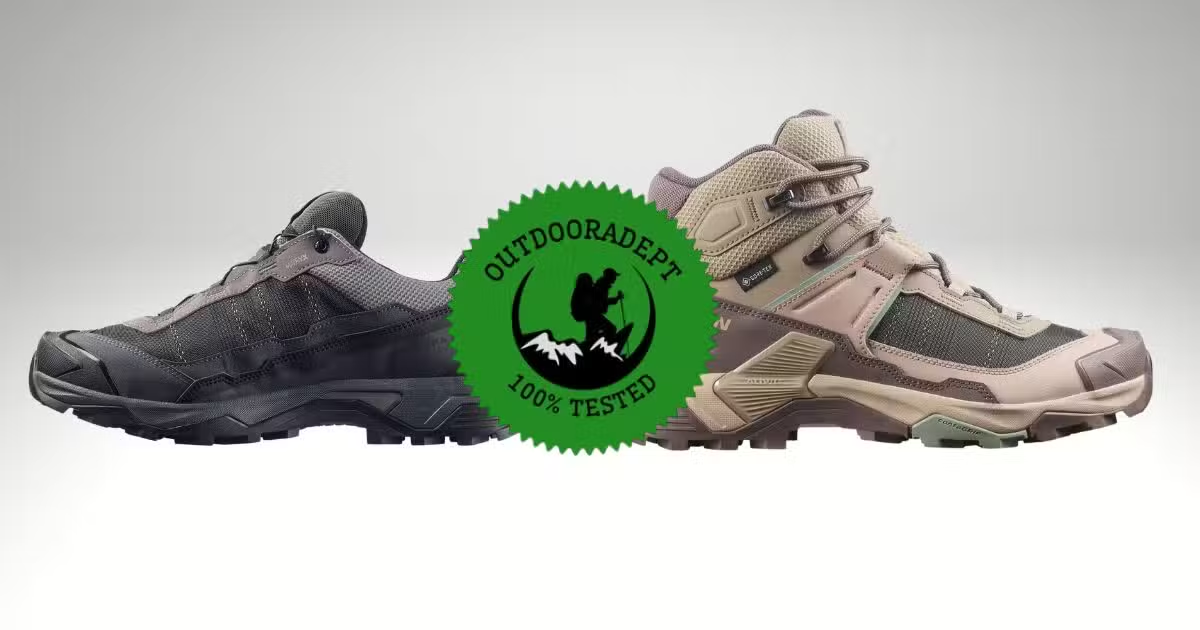
2) Salomon X Ultra 3 Mid – #2 Cult Favorite
Sometimes, the sequel isn’t better than the original. The Salomon X Ultra 3 Mid holds a unique spot in hiking history: it is the boot that hikers actively hunt for, even after its successors were released.

Why the cult following? The X Ultra 3 perfected the “running shoe chassis in a hiking boot body.” While newer models tried to go even lighter or change the ankle collar, many purists argue the X Ultra 3 offers superior heel lock and a more secure fit.
It features Salomon’s legendary Descent Control Technology, which provides unparalleled stability when hiking downhill on loose gravel. During our tests, the aggressive lug pattern clawed into mud and wet rock better than almost any other lightweight boot we’ve reviewed.
It remains a classic because it bridges the gap between a trail runner and a boot perfectly. It is nimble enough for fast-packing but supportive enough to save your ankles on technical terrain.
Key Specs
Weight (pair): 1 lb 15.7 oz900 grams
Material: PU Coated Leather / Textile
Waterproofing: GORE-TEX® Performance Comfort
Outsole: High Traction Contagrip®
Popularity: >10 million pairs sold
Release: 2018
Start of the Ultra X series: 2012
PROS
CONS
Trail tips, news and giveaways
One email a month: hiking tips, gear news, giveaways, fresh footwear verdicts and more. No spam, unsubscribe anytime.
3) Lowa Renegade – #3 The Leather Benchmark
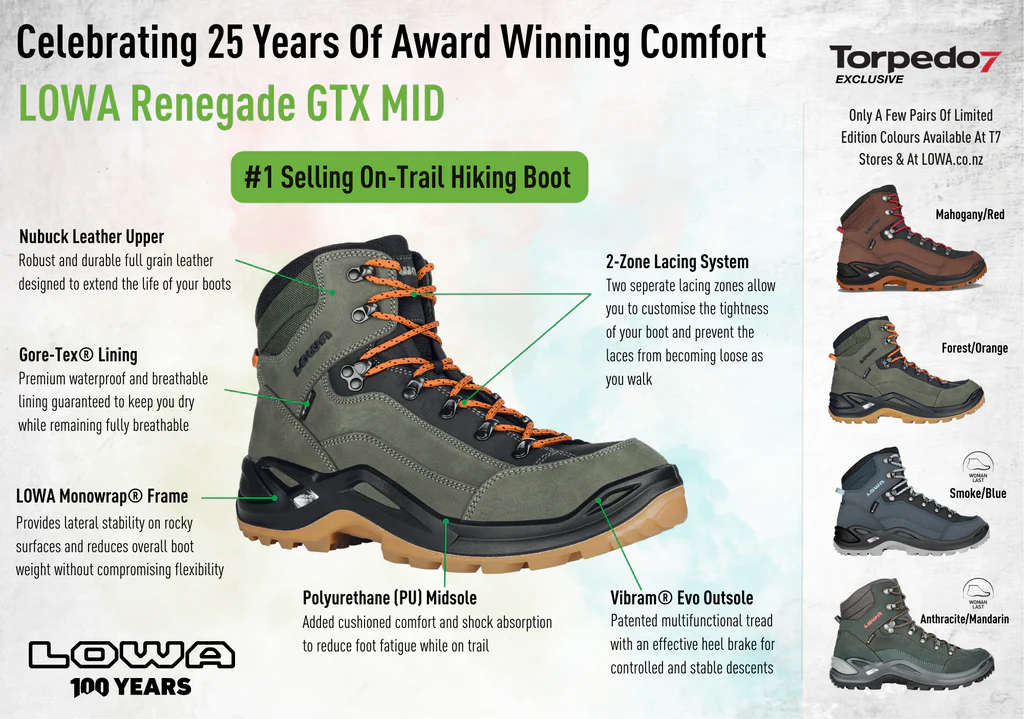
If the Moab is the king of day hikes, the Lowa Renegade is the emperor of backpacking. Launched over 25 years ago (in 1997), the Renegade has sold more than 12 million pairs, making it Europe’s best-selling outdoor boot of all time.

The Renegade is a classic because it proved that a leather boot doesn’t have to feel like a concrete block. It was one of the first boots to use an injected PU midsole (the Monowrap® frame), which bonds the sole to the upper for a lightweight but incredibly stable structure.
Handcrafted in Europe (Germany, Italy, and Slovakia), the build quality is undeniable. In our testing, the Nubuck leather upper proved resistant to abrasion on rocky scrambles, while the Vibram® Evo outsole provided grip that felt secure on everything from wet roots to granite slabs. It is an investment piece—a boot you buy for the next decade of adventures, not just the next season.
Key Specs
Weight (pair): 2 lbs 7 oz1110 grams
Material: Nubuck Leather
Waterproofing: GORE-TEX®
Outsole: Vibram® Evo
Popularity: >12 million pairs sold
Release: 1997
PROS
CONS
Comparison Table
| Product Name | Rating | Best For | Weight (Pair) |
|---|---|---|---|
| Merrell Moab 2 Mid WP | #1 | Day Hiking & Moderate Terrain | 2 lbs 4 oz1012 grams |
| Salomon X Ultra 3 Mid | #2 | Fast-paced & Technical Trails | 1 lb 15.7 oz900 grams |
| Lowa Renegade GTX | #3 | Backpacking & Durability | 2 lbs 7 oz1110 grams |
What Makes a Hiking Boot a Classic?
When curating this top 3 list, we didn’t just look for “best-sellers.” We looked for boots that have transcended trends to become industry benchmarks. Through our analysis of market data and historical performance, we identified five specific factors that separate a temporary hit from a permanent legend.
1. Longevity & Sales Volume
You cannot buy heritage; you have to earn it one pair at a time. A classic hiking boot must demonstrate sustained success over decades, not just a single season.
The Merrell Moab franchise reaching 28 million pairs sold and the Lowa Renegade celebrating over 25 years of production proves these aren’t just marketing hype.
In an industry where product lifecycles are often just 18 months, surviving for 25 years implies that the product has successfully spanned multiple generations of hikers.
2. Cult Loyalty

The true mark of a classic is when customers actively revolt against changes. This is often driven by “The Last” (the 3D mold upon which a shoe is constructed).
The Salomon X Ultra 3 is the perfect case study. Despite the release of the newer X Ultra 4 and 5, the demand for the specific heel-lock and chassis of the “3” remained so high that Salomon was forced to keep it in production longer then initially intended.
Classics inspire “hoarding behavior.” When a hiker finds a classic that works, they will often buy two or three backup pairs to ensure they are set for the next decade.
3. Thru-Hiker Validation

A boot doesn’t become a classic until it has conquered the “Big Three” trails (Appalachian Trail, PCT, CDT). We look at data from long-distance hiker surveys to confirm durability.
According to the annual Appalachian Trail Thru-Hiker Survey conducted by The Trek, brands like Merrell and Salomon consistently rank highly for hiking boots worn by hikers completing the 2,190-mile journey.
Thru-hikers put more wear on a boot in five months than the average hiker does in five years. If a model consistently tops these surveys year after year, its durability and comfort are indisputable facts, not opinions.
4. Category Definition
A classic doesn’t just participate in a category; it often invents it.
Before 1997, hiking boots were heavy, stitched monsters. The Lowa Renegade revolutionized the market by utilizing injected PU technology (the Monowrap® frame), creating the first “All Terrain Classic” (ATC).
It proved that a boot could offer the stability of a heavy trekker with the weight of a sneaker. Every lightweight hiking boot on the market today is, in some way, chasing the standard set by the Renegade.
Honorable Mention: The Budget Classic
Columbia Newton Ridge Plus II

You cannot talk about classics without mentioning the Columbia Newton Ridge.
While the original version launched in the early 2000s, the current Plus II model has held the crown as the internet’s “Best Selling Hiking Boot” for over a decade.
Why it didn’t make the Top 3
The Newton Ridge is a classic because of its price, not its technical performance. In other words, affordable products sell at higher volumes. This does not make it a legendary boot, as can be seen by its performance:
- Traction: Its Omni-Grip outsole lacks the stickiness of the Vibram® rubber found on the Merrell and Lowa, making it slippery on wet rock.
- Support: The foam midsole is soft and comfortable for casual walks (like walking the dog), but it collapses under the weight of a heavy backpack.
Verdict: It is the undisputed king of entry-level boots, selling millions of pairs to casual hikers. If you are on a tight budget, it’s a great start. But for serious adventures, the Top 3 legends above are worth the investment.
For more information, see our review of the Columbia Newton Ridge Plus II
Final Words
In a world where outdoor gear is constantly being reinvented with lighter materials and smarter tech, there is something deeply reassuring about lacing up a pair of boots that hasn’t changed in a decade.
Whether you choose the unmatched value of the Merrell Moab, the technical precision of the Salomon X Ultra, or the bombproof European craftsmanship of the Lowa Renegade, you aren’t just buying footwear—you are buying peace of mind. These legends have carried millions of hikers safely home, and they are ready to do the same for you.
We Want To Hear From You
Defining classic hiking boots is often personal. Did we leave out your trusty old Vasque Sundowners, Asolo TPS 520s, or another vintage hiking boot that you refuse to retire? Drop a comment below and tell us which boot you think deserves a spot in the Hall of Fame.
Also, the industry moves fast. Do you think these legends will still be ruling the trails in 2030? Let us know if you would like us to do a follow-up to this article in a few years to see which of these icons survived the test of time.
FAQ
While the Moab 3 offers slight sustainable material updates, the Moab 2 is often available at a better price point and retains the exact fit that millions of hikers already know and love. It remains the value king.
Yes, but stocks fluctuate. The production has been discontinued, but they can still be found online and in stores.
If you hike regularly or carry a heavy pack, yes. The injected PU midsole offers longer-lasting support than standard EVA foam found in cheaper boots, meaning the boot keeps its structure for more miles, saving you money in the long run.