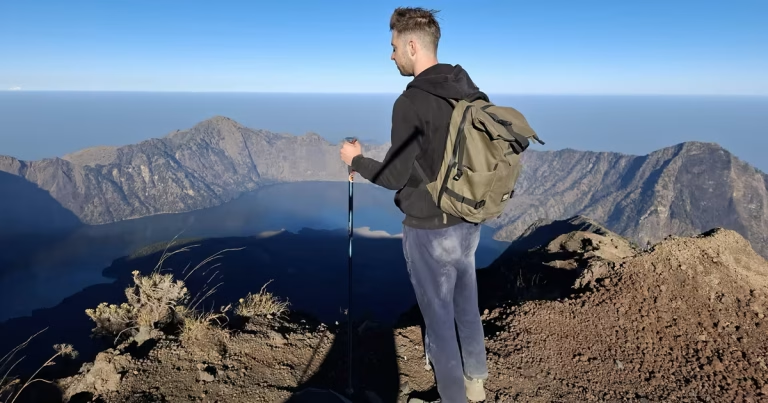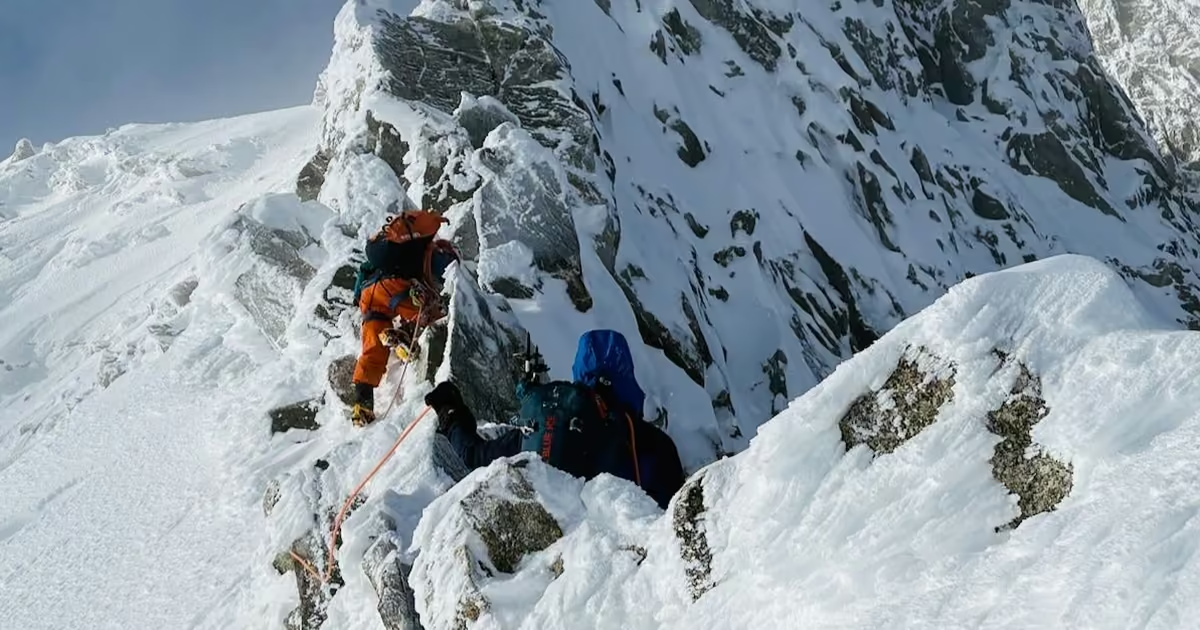
Next year I’m going to Chamonix for my first alpine routes. I’m reasonably fit from other sports, but I live in the Netherlands, where the biggest climb on most training days is a staircase. So I put my questions to someone who had exactly the same problem: Jakob Ulcnik, a Slovenian climber based in Amsterdam who co-founded the training app Train to Mountain after his own preparation for an alpine ridge fell short.
I interviewed Jakob for this article in October 2026. He answered my questions in writing, plus a round of follow-ups, and every quote below is in his own words. His answers are more specific than most training advice you’ll find online. He puts a number on how many weeks Mont Blanc, Kilimanjaro and Everest Base Camp take, on how much a stair machine is really worth compared with a mountain, on how to train the descent, and on how heavy your training pack should get. He is also blunt about what you can’t train at sea level at all.
In this guide
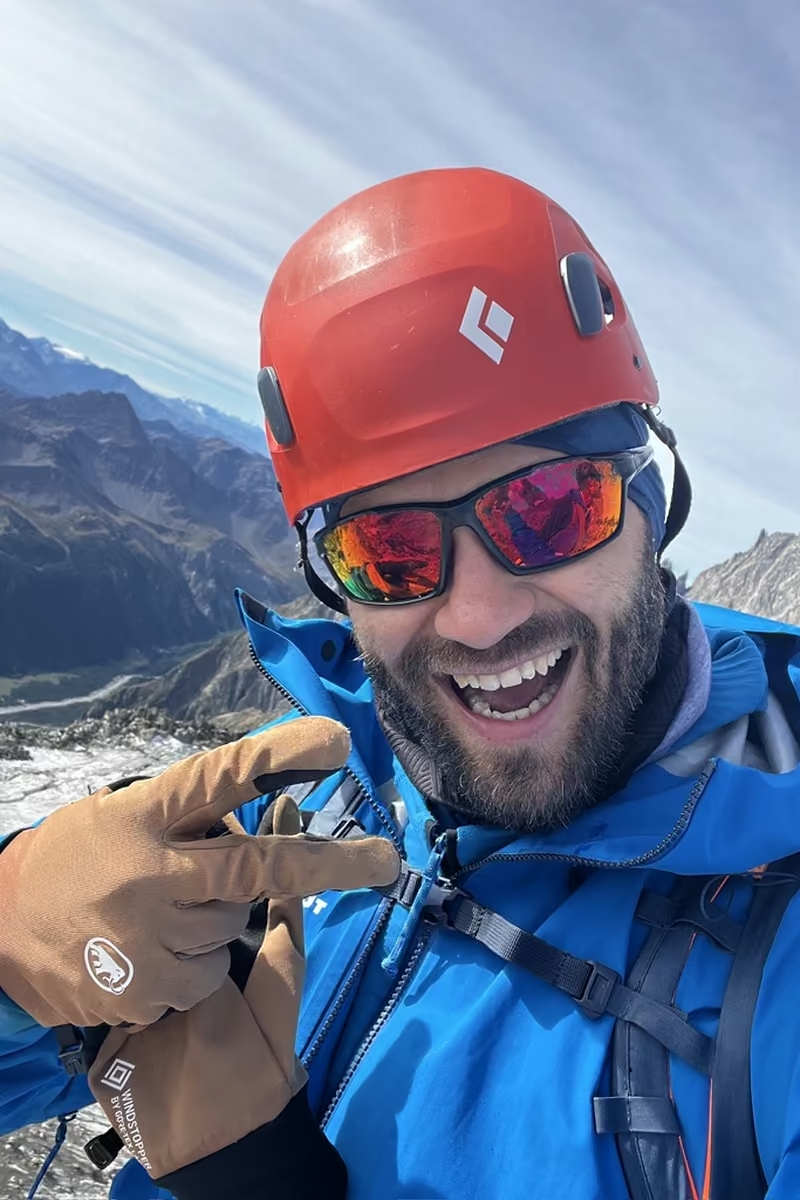
Jakob Ulcnik
Co-founder, Train to Mountain
Amsterdam, the Netherlands
Jakob grew up in Slovenia and climbed every weekend as a teenager. After moving to the Netherlands, a trip to Chamonix in 2019 brought him back to the mountains. Since then he has done several mountaineering courses, summited Alpine peaks such as the Weissmies, and called off a Mont Blanc attempt when he knew he wasn’t ready.
In January 2026 he and co-founder Gino started building Train to Mountain, an app that plans mountaineering training around your objective, your date and your current fitness.
Why Most Mountain Training Falls Short
Jakob didn’t start Train to Mountain because he had the answers. He started it because his own preparation failed. In December 2025, on the way to the Aiguilles Marbrées ridge in the Mont Blanc massif, he realised that months of training hadn’t been the right training:
Co-founder, Train to Mountain“I followed a PDF plan that looked perfect on paper, but then I got caught up in Reddit saying one thing, a YouTube video saying another, and ChatGPT saying a third. I also used third-party apps and asked my guide. It came down to the fact that I simply didn’t know how ready I was.”
What gave out was his aerobic base. “My cardio engine wasn’t built enough, and my heart rate made that abundantly clear,” he says. As the day went on, the exhaustion built up, and the one thing that mattered was being honest with his guide about it. “Ego has no place in the mountains.”
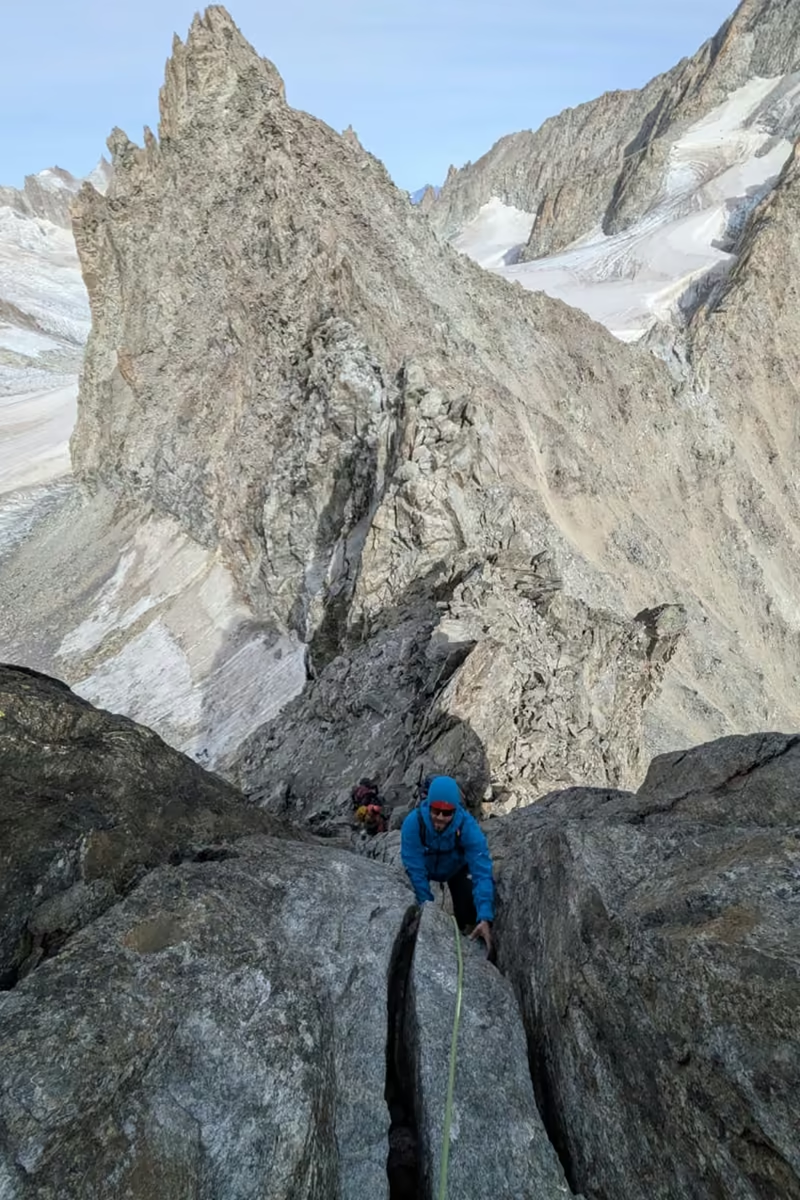
It wasn’t his first lesson in readiness. Before that, Jakob had called off a Mont Blanc attempt, and not because of his legs. In the weeks before the trip, several big stressors piled up at once:
Co-founder, Train to Mountain“After arriving in Chamonix and acclimatizing, I realised that pushing for the summit would be irresponsible and, more importantly, would put other people at risk. So I made the hard choice and admitted to myself that the mountain will be there next year.”
Both stories point the same way: being ready is about more than the hours you logged, and you want to know where you stand before you’re on the mountain, not on it. When I asked what people get wrong most often, he named five mistakes.
1. Training for an Hour When the Day Lasts Ten
Jakob uses Mont Blanc’s Goûter route as the example. Summit day starts at the hut and takes 7 to 10 hours. You climb about 3,200 feet970 meters in 4 to 6 hours, mostly in the dark, then come all the way back down in another 3 to 4 hours, tired and at altitude. Most people prepare with one-hour sessions and never get close to a day like that.
2. Training Only to Go Up
Co-founder, Train to Mountain“Stair machines and incline treadmills are useful, but it’s the descent that wrecks your quads, and almost nobody trains for it.”
3. Never Training with a Pack
On a route like Mont Blanc you carry 18 to 26 pounds8 to 12 kilograms for hours. In Jakob’s words, that is “a different sport from walking without one”, yet plenty of people arrive never having trained with weight on their back.
4. Doing Every Session at Medium-Hard Effort
Medium-hard sessions feel productive, but they don’t build the aerobic base a long day runs on. Jakob wants most of your training to be easy, in Zone 2, which he defines as 85 to 89% of your lactate threshold heart rate: roughly the highest heart rate you could hold for an hour of hard, steady effort.
You don’t need a lab to find it. Train to Mountain anchors all its zones to that threshold, and Jakob gives three ways to get it, from most to least accurate:
- A field test. Do a 30-minute solo all-out effort on a steady climb or a treadmill. Your average heart rate over the last 20 minutes is your threshold.
- Your watch. If it gives you a lactate threshold estimate, use that.
- A formula. Take 208 minus 0.7 times your age as your maximum heart rate (the Tanaka formula), and use 88% of that as your threshold. It’s only an estimate.
Zone 2 is then 85 to 89% of your threshold. Jakob’s example: with a threshold of 162 bpm, that’s roughly 138 to 144 bpm. To show the formula route, I did the math for a 40-year-old: a maximum of 180 bpm, a threshold of about 158 bpm, so a Zone 2 of about 135 to 141 bpm. What Jakob would avoid is the classic “220 minus your age”, which he says can be off by 10 to 20 beats either way.
5. Starting Late with a Plan That Never Changes
Co-founder, Train to Mountain“Life gets in the way, you miss a week, and the plan just carries on as if nothing happened. That’s exactly what happened to me.”
How Long Should You Train for Mont Blanc, Kilimanjaro or Everest Base Camp?
Further ahead than most people think, says Jakob, and it depends more on where you start than on the mountain. These are the numbers Train to Mountain’s readiness model gives. “Fit” means you already train 5 to 6 hours a week, walk hilly trails and have done a long day recently.
| Objective | Already fit | Barely training |
|---|---|---|
| Mont Blanc (Goûter route) | About 17 weeks | About 24 weeks |
| Everest Base Camp trek (17,598 ft5,364 m) | About 18 weeks | About 25 weeks |
| Kilimanjaro (19,341 ft5,895 m) | About 20 weeks | About 28 weeks |
| Any objective | Never less than 12 weeks | Never less than 12 weeks |
Source: Train to Mountain’s Summit Check, as run by Jakob Ulcnik for this article. The model is built around climbing objectives, so for treks Jakob calls it a conservative starting point.
The two treks surprise people, because both come out longer than Mont Blanc. Jakob’s explanation is that the model gives altitude more weight the higher you go, “and walking instead of climbing doesn’t make the altitude any easier.” Train to Mountain plans to launch dedicated trekking plans on 5 November 2026.
The key, in his view, is to plan forward from your current fitness, not backwards from the date you booked:
Co-founder, Train to Mountain“If you’re starting from zero, 12 weeks just isn’t enough. You either get injured trying to cram it in, or you arrive underprepared.”
If you want a number for your own objective, Train to Mountain’s free Summit Check or Trek Check asks ten questions about your training and your goal and estimates how many weeks you need.
Trail tips, news and giveaways
One email a month: hiking tips, gear news, giveaways, fresh footwear verdicts and more. No spam, unsubscribe anytime.
How to Train for Mountains Without Mountains
Jakob trains in Amsterdam, so this is the part he has had to solve himself. His honest answer: you can build most of it at home, but not all of it.
Stairs: Your Best Friend
A building floor is roughly 10 feet,3 meters, so 100 floors gives you about 1,000 feet300 meters of climbing. A tall building or a parking garage works fine. Walk down as well, or take the lift up and walk down only: that is how you train the descent. And if there is any hill within reach, his tip is to go up and down it over and over.
To make that concrete, I converted Jakob’s Mont Blanc numbers into floors and machine meters:
| Target | Real vertical | Building floors | On a stair machine | On an incline treadmill |
|---|---|---|---|---|
| Mont Blanc summit day, way up | 3,200 ft970 m | About 320 | 5,300 ft1,620 m | 6,400 ft1,940 m |
| Peak training week for Mont Blanc | 4,900 ft1,500 m | About 500 | 8,200 ft2,500 m | 9,800 ft3,000 m |
Our calculation from Jakob’s figures: 10 ft3 m per floor, a stair machine counts for 0.6 of mountain vertical and an incline treadmill for 0.5.
Machines Count for Less Than You Think
Stair machines and incline treadmills are great for volume, but they are easier than real terrain. Train to Mountain’s model counts a meter on a stair machine as 0.6 of a mountain meter, and a meter on an incline treadmill as 0.5.
Those factors are a judgment call built on research, and Jakob is open about that. A 2020 study in the Journal of Biomechanics compared climbing regular stairs with a stairmill and found that on the machine your foot stays planted for a larger share of each step and your shin muscles work less. A machine also removes the uneven ground and, above all, the descent. As Jakob says himself:
Co-founder, Train to Mountain“No study converts machine metres into mountain metres one to one, so we built that evidence into our model as a factor.”
OutdoorAdept note: the study was small (12 people, one minute on the machine) and only looked at climbing, not descending. Treat the 0.6 and 0.5 factors as a sensible estimate, not a measured conversion.
In practice, that’s why the 4,900 feet1,500 meters a week Jakob aims for in peak Mont Blanc weeks becomes closer to 8,200 feet2,500 meters on a stair machine.
Train the Descent
This is the part almost everyone skips, so I asked Jakob for exact numbers. These are the exercises Train to Mountain’s plans prescribe, from the start of a plan to the final phase:
| Exercise | Start (base phase) | Final phase |
|---|---|---|
| Eccentric step-down: stand on a 8 to 16 in20 to 40 cm box and lower the other foot to the floor as slowly as you can | 3 sets of 10 per leg, body weight only, 4-second lowering | 4 sets of 10 per leg with 12% of your body weight (build phase in between: 4 x 10 with about 8%, 5-second lowering) |
| Tempo reverse lunge | 3 sets of 8 per leg at about 55% of your one-rep max, 3-second lowering | 4 sets of 6 at 68%, 4-second lowering |
| Bulgarian split squat | 3 sets of 10 at 65% of your one-rep max | 3 sets of 6 at 78% |
| Walking down a long staircase | 3 rounds of 2 minutes of controlled descent | 5 rounds of 3 minutes with 15% of your body weight on your back (in between: 4 x 3 minutes with 10%) |
Source: Train to Mountain’s training plans, as given by Jakob Ulcnik.
Instead of a fixed number of descent meters per week, the plans make sure descent-type work is a big enough share of your total training load:
- Base phase: at least 15%
- Build phase: at least 20%
- Final phase: at least 30%
- Last four weeks before the summit: 35%
- Every week: at least one session that is purely about descent
- Last 7 to 10 days: keep the exposure, but add nothing new, so your legs arrive fresh
Build the Long Day on a Machine
The long day is the hardest thing to replicate without hills. Jakob’s answer is a long stair-machine session:
- Structure: 55 minutes on, 5 minutes off.
- Length: start around four hours and build to 7 to 8 hours as a full summit simulation.
- Fuel: eat exactly as you would on the mountain, every 45 to 60 minutes.
- Kit: the boots and the pack you will use on the day.
Co-founder, Train to Mountain“It’s boring, but it works.”
Eight hours on a machine burns a lot of energy. Our hiking calorie calculator gives you a rough number to plan your food around.
How Heavy Should Your Training Pack Be?
Build the weight up gradually. For the long summit simulations, Jakob goes up to around 12 to 18% of your body weight, which for most people is 20 to 29 pounds.9 to 13 kilograms. Here is what that range means for a few body weights:
| Your body weight | Pack for long simulations (12 to 18%) |
|---|---|
| 130 lb60 kg | 16 to 24 lb7 to 11 kg |
| 165 lb75 kg | 20 to 30 lb9 to 13.5 kg |
| 200 lb90 kg | 24 to 36 lb11 to 16 kg |
Our calculation from Jakob’s 12 to 18% range, rounded.
Do Your Long Sessions in Your Mountain Boots
Jakob’s advice is to do the long sessions in the boots you’ll wear on the mountain. Mountaineering boots are much stiffer and heavier than trail shoes (our comparison of mountaineering boots vs hiking boots explains the difference), and an eight-hour stair session is a far better place to find a pressure point than a glacier at 3 am. If you’re still choosing, our guide on how to choose hiking boots covers fit, and our crampon guide explains which boots work with which crampons.
What a Stairwell Can’t Give You
Co-founder, Train to Mountain“I’d be lying if I said you need no real terrain at all. Before a big objective, I’d plan a few hill weekends, especially for the descent. The stair machine gets you most of the way, not all of it.”
Train to Mountain uses a simple rule of thumb here: the app recommends real-terrain days when less than about 30% of your vertical comes from real terrain. It doesn’t force them, because not everyone can get away.
Altitude: What Sea-Level Training Can and Can’t Do
At sea level you can build the engine: aerobic fitness, leg strength and the ability to keep going for 8 to 10 hours with a pack. What you can’t train is how your body reacts to thin air.
Co-founder, Train to Mountain“Being fit doesn’t protect you from altitude sickness. Very fit people get it too, often because they feel strong and go up too fast.”
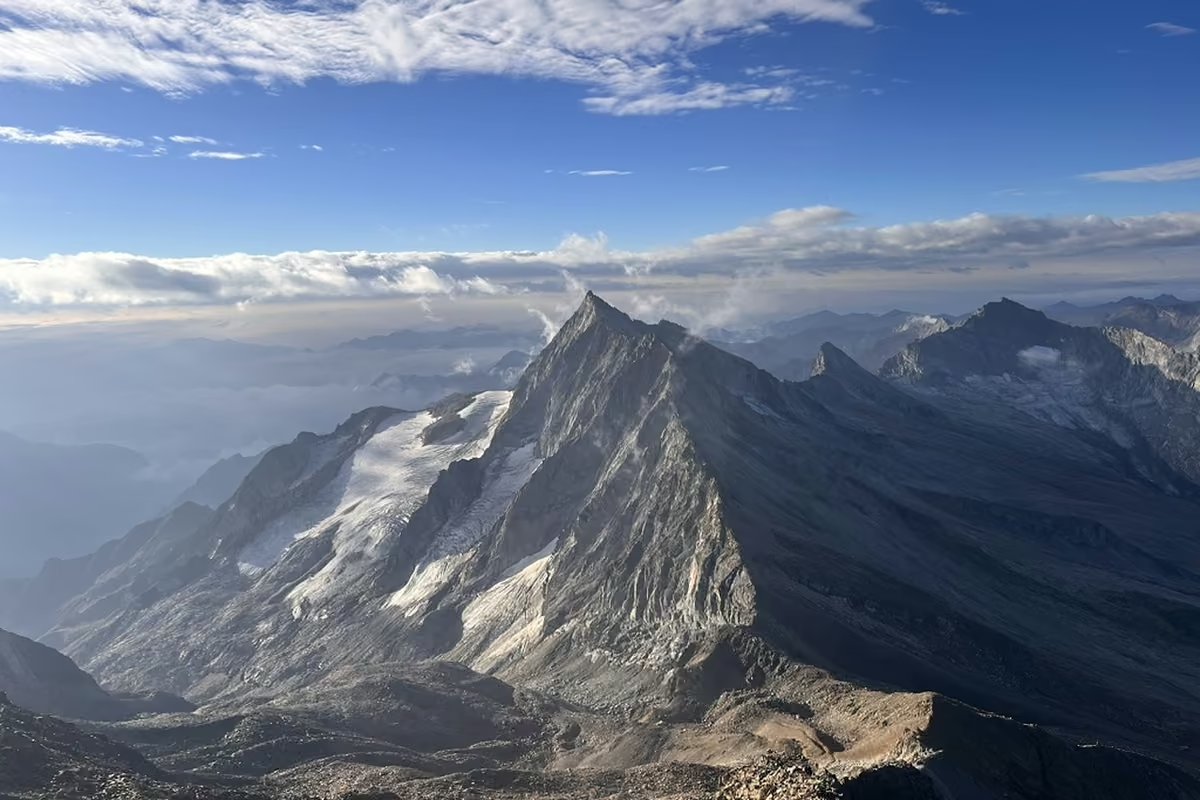
What fitness does give you is margin: the same pace costs less, so you have more in reserve when the altitude starts to bite. Above about 9,800 feet,3,000 meters, acclimatization takes over. The usual guideline Jakob points to is to raise your sleeping altitude by no more than about 1,600 feet500 meters a day, with rest days built in, or to climb high and sleep low. Our altitude sickness guide covers the symptoms to watch for.
Do Altitude Masks and Altitude Tents Work?
- Altitude (elevation) training masks: they don’t simulate altitude at all. They make breathing harder, but the air you breathe has the same oxygen.
- Altitude tents: they can help you pre-acclimatize, but only if you sleep in one for many hours a night over several weeks, and the evidence is mixed.
Co-founder, Train to Mountain“For most people, the money is better spent on a couple of extra days on the mountain.”
Already Fit from Running or Cycling?
This is the question I asked for myself. Jakob calls a marathon “a great base, but a different sport”, and that is the trap. A marathon takes 3 to 5 hours; a Mont Blanc summit day takes 7 to 10, at a much slower pace, after an approach the day before. What fit people from other sports typically miss:
- Braking under load. Runners and especially cyclists have never trained their quads to brake for hours on the way down.
- The pack. It changes your heart rate, your posture and how your feet and knees feel.
- Pacing. Fit people go out too hard because they can. Heart rate on a slow, steep climb with a pack is often much higher than an easy running pace suggests.
Co-founder, Train to Mountain“That’s why you can’t train on feel. Your feel was calibrated for a different sport.”
The good news: fitness does buy you time. In Train to Mountain’s model, a fit runner needs about four months for Mont Blanc instead of six.
Am I Fit Enough for Mont Blanc? A Do-It-Yourself Check
Jakob doesn’t believe in one test a few weeks before departure, because by then it’s too late to fix anything. He wants readiness to be visible week by week. In the app, physical readiness is built from five parts:
- Aerobic fitness (the biggest part, but only about a third of the score)
- How much vertical you’re handling
- Long-day capacity
- How ready your legs are for the descent
- How consistent you’ve been
That split explains why a strong runner can still score low: great aerobic fitness, but no long days and no descent work. For readers who don’t use an app, I asked for a simple version. This is Jakob’s checklist for Mont Blanc, three to four weeks out, taken from how Train to Mountain’s model plans for that mountain:
Mont Blanc readiness check, 3 to 4 weeks out
- You’ve done a long day of about 7 hours with your summit pack (12 to 18% of your body weight), ideally with at least 3,200 feet970 meters up and the same back down.
- The next day, you managed a medium day of about 3 hours.
- In a normal week, you’re handling around 4,900 feet1,500 meters of vertical on real terrain, or roughly 8,200 feet2,500 meters on a stair machine.
- You can do 4 sets of 10 slow step-downs per leg with 12% of your body weight.
- The day after your long day, you feel sore but fine, not wrecked.
Co-founder, Train to Mountain“If one of those is missing, that’s your gap, and it’s better to find it at home than at 4,000 m (13,100 ft).”
He is also clear about what physical readiness doesn’t cover:
Co-founder, Train to Mountain“Physical readiness isn’t the same as summit readiness. Your technical skills, how you handle altitude, the weather, and your guide’s call on the day all sit outside that score. A high score means your body is prepared. It doesn’t mean the mountain will say yes.”
For the technical side, our mountaineering beginners guide and our guide to rope skills and knots are good starting points.
Training the Mental Side of Long Days
Co-founder, Train to Mountain“On long days, often your head gives up before your legs do. But the mental side is much easier when you have physical margin. Being fit makes you calmer.”
You can train it, too:
- Early starts. Do a few sessions at 4 or 5 am. Alpine starts are often at 2 or 3 am.
- Bad weather. Train in the rain and the cold instead of skipping those days.
- Fueling on the move. Eat and drink every 45 to 60 minutes. People who stop fueling are usually the ones who fall apart mentally.
- Small pieces. On the day, aim for the next rest stop or the next ridge, not the summit.
- A turnaround time. Decide it before you start, not when you’re tired. Your guide or more experienced team members will usually advise one.
Co-founder, Train to Mountain“Remember, fatigue and ego don’t mix well on the mountain.”
Can You Train for a Mountain in 12 Weeks?
I asked how he would split 12 weeks at 4 to 5 hours a week. His first answer was a warning: for Mont Blanc, that isn’t enough, and Train to Mountain’s own tool says so. Put Mont Blanc into the Summit Check with only 12 weeks and it comes back with “your date is shorter than your fitness needs today”, for someone fit and for someone starting low.
| Mont Blanc plan | Already fit | Starting low |
|---|---|---|
| Recommended length | About 17 weeks | About 24 weeks |
| Peak training week | Around 9 hours | 11 to 12 hours |
| Longest single day | About 7 hours | About 7 hours |
Source: Train to Mountain’s Summit Check, as given by Jakob Ulcnik. That long day alone is bigger than a 4- to 5-hour week.
Twelve weeks at 4 to 5 hours does work if you’re already fit and your objective has a summit day of around 4 to 5 hours, or as a base block before a proper specific block. This is how he would divide it:
| Weeks | Focus |
|---|---|
| 1 to 4 | Two easy 45-minute Zone 2 sessions, one strength session, one walk or stair session of about 90 minutes with a light pack |
| 5 to 8 | Same structure; more weight in the pack, descent work added, long session growing to 2.5 to 3 hours |
| 9 to 10 | The long day starts to look like the real thing, ideally on real terrain |
| 11 to 12 | Taper so you arrive fresh |
Make every fourth week a bit lighter so your body can absorb the work. Source: Jakob Ulcnik.
Co-founder, Train to Mountain“If your objective is bigger, give yourself more weeks rather than squeezing more hours into fewer weeks.”
The Myth Jakob Wants Gone
Co-founder, Train to Mountain“Being fit for your sport is not the same as being ready for a 9-hour day with a pack at altitude, with the hardest part being the descent on tired legs at the end.”
For me, that is the takeaway. I’ll be training for Chamonix from the Netherlands with stairs, a loaded pack, slow step-downs and some very long, very boring machine sessions, plus a few hill weekends before I go. I’ll report back on how it went. If you’re still deciding what kind of climbing you’re training for, our explainer on alpinism vs mountaineering is a good place to start.
A Word of Thanks
Thanks to Jakob for taking the time to answer my questions in so much detail. The week counts, machine factors and descent numbers come from Train to Mountain’s own model; the floor, pack-weight and heart-rate examples are my own arithmetic from his figures. If you want to see how the model works for your own objective, you’ll find it at Train to Mountain. For the record: OutdoorAdept has no commercial relationship with Train to Mountain.