HOKA released the Challenger 8 in autumn 2025, another turn of a series that has long been one of its most popular door-to-trail shoes. This version brought more cushion and a roomier forefoot, raised the drop from the 7, and carried a small price increase.
Early reaction split along familiar lines, with most reviewers welcoming the extra comfort and the wider fit while some longtime HOKA runners grumbled about the higher drop and the same EVA foam held over from the 7.
I ran the shoe on two trips this spring and summer, and between them, they gave me a clear picture for my HOKA Challenger 8 review.
My first was five days in the Hungarian Pilis Mountains at the end of May, 86 miles138 km over sharp limestone, technical climbs steep enough to need my hands, and long descents on loose rock.
The second trip was shorter, about 40 miles64 km at the end of June in the Ciucaș Mountains in Romania, mostly rocky sections broken up by smoother alpine trail.
Where a spec was in question I measured it myself and checked it against the manufacturer and REI. Here is how the Challenger 8 held up.
Quick Verdict: 4.2 / 5
HOKA Challenger 8
The HOKA Challenger 8 is a soft, heavily cushioned road-to-trail cruiser that soaks up long, easy miles without beating up your feet.
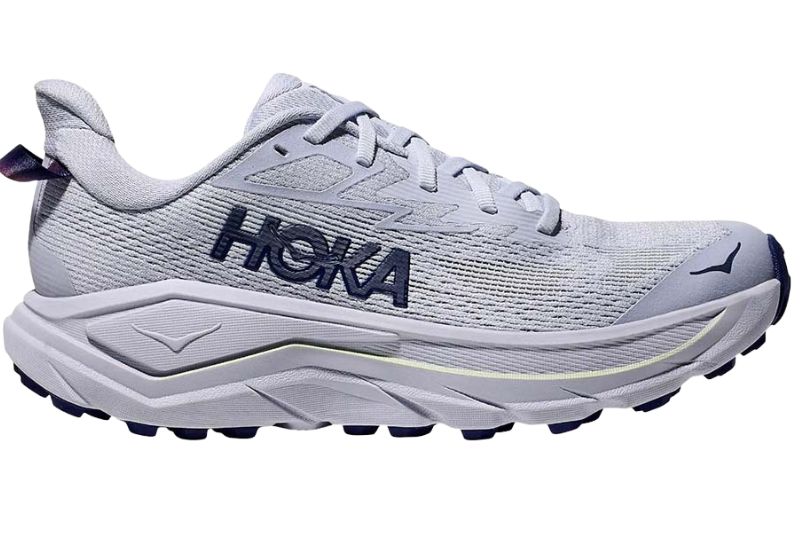
What keeps it from a top score is a flat foam with little spring and a tall stack that gets unsteady on technical ground.
Buy it if you spend most of your miles on dirt roads, gravel, and smooth trail and you want a plush, protective ride over ground feel. For that kind of running it is very good.
Skip it if your trails turn wet, rocky, or steep, or you would rather have a light, responsive shoe underfoot.
Highlights
| Feature | As tested |
|---|---|
| Weight | 8.1 ounces230 grams per shoe, women's; light for this much stack |
| Water resistance | Non-waterproof mesh; drains and dries fast, soaks through in sustained wet |
| Traction | 4 mm lugs; sure on dry dirt and gravel, loose on wet rock and mud |
| Comfort | Soft cushioning, no break-in |
| Adjustability | Standard lacing, secure hold once set |
| Breathability | Very good, one of the shoe's real strengths |
| Durability | Rubber wears slowly; the outsole glue is the one thing to keep an eye on |
| Arch support | Minimal, a neutral platform |
| Toe protection | Good, with a reinforced 3D-printed toe cap |
| Release | 2025 |
| Current price | $155 |
Thanks, one more step
Check your inbox to confirm your rating. Once confirmed, it counts toward this shoe’s community score.
See how it ranks on the full leaderboard →PROS
CONS
Trail tips, news and giveaways
One email a month: hiking tips, gear news, giveaways, fresh footwear verdicts and more. No spam, unsubscribe anytime.
Things We Tested

Traction
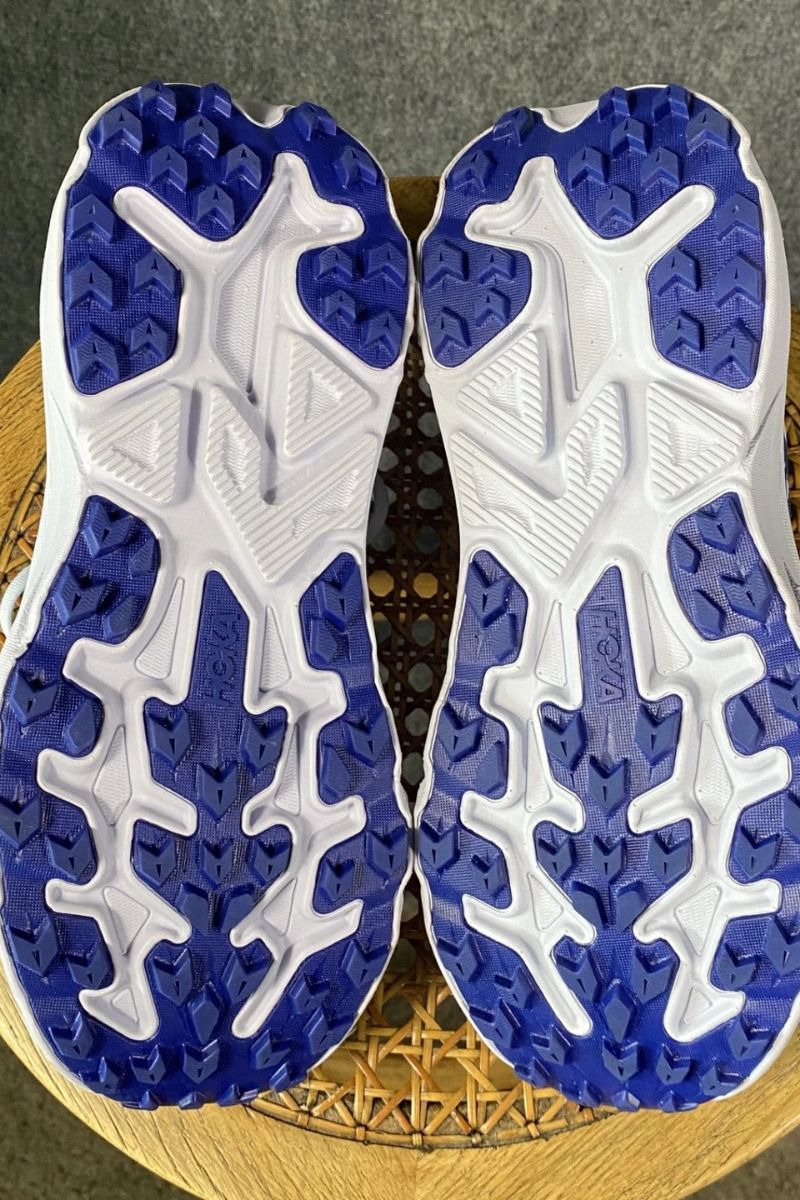
The reworked 4-mm lugs grip dry gravel and packed dirt clearly better than the Challenger 7 did, and they hold moderate trail without trouble. On the dry, loose rock of the first few days I had no complaints climbing or descending, and the smoother sections later were fine.
Yet, wet ground is another story. During the rainy afternoon the shallow tread slid on slick limestone, and I would not trust it on anything wet and steep. HOKA leaves most of the midfoot untreaded to help the shoe roll on pavement, and that bare foam is part of why grip falls off on soft or slippery surfaces.
For dry trail it has enough. For wet rock, mud, or steep loose ground I would rather have a Salomon Speedcross 6 or a mountain shoe like the HOKA Speedgoat.
Durability
My pair came through both trips in good shape. Its lugs held their depth over sharp limestone and the rubber barely wore, which fits the lab teardowns I’ve read that rate the abrasion resistance highly.
One thing I noticed, by the end of my first trip – that would be about 86 miles138 km – there was a small spot where the outsole looked like it could begin lifting away from the foam.
It never separated, and the shoe stayed sound the whole way, but it was enough to make me watch it, since a number of owners and one well-known 300-mile field test report the glue letting go early on the 8.
My old HOKA Challenger 7 never gave me even that much of a hint. So the rubber lasts and holds, with one caveat worth knowing before you commit to big mileage in them.

Comfort
They needed no break-in and were comfortable from the first mile, with no hot spots on either trip, and the padded collar and tongue kept pressure off the top of my foot over long hours. There is a lot of foam here, and it is soft, softer even than a Speedgoat 6.
Once my legs were tired on the long days, that cushioning did real work and kept the pounding off my joints.
What you give up for the softness is any spring. The compression-molded EVA is the same foam as before and returns almost nothing to your stride, so the ride is soft but flat. That height costs you off-road too, and on rockier ground the tall midsole blurred the feedback I wanted underfoot.
A gentle Metarocker helps the foot roll forward on smooth trail. Some testers report rubbing along the arch, though I got none of that, and the stock insole lifts out cleanly for a custom orthotic.
Weight
My women’s pair weighed close to HOKA’s listed 8.1 ounces230 grams per shoe, and on foot it felt about right, maybe a touch lighter. For a shoe with this much stack and foam that is reasonable, and I never noticed the weight on the climbs or descents.
Next to a lean gravel or crossover shoe built for speed it does feel slower, since all that cushioning has to weigh something. Among max-cushion trail shoes it is unremarkable, and that is fine.
Waterproofing
The HOKA Challenger 8 is not waterproof, and the standard build uses an open mesh that moves air rather than blocking water. It drains and dries quickly, and after the one rainy afternoon it was dry again within a mile or two of the rain stopping.
In the wet itself it soaked through fast, so this is not a shoe for sustained rain or stream crossings. HOKA does sell a Challenger 8 GTX with a Gore-Tex membrane if you need to stay dry, at the cost of some of this breathability. For wet running, our picks for waterproof trail running shoes are a better place to start.
Support

The Challenger 8 is a stable platform rather than a stability shoe, and that difference is worth getting right before you buy. HOKA uses a wide base, a J-Frame, and an Active Foot Frame to resist inward roll without correcting your gait, so a neutral runner gets a settled, planted feel and no forced motion control.
On the smoother alpine trail it felt solid. However, on technical ground, it didn’t do so well. That tall, soft stack raises your centre of gravity, and on loose rock and off-camber lines I felt it wobble enough that I slowed down and placed my feet more deliberately.
HOKA lists the drop at 8 mm, though I measured closer to 7 mm on my women’s pair, up from the 5 mm of the Challenger 7. A moderate offset like that leans you slightly toward a heel landing without forcing it, and my own ankles handled the wobble fine.
A runner who leans on a shoe for side-to-side security will want something more grounded. The padded heel held me without slipping across both days, and the reinforced toe cap shrugged off the odd kicked rock.
Breathability
Airflow is one of the shoe’s clear strengths. Its recycled mesh upper kept my feet cool through warm late-spring and summer days, with none of the swampy heat you get from denser trail shoes, and it dried within a mile or two after the rain stopped.
Yet, a weave this open lets fine grit through, and after a dusty day on the limestone my socks were nearly black from what had sifted in. On clean trail it never came up. On dry, dusty ground you will get dirty feet. For a roomier, similarly airy option, the Altra Experience Wild 3 is worth a look.
Fit and Sizing
The forefoot is noticeably roomier than the Challenger 7. It gave my wider feet room to splay without pinching, though it still is not as wide as an Altra or a Topo, and anyone coming over from a foot-shaped shoe like the Altra Lone Peak 9 will find it narrower than that. For most feet the extra room is a help.
My usual US 8.5 size fit true with wide feet, so order your normal number if your feet run standard to wide. Narrow-footed runners are the exception, since a fair number find the fit runs slightly large, so if you tend to have room to spare, going down half a size is worth a look.
Lockdown held well on the steep climbs and long descents, with the upper wrapping my midfoot and the padded heel keeping me from sliding forward downhill. That security is worth separating from the stability point above, since the wobble I felt came from the tall stack moving under me and not from my foot shifting inside the shoe.
How the HOKA Challenger 8 Compares
HOKA Challenger 8 vs. HOKA Speedgoat 6

If the Challenger’s grip left you wanting, the HOKA Speedgoat 6 is the fix inside HOKA’s own line. Its Vibram Megagrip outsole and deeper 5 mm lugs hold wet rock, mud, and steep loose ground that the Challenger slides on, and the closer-fitting upper locks the foot down for technical running.
You lose some of the Challenger’s softness and its easy road feel in return. It comes down to terrain, with the Challenger the better choice on buffed trail and pavement and the Speedgoat the one for real mountain running.
HOKA Challenger 8 vs. HOKA Clifton 10

This shoe and the Clifton 10 share the same soft compression-molded EVA and the same cushioned feel, which makes the Clifton the road version of what the HOKA Challenger 8 does on dirt. The Clifton keeps a smooth outsole for pavement, so it slides the moment you hit loose ground, while the Challenger’s 4-mm lugs and tougher upper let it handle gravel and light trail.
If you run only on roads the Clifton makes more sense, though the Challenger is worth the small penalty it pays on pavement once dirt is a regular part of your week.
HOKA Challenger 8 vs. Nike Wildhorse 10

The Nike Wildhorse 10 is the shoe I would point energy-hungry runners to, since its midsole gives something back where the Challenger’s foam just absorbs and moves on. It also holds technical trail better and stays composed where the Challenger starts to feel tall and unsteady.
What the HOKA Challenger 8 keeps over it is the softer, more cushioned feel on long, easy miles. For a more responsive, sure-footed ride I would take the Wildhorse, and reach for the Challenger when soft cushioning on gentle ground is what you are after.
Where the HOKA Challenger 8 Performs Best
This shoe is at its best on long, easy-to-moderate runs where cushioning helps more than ground feel does. Door-to-trail routes that start on pavement and end on dirt suit it well, along with gravel paths and recovery days, and it does well on warm outings where the breathability helps.
Wider-footed runners who could never get comfortable in a HOKA should find this one workable, and it takes high-mileage weeks on gentle terrain in stride. As an easy daily cruiser it holds up against something like the Brooks Divide 4, and on that ground it is good company and easy to recommend.

Where It Falls Short
The limits show up once the terrain gets demanding. Wet rock, mud, scree, and steep off-trail ground ask more of the shallow tread and the tall stack than they can give, and technical mountain running wants a precision this shoe is not built for.
Runners chasing speed or a springy ride will find the flat foam underwhelming, and anyone who likes to feel the trail will get little of that here. For rough or technical outings, a grippier, more surefooted shoe like the Saucony Peregrine 15 is the better tool.
Do We Recommend It?
HOKA Challenger 8
The HOKA Challenger 8 is a soft, heavily cushioned road-to-trail cruiser that soaks up long, easy miles without beating up your feet.
However, HOKA sells the Challenger as an all-terrain trail shoe, and two trips on real mountain ground showed me something gentler, a cushioned cruiser that is happiest on the smooth stuff. If you run technical terrain, want speed, or need grip in the wet, it is not the shoe for you. Take it for what it is, a plush cruiser for easy-to-moderate miles, and it does that job very well.
Where to Buy
The HOKA Challenger 8 retails for around $155 in both standard and wide widths. It is widely available, and checking more than one seller is the easiest way to catch your size, colourway, and any sale pricing.
| WHERE TO BUY? | MEN | WOMEN |
| Amazon | See Pricing» | See Pricing» |
| REI | See Pricing» | See Pricing» |
| HOKA | See Pricing» | See Pricing» |
FAQs
Yes, on the right ground. The soft cushioning and forgiving ride make it approachable for newer trail runners, and the roomy, true-to-size fit is easy to get along with. Keep it to gravel and easy-to-moderate trail, since it turns unsteady on rocky terrain.
The foam is good for the usual 400 miles644 km to 500 miles805 km and the lug rubber wears slowly. Some owners report the outsole glue lifting early, so if you run high mileage it is worth watching the tread, though my own pair held together without separating.
Not in the corrective sense. The Challenger 8 is a neutral shoe with a wide base and a J-Frame that limits inward roll without steering your gait, so it feels planted on smooth ground and tippy on technical terrain. Overpronators who need real support should look at a dedicated stability model.
Prices in this article are approximate and updated annually. Check the retailer for current rates.