Brooks has been making the Cascadia since 2004, when it developed the first version with ultrarunner Scott Jurek. Twenty versions later, the Cascadia 20 gets Vibram Megagrip rubber, a first for the standard Cascadia, along with a new DNA FLASH v2 midsole. Brooks also removed the rock plate. If you’ve owned an older Cascadia, there’s surprisingly little underfoot that carries over.
With so much changed, I wanted to see whether the new grip came at the expense of the protection and stability that have made the Cascadia so popular. So I put about 80 miles130 km of hiking and running on a pair over four weeks in Romania’s Carpathian Mountains.
Much of this Brooks Cascadia 20 review comes down to wet rock and sharp limestone, where the new rubber and the missing rock plate made the biggest difference.
Quick Verdict: 4.6/5
Brooks Cascadia 20
Brooks’ rebuild of the Cascadia worked for me. I had dependable grip on wet rock and stayed steady on rocky, sloping ground, and the firmer foam held up through long days. Without a rock plate I felt a few sharp points underfoot, but none of them hurt.

I trusted them a little more with each outing, and by the end of the month they had become my usual pick for mountain days.
Skip it if you’re after a low, nimble shoe for technical running, where the Saucony Peregrine 16 suits better, or if most of your hiking happens in the rain, when a waterproof pair like the Salomon X Ultra 5 GTX makes more sense.
Highlights
| Feature | Brooks Cascadia 20 |
|---|---|
| Specs | |
| Weight | 9.8 oz279 g per shoe, women's US 8.5 Wide · OutdoorAdept 9.7 oz275 g per shoe, women's US 8 · Brooks |
| Fit | True to size in the Wide; room for toe splay; heel lock for steep descents · OutdoorAdept |
| Waterproofing | Not waterproof; wet grass soaks through quickly; mostly dry overnight · OutdoorAdept; GTX version available |
| Stack height | 38 mm heel · Brooks 32 mm forefoot · Brooks |
| Heel-to-toe drop | 6 mm heel to forefoot · Brooks |
| Lug depth | 4 mm Vibram Megagrip lugs · Brooks |
| Adjustability | Standard lacing with a heel-lock eyelet; elastic strap tucks the laces |
| Upper | Air mesh with 3D overlays; semi-gusseted tongue |
| Midsole | Nitrogen-infused DNA FLASH v2; more foam than the Cascadia 19 |
| Outsole | Vibram Megagrip with Traction Lug |
| Widths | Women's Medium (B) and Wide (D) and Men's Medium (D) and Wide (2E) at the same $160; GTX in Medium only; tested in Wide |
| Toe Protection | Toe cap and mudguard; no rock plate |
| Figures credited to OutdoorAdept are our own measurements. The rest are the brand’s published specs. How we test | |
| How it performed | |
| Traction | 5/5 Secure on wet rock and loose climbs; wet roots less sure · OutdoorAdept |
| Comfort | 4.5/5 Firm with some spring; supportive on long days; short break-in · OutdoorAdept |
| Breathability | 4.5/5 Airy in mild weather; drafty on cold mornings; summer heat untested · OutdoorAdept |
| Durability | 4.5/5 Minimal early wear; slight lug rounding; mesh and toe caps intact · OutdoorAdept |
| Arch Support | 4.5/5 Neutral and natural; no arch ache on long days · OutdoorAdept |
Thanks, one more step
Check your inbox to confirm your rating. Once confirmed, it counts toward this shoe’s community score.
See how it ranks on the full leaderboard →PROS
CONS
Trail tips, news and giveaways
One email a month: hiking tips, gear news, giveaways, fresh footwear verdicts and more. No spam, unsubscribe anytime.
How We Tested
I wore the Cascadia 20 about twice a week from early September to early October 2026 (except for the week I spent testing the Speedgoat 7 in Croatia), mostly hiking with some running mixed in. I chose two main hikes in the Romanian Carpathian Mountains to cover different terrain and weather.
The first was about 8 miles13 km with 2,560 ft780 m of climbing on forest trails, including rocky and rooty sections. Conditions were mild and dry, but the forest floor still had wet rock from the previous day’s rain.
The second was shorter but more technical: about 7.5 miles12 km with 2,300 ft700 m of gain over exposed limestone and loose rock. Cloud and rain on the summit made me pay closer attention to every foot placement.
Across the month, most of my miles were on forest trails and dirt, with plenty of rocks and roots and some mud after rain. I also deliberately sought out wet sections to see how the grip held up. I carried an 11 lb5 kg pack on both hikes, wore merino-blend socks and kept the stock insole.
Things We Tested When We Reviewed the Brooks Cascadia 20

Traction
I was most eager to see what the Megagrip outsole would do for this shoe. It’s a soft rubber that molds to the rock’s surface under your weight, and the 4 mm lugs carry Vibram’s Traction Lug texturing for extra contact.
The difference showed most on wet rock. I crossed plenty of smooth, wet slabs at an angle after rain, braking through my heels, and the rubber kept its contact even with water on the stone.
On steep downhills, I could lean back and keep a normal stride, and climbs over loose dirt and rock felt just as secure.
Wet, rounded roots were less reliable, and the outsole could slide sideways on them before it caught. Roots worn smooth offer the rubber little texture, and their curve leaves only a narrow strip of sole in contact, so I took more care on roots than on rock.
Mud stayed shallow, about 2 in5 cm at most, and the lugs cleared quickly on firmer ground.
Durability
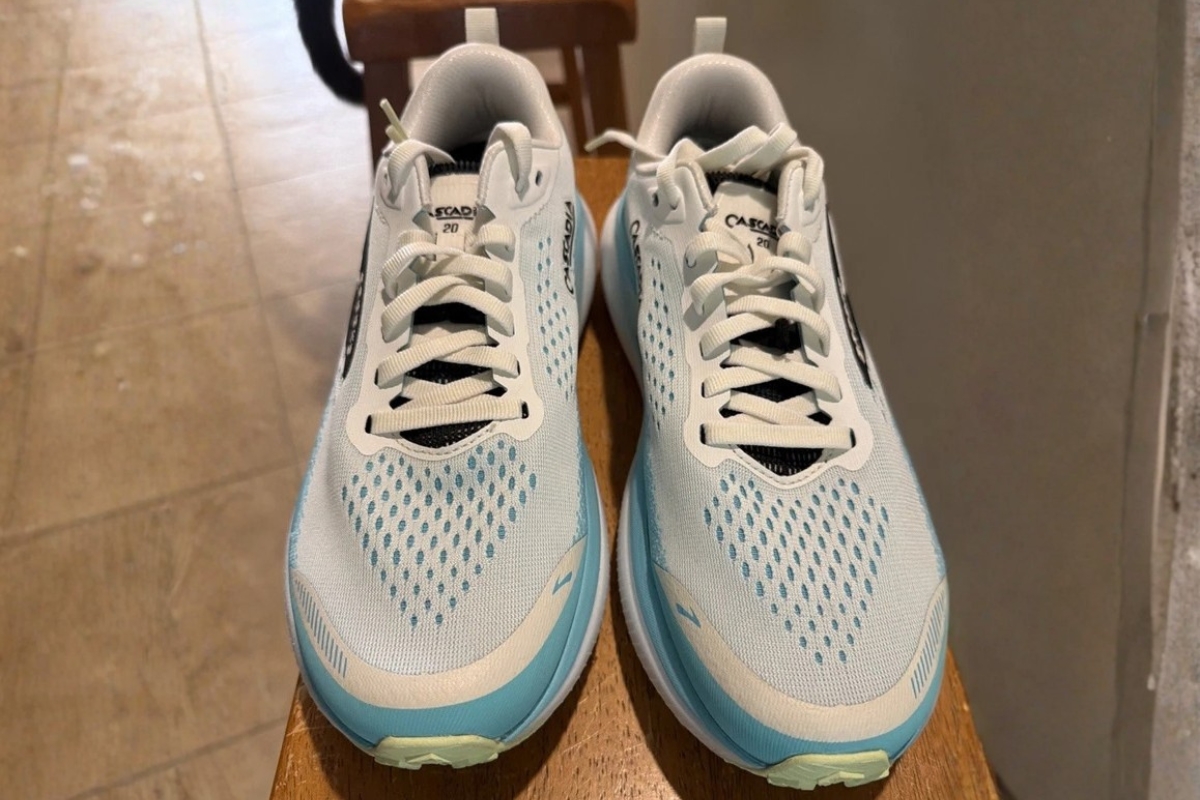
Four weeks in, the wear on my pair amounts to slightly rounded lug edges and scuffed toe caps.
Most of the rounding is under the forefoot, below the big toe and along the outer edge, where I push off. Braking on hard, rocky descents has flattened the heel lugs a little. No lug has chunked or torn, and the exposed foam between them carries only light scuffs.
Brooks reinforces the air mesh with 3D overlays in the high-wear zones and wraps the front and lower edges in a toe cap and mudguard. The toe caps took the knocks from rocks so my toes didn’t have to, and they’re still firmly attached.
The mesh shows dirt and light surface abrasion low on the sides, with no fraying or holes after some properly rocky sections.
Where my heels sit, the padding has flattened slightly without loosening the hold. At 80 miles130 km it’s too early to judge how long they’ll last, so I’ll add to this section as my pair racks up more trail.
Comfort
DNA FLASH v2 replaces the Cascadia 19’s DNA LOFT v3, and the listed stack rises from 35/29 mm to 38/32 mm. Both foams are nitrogen-infused to cut weight and add bounce, but FLASH has a smaller cell structure tuned for response, while LOFT’s larger cells give a softer landing.
The result on my feet is firm with some spring. The firmness made more sense to me as the day went on. After four or five hours, the foam hadn’t gone flat, and descents near the end still felt cushioned.
The upper felt a little structured on day one without rubbing anywhere, but by the third or fourth outing it had shaped itself around my heel and foot, so there’s no break-in to plan a long first day around.
I didn’t have blister trouble in my merino-blend socks. My one complaint, pressure across the top of my foot on long descents, came from pulling the laces too tight, and loosening the top eyelets sorted it on the spot.
With a semi-gusset anchoring it partway up both sides, the tongue stayed centered under the laces without slipping or bunching.
They also ran better on smooth forest trail than I’d assumed a shoe this protective would, with enough response from the foam to make running feel natural.
Weight
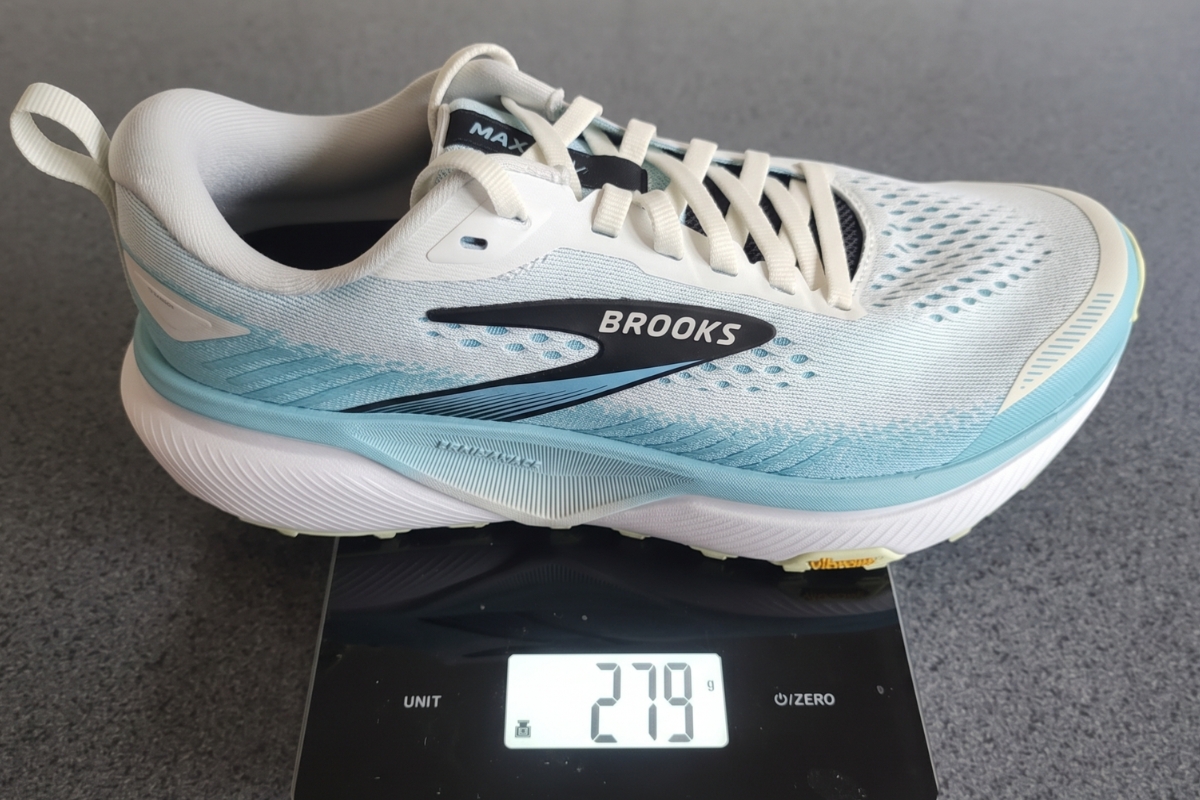
My women’s US 8.5 Wide weighs 9.8 oz279 g per shoe. Brooks lists 9.7 oz275 g for a women’s US 8, so mine comes in only a few grams heavier at half a size bigger and in the Wide.
That puts the Brooks Cascadia 20 on the heavier side for a trail runner, which follows from how much foam and rubber sits underfoot.
Uphill they felt reasonably light for that much protection. As I tired on sustained climbs I noticed them more, but with a pack on, a solid platform was worth the extra grams.
On tight, rooty sections that called for quick, precise steps, I noticed the weight and the stack more than anywhere else.
Waterproofing
The standard Brooks Cascadia 20 is mesh all the way through, without a waterproof lining, so wet ground reaches your socks fast.
Wet grass after a night of rain had mine damp within a quarter of an hour, and on the rainy limestone hike my feet were wet after about half an hour. As the air cooled late in the day, it got uncomfortable, although nothing rubbed or blistered.
The same open mesh helps with drying. With the insoles out and the laces loose, my pair spent the night indoors, and by morning only the tongue and heel padding were still damp, so give those a squeeze before you lace up, unless cold socks are part of your routine. Drying out completely took 12 to 18 hours.
For hikes that are wet from start to finish, Brooks sells a GTX version (see the FAQs), and our waterproof trail running shoe picks cover the ones we’ve tested.
Support
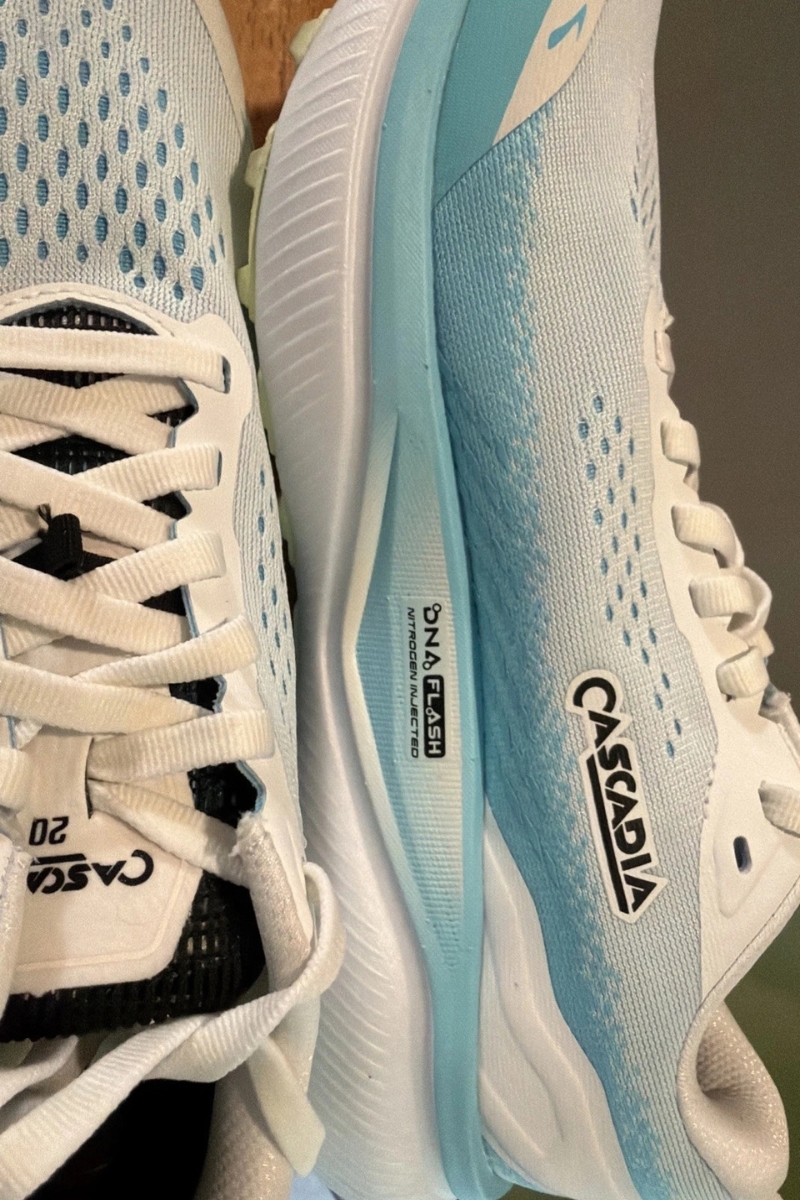
Side slopes and rocky ground never unsettled me in these, and my ankles held up fine over the four weeks.
Brooks builds the sole on its TrailAdapt platform, a wide base that flexes in key areas, with lugs shaped to adapt to uneven ground. The width did the most for me.
A broader base gives your foot more room to land before the shoe starts to tip, so on tilted rock my attention could go to the route instead of my ankles.
The Cascadia 19 had a flexible forefoot rock plate, Brooks’ Ballistic Rock Shield, set between foam and rubber to spread the pressure of a sharp point. The 20 leaves it out.
On limestone I felt some of the sharper rocks through the sole. When I stepped squarely on one pointed rock, my only thought was “yep, I can feel that.” None of it hurt, and for hiking the foam gave enough protection. For days with a lot of scrambling, I’d switch to an approach shoe built for it, like the La Sportiva TX4 Evo.
Arch support felt natural without being pronounced, and on my longest hikes I didn’t get the specific ache under my arches I’ve had in some other shoes.
Breathability
My test ran from 46 °F8 °C mornings to 72 °F22 °C afternoons, and in that range I didn’t have trouble with hot feet, uphill runs included.
The air mesh is open enough to let heat out as you work, and on the warmer days I preferred it to an enclosed hiking shoe. Anything hotter is outside what I tested.
The wind found its way through the mesh on a couple of cold mornings while I walked slowly, until I got moving and forgot about it. A slightly warmer sock is the easy fix for early autumn starts.
Fit and Sizing
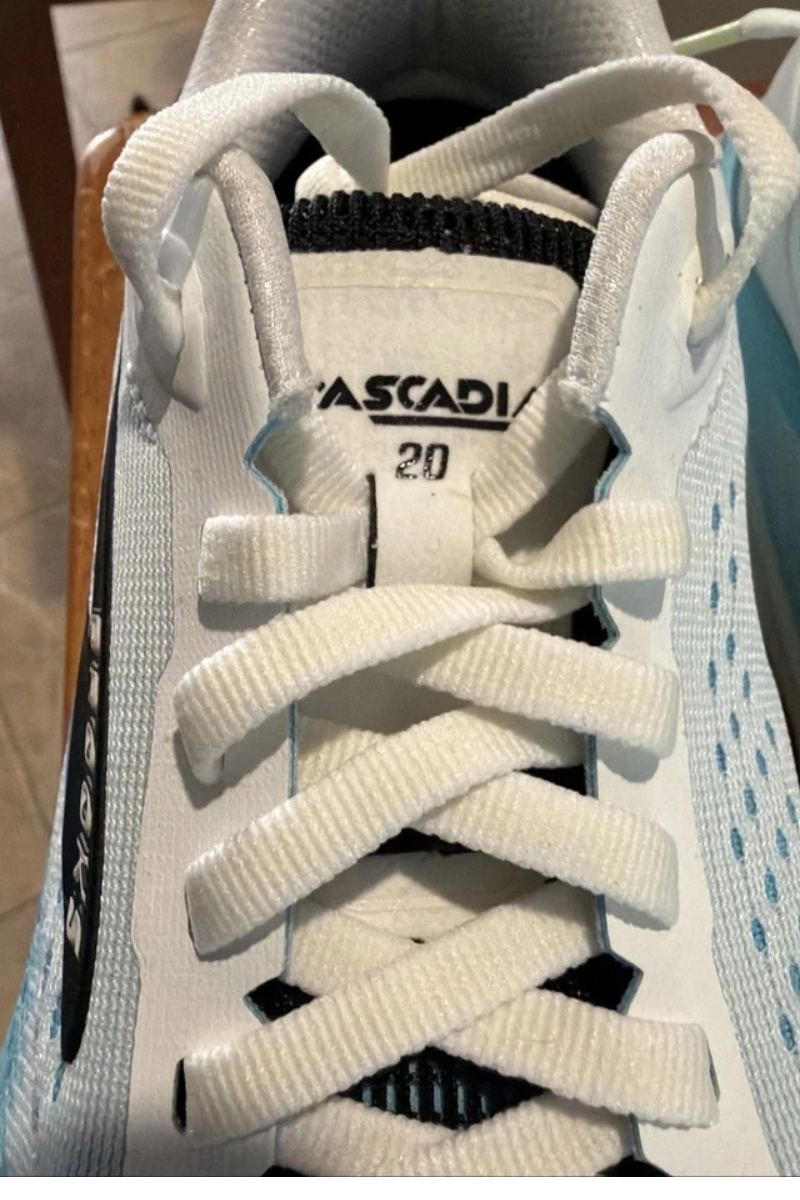
My usual women’s US 8.5 fit true to size in the Brooks Cascadia 20, and the Wide is what I tested.
Length was right, with space ahead of my toes on normal descents. The same 8.5 Wide fit me in the Peregrine 16, but the Speedgoat 7 needed a 9 Wide, and since brands build on different lasts, don’t assume your HOKA size carries across.
Brooks sells the Cascadia 20 in women’s Medium (B) and Wide (D) and men’s Medium (D) and Wide (2E) at the same $160, with the GTX in Medium only.
I chose the Wide so my forefoot wouldn’t feel squeezed after several hours, and it let my toes spread as my feet swelled, without the shoe feeling loose.
The midfoot felt secure once the lacing was right, and my heel moved only slightly at first. On very steep descents the angle pushed my foot forward until I used the heel-lock eyelet, looping each lace into the top eyelet on its own side and threading the laces through the opposite loops before pulling down.
That snugs the collar around your ankle and keeps the heel seated without cranking the whole shoe down, and an elastic strap across the tongue stops the tucked-in laces from flapping when you run.
How the Brooks Cascadia 20 Compares
Brooks Cascadia 20 vs HOKA Speedgoat 7
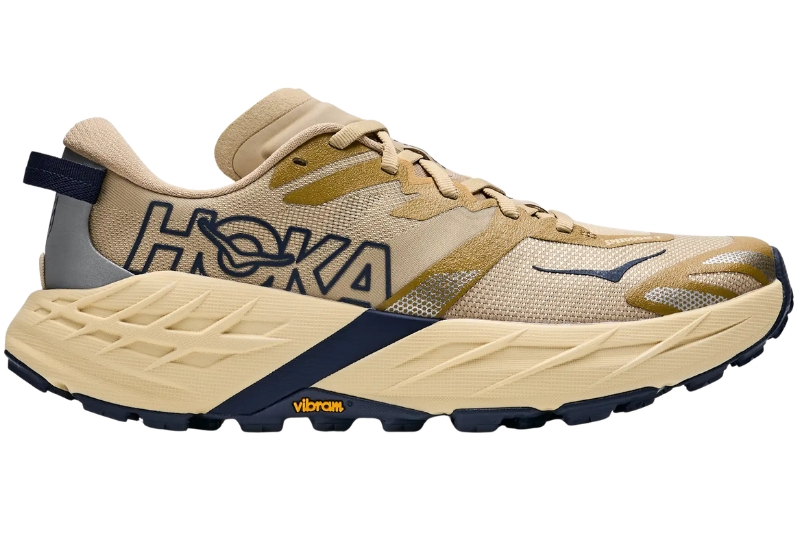
The Speedgoat 7 sits on supercritical EVA foam with a rockered sole, so it feels more cushioned the moment you lace up, and its Megagrip lugs go a millimeter deeper, to 5 mm.
Over changing mountain terrain at a fast walk, I felt more planted in the Brooks. Moving from rock to dirt and back without adjusting my stride, I found its firmer ride easier to predict, and that gave me confidence. If you’d rather have the softer ride, go for the HOKA.
On our scale, my 9 Wide Speedgoat weighed 8.5 oz241 g per shoe, so the Cascadia, at 9.8 oz279 g in an 8.5 Wide, carries about 1.3 oz38 g more per shoe despite being half a size smaller. At $165, the HOKA costs a few dollars more.
Brooks Cascadia 20 vs Saucony Peregrine 16
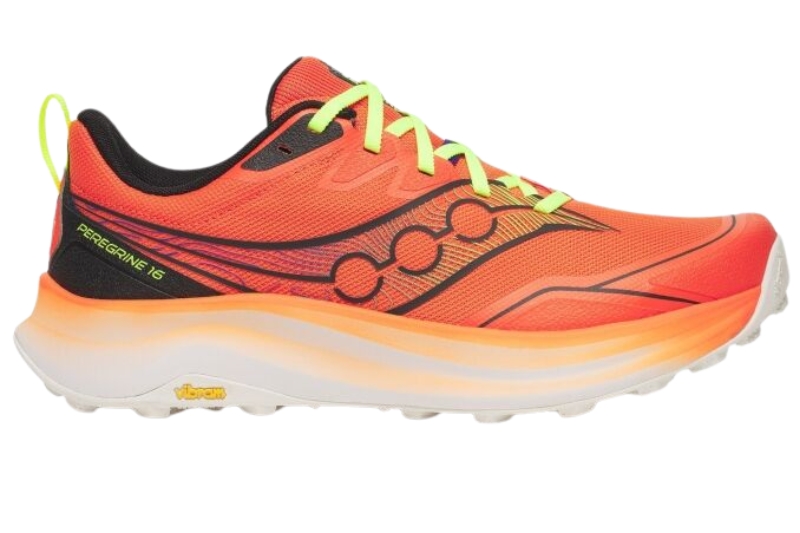
Same rubber, same 4 mm lug depth, so what separates these two sits above the outsole.
The Peregrine‘s 32 mm heel and 4 mm drop put me lower and let me feel more of the ground. I could move quickly in it between rocks and roots and through tight sections, with grip I trusted in the wet. For running that’s mostly technical, where every step needs placing, it’s the better fit.
After hours of downhill, the Cascadia’s deeper foam was the protection I was glad of, even though the Peregrine is the one with a forefoot rock guard. It costs $150 and weighed 8.6 oz245 g per shoe in a women’s US 8.5 Wide on the same scale.
Brooks Cascadia 20 vs HOKA Challenger 8
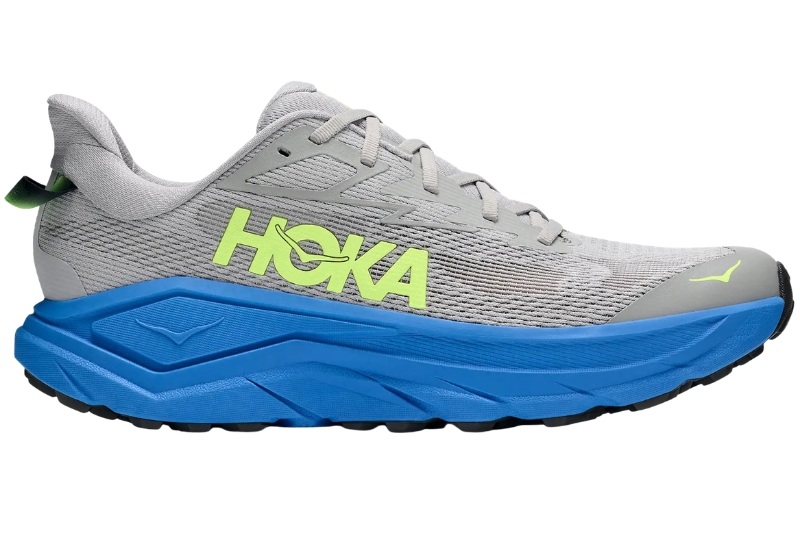
On damp roots and wet slabs I felt surer in the Brooks, and the soles explain most of it. The Challenger 8 is a road-to-trail shoe, with bare foam through much of the midfoot to help it roll on pavement, and it slipped on me more than once on wetter sections.
Easy trail and gravel suit the HOKA better, especially on running-heavy days, when its lighter weight makes it quicker to turn over, even if the foam is flatter. On rough trail with steep pitches and loose ground, the Cascadia’s wider, more stable platform makes a noticeable difference, and going downhill I’d take its firmer feel over a softer shoe moving around underneath me.
My women’s US 8.5 Challenger weighed close to HOKA’s listed 8.1 oz230 g per shoe, and it costs $155.
Where the Brooks Cascadia 20 Performs Best
Long mountain days on trail that keeps switching between dirt and wet rock, under weather you can’t predict, are where I’d choose the Brooks Cascadia 20. The Megagrip rubber covers the wet sections, and the wide base keeps you steady once the ground tilts.
It also suits outings where you hike most of the way and run the easier stretches, as the foam stays supportive over a long hike and still runs well. If you’re unsure which kind of shoe to wear for that mix, our guide to hiking in trail running shoes walks through it.
Where It Falls Short
My test never got past shallow mud, but for deep, soft mud I’d change shoes, as 4 mm lugs can’t dig down to anything firm. Of the pairs we’ve tested, the Salomon Speedcross 6, with deeper lugs designed for soft ground, is the one I’d pick there.
Stepping from rock to rock on technical trail, I had less feel for the ground than I like, the price of 38 mm of foam under the heel. Fast running on terrain like that is a job I’d hand to the Peregrine 16.
Do We Recommend It?
Brooks Cascadia 20
After 80 miles130 km in the Carpathians, I’d pay for this pair myself. I started the test wondering whether Brooks had traded away protection for the new grip, and the shoe does give up a little underfoot, though not enough to spoil a hike.
At $160 you get Vibram rubber on a planted platform and an upper that came through a month of rock with little more than scuffs, so the price feels fair to me.
Buy them if one pair has to cover your mixed mountain days and you’d rather trust your footing than save a little weight. To see where a 4.6 sits in the wider field, check our footwear leaderboard.
Where to Buy
| WHERE TO BUY? | MEN | WOMEN |
| Amazon | See Pricing» | See Pricing» |
| Backcountry | See Pricing» | See Pricing» |
| REI | See Pricing» | See Pricing» |
FAQs
No. Brooks doesn’t list one on the Cascadia 20, and REI’s spec sheet confirms there isn’t one. Between you and sharp rock sit the 38 mm heel stack and the Vibram outsole.
Yes. Brooks sells the Cascadia 20 GTX for $190, with a GORE-TEX Invisible Fit membrane fused to the upper in place of a separate inner bootie, which the brand says keeps it light and flexible. I tested only the standard mesh version.
The Cascadia 20 swaps the 19’s DNA LOFT v3 foam for DNA FLASH v2 and its TrailTack Green rubber for Vibram Megagrip, drops the rock plate and moves from a 35/29 mm stack to 38/32 mm. I haven’t run in the 19 myself, although our Brooks Cascadia 18 review covers an earlier version.
Prices in this article are approximate and updated annually. Check the retailer for current rates.