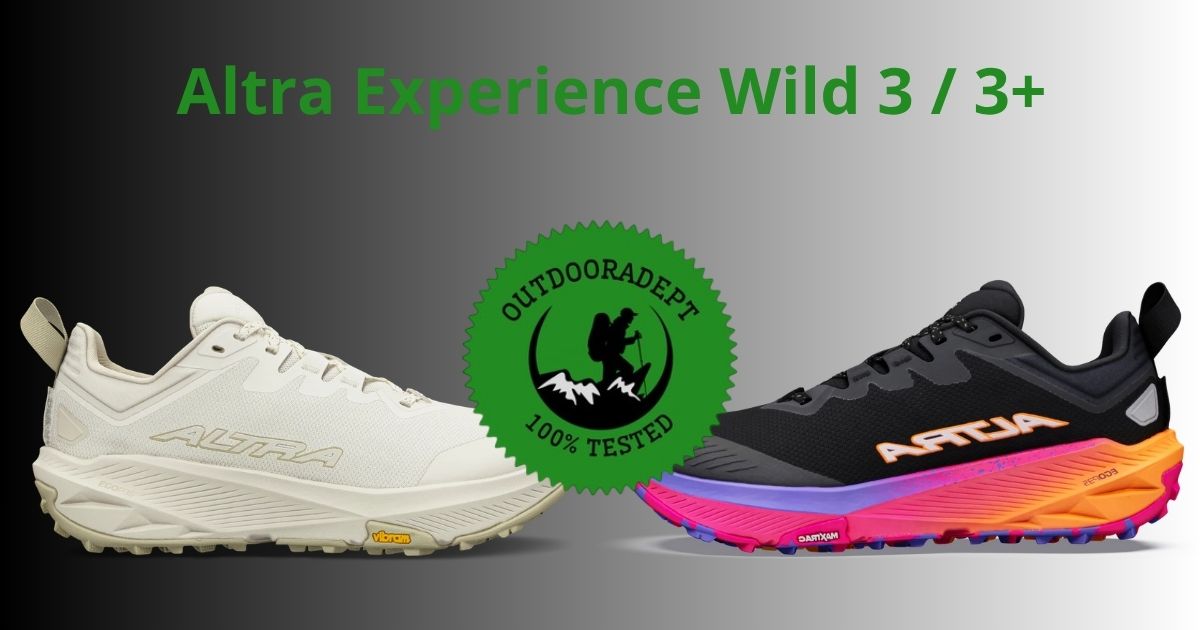
The Altra Experience Wild 3 comes in two versions that look nearly identical on the shelf. The standard Wild 3 uses Altra’s own MaxTrac rubber and costs $150. The Wild 3+ swaps in a full-length Vibram® Megagrip outsole for $165. Everything above the outsole is shared: the same EGO™ P35 foam, the same 4 mm drop, the same Standard FootShape™ fit and the same open-weave mesh upper. I tested both, over 60 miles traversing the varied terrain of the Pacific Northwest and the rolling foothills of Colorado.
My primary testing ground was a regular 8-mile13-km loop starting from downtown Boulder out to the Mesa Trail. The route requires about 2 miles3.2 km of pavement to reach the dirt, followed by sandy singletrack, pine forest loam, and punchy climbs. For my second major outing, I took them on a 15-mile24-km fast-pack hike in Washington’s Cascade Mountains, mixing hardpack dirt, rocky descents, and wet granite.
Testing the standard model kept pointing at the same weak spot: the outsole. MaxTrac held up beautifully on dry dirt and forest trails, but it showed noticeable hesitation on wet, smooth rocks, and the heel lugs were already smoothing after 60 miles.97 km. So I took the Wild 3+ over both routes again, this time in reverse.
Walking a route backwards is a fairer test than simply repeating it. The surfaces are the same, but every climb becomes a descent and the tricky sections arrive in a different order, so I could not lean on footing I had memorised the first time. Any extra grip had to come from the shoe.
More on how both versions performed in the full Altra Experience Wild 3 and 3+ review below.
Quick Verdict
Altra Experience Wild 3 4/5
A lightweight, low-drop (4 mm) road-to-trail shoe with the Altra MaxTrac outsole, EGO™ P35 foam and a Standard FootShape™ fit. Good on pavement, gravel and dry dirt, but the MaxTrac rubber hesitates on wet rock and wears quickly at the heel.

Altra Experience Wild 3+ 4.7/5
The Wild 3+ is the version to buy. It keeps everything that makes the Wild 3 a good road-to-trail shoe, and the Vibram® Megagrip outsole fixes its two weak points: grip on wet rock and outsole wear. Over the same routes walked in reverse, both were noticeably better than on the standard model.

Note: I would take the 3+ for trail running and day hiking on anything that gets wet: rock slabs, roots, dewy grass and technical descents. It is also the better buy if you put in real weekly mileage, because the outsole is what wears out first on this shoe. More on that upgrade later in this article.
The standard Wild 3 makes sense if most of your miles are pavement, gravel paths and dry, easy dirt, or if you find it discounted well below the 3+.
Both versions work well for medium-width feet that want trail capability without committing to a zero-drop platform. Neither will satisfy very wide feet, and neither is built for steep technical terrain or sustained mud.
Highlights
| Feature | Altra Experience Wild 3 | Altra Experience Wild 3+ |
|---|---|---|
| Weight | 8.67 oz246 g per shoe, women's US 8.5 · OutdoorAdept 9.1 oz256 g per shoe, women's · Altra 11.1 oz315 g per shoe, men's · Altra | 8.57 oz243 g per shoe, women's US 8.5 · OutdoorAdept 9.3 oz264 g per shoe, women's · Altra 11.4 oz323 g per shoe, men's · Altra |
| Fit | Standard FootShape: true to size, room to splay, a narrower midfoot than the Original fit. No wide version. · OutdoorAdept | Identical, so the same size in either version. · OutdoorAdept |
| Waterproofing | Not waterproof; the open-weave mesh drains and dries fast. No waterproof version. | The same upper, so identical. |
| Stack height | 32 mm heel · Altra 28 mm forefoot · Altra | 32 mm heel · Altra 28 mm forefoot · Altra |
| Heel-to-toe drop | 4 mm low drop, not zero drop · Altra | 4 mm low drop, not zero drop · Altra |
| Lug depth | 4 mm on our calipers · OutdoorAdept 4 mm opposing-triangle pattern · Altra | 4 mm on our calipers · OutdoorAdept 4 mm opposing-triangle pattern with the Traction Lug · Altra |
| Outsole | Altra MaxTrac rubber | Vibram Megagrip, with the toe bumper built into the outsole |
| Midsole | Altra EGO P35 | The same EGO P35 |
| Upper | Open-weave engineered mesh | The same upper |
| Adjustability | Traditional lacing; GaiterTrap heel tab for strapless gaiters | Identical |
| Toe Protection | Toe bumper on the upper | Bumper built into the Vibram outsole |
| Release | 2026 | 2026 |
| Price | $150 | $165 |
| Figures credited to OutdoorAdept are our own measurements. The rest are the brand’s published specs. How we test | ||
| How it performed | ||
| Traction | 3.5/5 Snappy on dry dirt and gravel, hesitant on wet, smooth rock | 4.5/5 Noticeably better on the same wet rock; the lugs are unchanged, so heavy clay still clogs both |
| Comfort | 4.5/5 EGO P35 foam, softer under the heel and firmer in the forefoot; no blisters or hot spots out of the box | 4.5/5 Identical underfoot over the same routes |
| Breathability | 5/5 Open-weave mesh moves air well and drains fast | 5/5 The same upper, so identical |
| Durability | 3/5 Lateral heel lugs already smoothing on our pair over mixed road and trail | 4.5/5 The outsole wore noticeably less over the same routes |
| Arch Support | 3.5/5 Neutral, with support coming from platform geometry | 3.5/5 Identical |
Tap a star to vote. Tap the left half of a star for a half star.
Thanks, your rating counts
It is now part of this shoe’s community score. Changed your mind? Tap a different star.
See how it ranks on the full leaderboard →PROS
CONS
Trail tips, news and giveaways
One email a month: hiking tips, gear news, giveaways, fresh footwear verdicts and more. No spam, unsubscribe anytime.
Things We Tested the Experience Wild 3 and 3+ On

Traction
Traction is where the two versions split. Both use the same 4 mm lugs in an opposing-triangle pattern, with a different layout at the heel and the forefoot. The difference is the rubber: Altra’s proprietary MaxTrac on the Wild 3, and full-length Vibram® Megagrip on the 3+. On hard dirt and crushed gravel, the standard model felt snappy and responsive.
On wet grass and morning dew, the standard Wild 3 was acceptable but required a bit of caution on sharp corners, exhibiting slight slippage. Where it struggled most was on wet rock and smooth granite in the Cascades. There was a noticeable hesitation and lack of bite compared to shoes equipped with Megagrip.
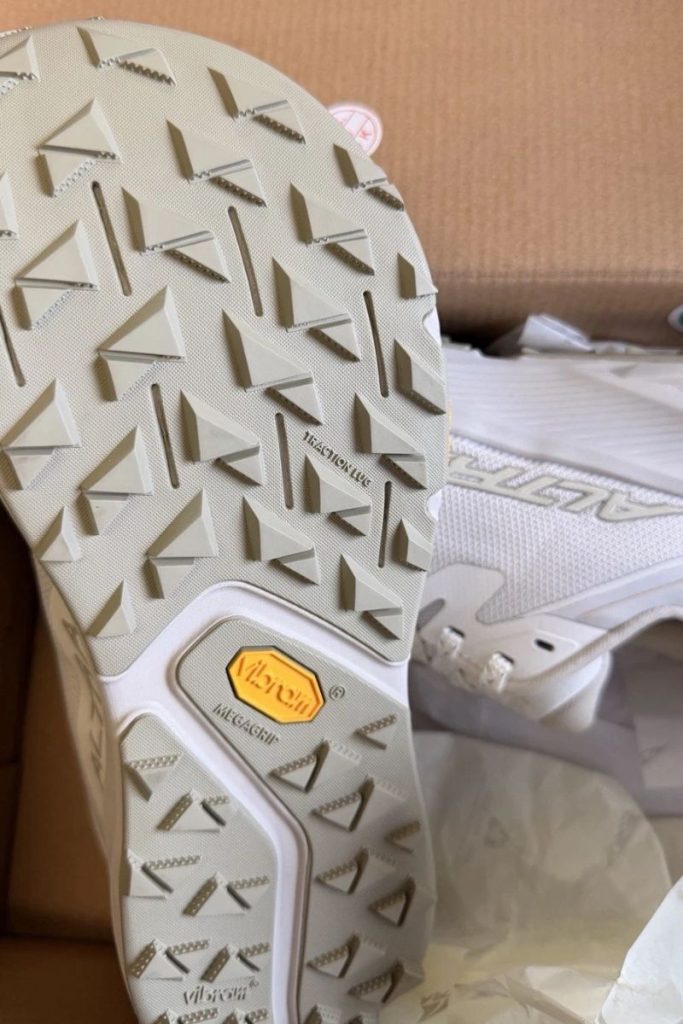

The Wild 3+ changed that. Walking the same routes in reverse meant I could not anticipate every slick patch the way I could have on a straight repeat, and the 3+ still gripped noticeably better on exactly the surfaces where the standard pair had hesitated.
Mud is the one place the upgrade does not help. Vibram changes the rubber, not the lug shape, so on a heavily rutted and muddy forest section the 4 mm lugs caked up quickly and failed to shed the heavy clay, on both pairs. If your trails are mostly deep mud, neither version is the right shoe. If they include any wet rock at all, the traction alone is worth the extra $15.
Durability
Above the outsole, both versions hold up well. The upper overlays and mesh at the flex points are holding up excellently without any signs of fraying or delamination, and the toe bumper absorbed rock and root impacts without peeling.

The outsole is where they part ways. On the standard model, reviewers have flagged faster MaxTrac wear on rock, snow and ice compared with Vibram Megagrip, and my own pair matched that: after 60 miles97 km of mixed road and trail, the lateral heel lugs already show premature smoothing.
On the standard model the outsole is undeniably the primary point of failure. The softer EGO P35 midsole gradually compresses over a few hundred miles, but the physical wear on the rubber indicates it will fail long before the cushioning breaks down.
The Megagrip outsole on the 3+ wore noticeably less over the same ground. Because both pairs covered the same two routes, the difference comes from the rubber and not from easier terrain.
The toe bumper was a pleasant surprise too. On the standard pair, the toe guard crept back on long descents and started to pinch the big toe. On the 3+, it felt noticeably better on the same descents. Altra builds the toe bumper on the 3+ into the Vibram outsole, which is the likely reason.
That is what makes the premium worth paying. The 3+ costs $15 more, about 10% over the standard model. It only has to last 10% longer to be the cheaper shoe per mile, and on this evidence it should clear that bar comfortably.
Comfort
My first run was a 9-mile15-km effort straight out of the box. Impressively, there were no blisters or hot spots. The interior finishing is smooth, the tongue padding is soft and protective against lace pressure, and the step-in feel is premium.
The EGO P35 cushioning provides excellent impact absorption on descents and longer efforts. The foam reads noticeably softer under the heel while remaining slightly firmer in the forefoot, which perfectly suited my mid-to-fast pacing, allowing for an energetic toe-off.
Nothing changes on the 3+. It uses the same midsole, the same interior and the same heel collar, and over the same routes it felt identical underfoot.
Weight

Out on the trail, the low weight makes the shoe feel incredibly nimble and easy to turn over. The Wild 3 sits below the Timp and Olympus in stack and weight, and reads as a lighter, livelier road-to-trail option rather than a max-cushion trail shoe.
When evaluating trail shoes we always verify weight independently. We placed a fresh out of the box Women’s US size 8.5 directly on our digital lab scale, and it weighed in at exactly 8.67 oz.246 g.
Altra publishes 9.1 oz256 g for the women’s Wild 3 and 11.1 oz315 g for the men’s, against 9.3 oz264 g and 11.4 oz323 g for the 3+. It never states which size those figures refer to, so treat them as a reference size rather than a promise about the pair in your hands: ours came in 0.43 oz12 g under the published women’s figure. The men’s weights above are Altra’s; we weighed only the women’s pairs, in Livia’s own US 8.5.
The Vibram outsole costs you nothing on the scale. Our Wild 3+ pair, in the same Women’s US 8.5, came in at 8.57 oz,243 g, which is 0.1 oz3 g lighter than our standard pair and 0.73 oz21 g under Altra’s published women’s figure for the 3+. Altra lists the 3+ as marginally heavier, so a difference that small is pair-to-pair variation rather than anything you would feel on trail.
Waterproofing
Neither version of the Altra Experience Wild 3 is waterproof. The open-weave mesh upper is intentionally breathable and will let water in during stream crossings, heavy rain, or wet grass. However, drainage is exceptional. After fully submerging the shoe in a puddle, the water squeezed out immediately, and the shoe felt dry enough to prevent chafing within 15 to 20 minutes of continued running.
Support

Both versions are neutral trail shoes. No medial post, no guide rails, no pronation correction. What they offer is structural support through geometry.
The Standard FootShape sidewalls come up around the foot for a stable platform on off-camber terrain, and the heel-cup lockdown is surprisingly secure for an Altra, holding the foot firmly in place.
Breathability
The open-weave engineered mesh moves air well across the top of the foot. My feet stayed perfectly cool and ventilated during a 75°F24°C afternoon run on the exposed sandy singletrack.
Compared to heavier, densely-woven trail uppers, the airflow is vastly superior, making this an excellent choice for summer miles.
Fit and Sizing
- The toe box: The Standard FootShape interior makes the toe box feel spacious on first try-on, with room for the toes to splay laterally. In terms of length, it fits perfectly true to size: my toes did not touch the front in my normal US 8.5. The 3+ fits exactly the same, so you can order the same size in either version.
- Standard vs. Original FootShape: Altra makes three fits. Original is the widest, found in the Lone Peak and Olympus. Standard sits in the middle, and both versions of the Experience Wild 3 use it. If your foot is genuinely wide, either version will likely feel cramped, and there is no wide version of either one.
- Heel and midfoot: The heel counter and collar fit are soft but lack rigid structure. I experienced minor heel slop initially, but running the laces through the top eyelet (runner’s loop) immediately solved the issue and locked me in.
Altra Experience Wild 3 vs 3+: Which One to Pick?
The midsole, upper, fit and geometry are identical on both versions, so the choice comes down to where you run and how long you want the shoe to last.
The 3+ is the default. If your routes include wet rock, roots, dewy grass or technical descents, or if you put in serious weekly mileage, the Vibram outsole is the upgrade that matters. Over the same two routes in reverse, it gave me the grip the standard pair was missing, and its outsole wore noticeably less.
The standard Wild 3 only makes sense if most of your miles are pavement, gravel paths and dry, easy dirt, or if you find it discounted well below the 3+. On those surfaces MaxTrac grips fine, it just will not last as long.
If you are unsure, buy the 3+. Fifteen dollars is a small price for fixing the two biggest weaknesses of an otherwise excellent road-to-trail shoe.
How the Experience Wild 3 and 3+ Compare with Other Shoes
Wild 3+ vs. Timp 6

The Timp 6 has used Vibram Megagrip from the start, so it is far superior on wet rock and steep technical terrain compared to the standard Wild 3’s MaxTrac rubber. Against the 3+, both shoes run the same rubber, and the choice comes down to the platform.
The Timp also feels slightly more structured underfoot with its EGO MAX foam. The trade-off is weight and geometry as the Wild 3 is noticeably lighter on foot, and its 4 mm drop makes the transition from standard road shoes much easier on the calves.
If you want a lightweight road-to-trail hybrid with real grip, go Wild 3+; if you’re hitting serious dirt and demand a zero-drop platform, grab the Timp 6.
Want to do more research? Our ALTRA Timp 6 Review is a great place to start.
Wild 3 vs. Lone Peak 9
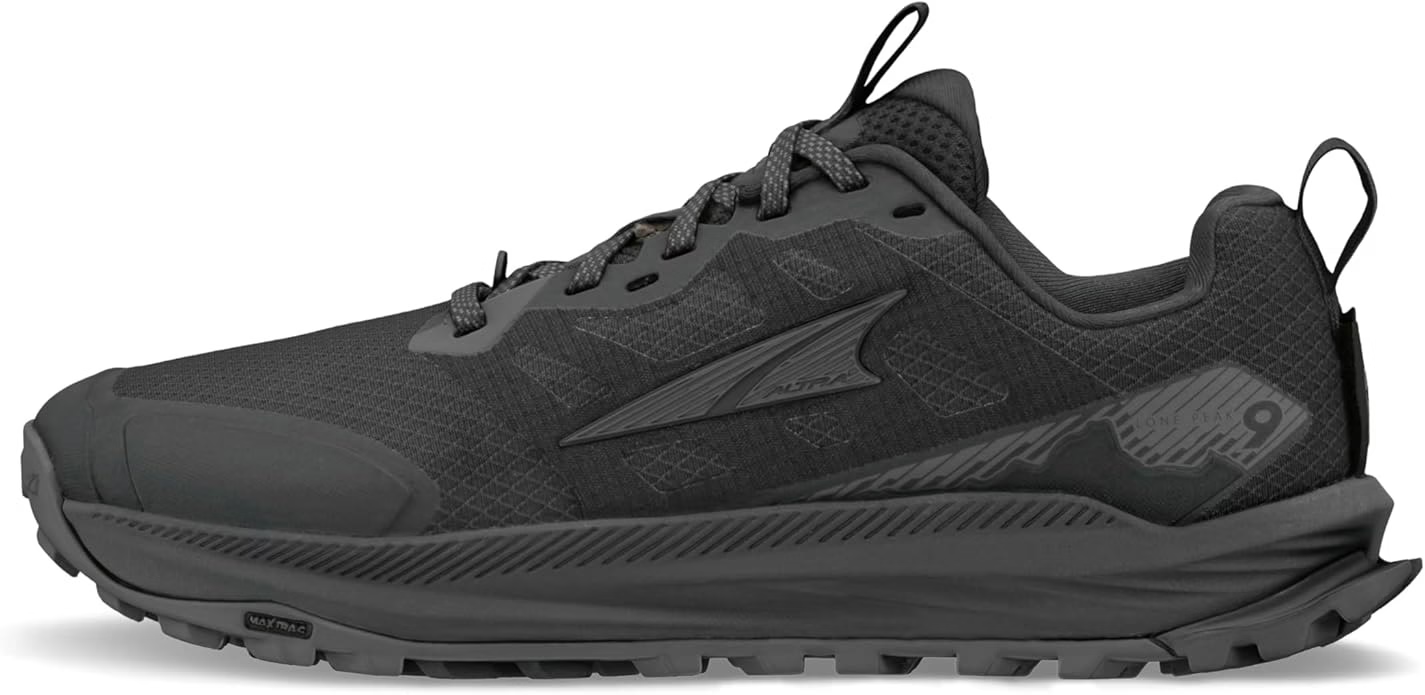
The Lone Peak is Altra’s trail benchmark: zero drop, the roomier Original FootShape, and a wide version.
Both Wild 3 versions are higher-stack, lighter on their feet, and add a 4 mm drop that makes the road-to-trail handoff smoother.
Downsides: the Standard FootShape is meaningfully tighter than the Lone Peak’s Original last, and the standard model’s MaxTrac outsole doesn’t grip technical ground as confidently, though the 3+ closes most of that gap.
For more information, read our ALTRA Lone Peak 9 Review.
Wild 3 vs. HOKA Challenger 7

The HOKA Challenger 7 is the obvious road-to-trail rival, with a 5 mm drop and a pronounced rocker that nudges you through each step.
The Wild 3 sits flatter at 4 mm and lets the foot do more of its own work. The Challenger 7 is also slightly lighter (8.9 oz252 g M9) and has a dedicated GTX version available. If wet rock is part of your routes, the Wild 3+ is the version to compare against it.
The test results of the HOKA Challenger 7 are worth a read if you are still undecided.
Wild 3 vs. Nike Pegasus Trail 5

The Pegasus Trail 5 is a staple in the road-to-trail category, sitting on a much higher 9.5 mm drop and utilizing Nike’s bouncy ReactX foam.
While the Pegasus feels a bit more fluid on extended pavement stretches, both Wild 3 versions are significantly lighter and offer a much wider, more accommodating toe box.
If you prefer a traditional, higher-drop shoe, go Nike; if you want a natural, low-drop feel with room for your toes to splay, go Altra.
Find out more in our Nike Pegasus Trail 5 Review.
Best Use Cases
The sweet spot is door-to-trail running and non-technical singletrack: the days where you run a few miles of road to reach the dirt, or mix packed dirt, grass, and gravel without anything that needs scrambling. Confirming this against my local routes, the low 4 mm drop and lighter build kept easy and longer efforts feeling manageable, and the outsole rolled onto pavement cleanly without the clunkiness of chunkier trail lugs. Both versions also double brilliantly as lightweight day-hiking shoes on established trails.
The 3+ stretches that range. With Megagrip underfoot, wet rock, roots and damp descents are part of its comfort zone rather than the place where you start picking careful lines.

Where the Experience Wild 3 and 3+ Fall Short
On the standard Wild 3, the MaxTrac outsole is the main limitation: on steep, wet or technical ground it gives up grip and longevity to Vibram, and its toe guard can creep back and pinch the big toe on long descents. The 3+ improves all three. Some limits apply to both versions: at 32 mm of stack with a 4 mm drop, precise foot placement on roots and rock slabs is less secure than in a lower shoe like the Superior or Lone Peak, and the 4 mm lugs struggle in heavy clay, so sustained mud is a problem either way.
Final Verdict: Do We Recommend It?
Altra Experience Wild 3 4/5
The standard Altra Experience Wild 3 is a strong low-drop road-to-trail shoe for runners who stay mostly on pavement, gravel and dry dirt and want one pair that also handles non-technical trail, without the commitment of a zero-drop platform.
Its standout strengths are the incredibly low weight, the smooth, un-clunky ride on pavement, and the phenomenal drainage when wet.
For serious hikers and trail runners, though, we would not buy the standard version. Given the hesitant grip on wet rock and the premature wear of the MaxTrac rubber, the $15 upgrade to the Wild 3+ is worth every cent.
Altra Experience Wild 3+ 4.7/5
For $165, the Vibram® Megagrip outsole fixes the standard shoe’s two real flaws: hesitant grip on wet rock, and heel lugs that wear smooth too early. Everything else stays the same, so you keep the light weight, the smooth ride on pavement and the phenomenal drainage. For anyone running or hiking off dry, easy trail, it is money well spent.
Want to explore more trail runners? Here are some of the best trail runners we have tested.
Where to Buy It?
| Altra Experience Wild 3 | MEN | WOMEN |
| Amazon | See Pricing» | See Pricing» |
| Backcountry | See Pricing» | See Pricing» |
| REI | See Pricing» | See Pricing» |
| ALTRA | See Pricing» | See Pricing» |
| Altra Experience Wild 3+ | MEN | WOMEN |
| Amazon | See Pricing» | See Pricing» |
| Backcountry | See Pricing» | See Pricing» |
| REI | See Pricing» | See Pricing» |
| ALTRA | See Pricing» | See Pricing» |
FAQ
Yes, both versions fit true to size in length. However, note that they use Altra’s Standard FootShape, which is noticeably narrower in the midfoot and toe box than the Original FootShape found on classic Altra models like the Lone Peak.
Absolutely. It is explicitly designed as a road-to-trail hybrid. The 4 mm drop and tightly packed 4 mm lugs make it roll smoothly on pavement without the clunky feel of a dedicated technical trail shoe.
Only the outsole. The standard Wild 3 uses Altra’s proprietary MaxTrac rubber, while the Wild 3+ uses Vibram® Megagrip with a toe bumper built into the outsole. Midsole, upper, fit, drop and stack height are identical. In our testing, the 3+ gripped noticeably better on wet rock and its outsole wore noticeably less over the same routes.
No. While Altra is famous for zero-drop footwear, the “Experience” line features a 4 mm heel-to-toe drop. This makes it an excellent gateway shoe for runners transitioning away from traditional high-drop shoes.
For most trail runners and hikers, yes. The 3+ costs $15 more ($165 against $150), about 10%. The standard model’s MaxTrac heel lugs were already smoothing after 60 miles,97 km, while the Vibram outsole on the 3+ wore noticeably less over the same routes, so it should be the cheaper shoe per mile on top of the better grip on wet rock.
That’s the GaiterTrap™ system. It’s a hook-and-loop tab built into the heel that lets you attach strapless trail gaiters directly to the shoe. Helpful for keeping rocks, sand, mud, and snow out on longer trail runs or hikes.


Tap a star to vote. Tap the left half of a star for a half star.
Thanks, your rating counts
It is now part of this shoe’s community score. Changed your mind? Tap a different star.
See how it ranks on the full leaderboard →Prices in this article are approximate and updated annually. Check the retailer for current rates.