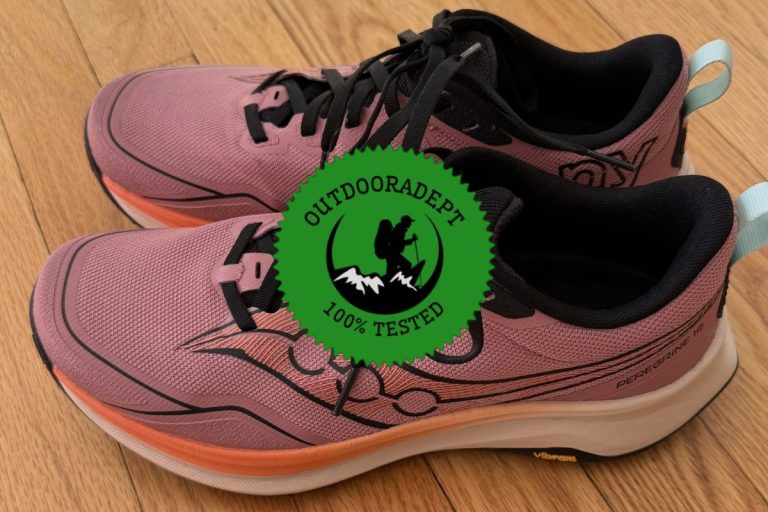
The Altra Timp 6 is built as a trail runner, but I had a hunch it would also do well as a hiking shoe. So I put that to the test over two days in the Netherlands.
The run was a 10 miles16 km loop in Nationaal Park Zuid-Kennemerland, the coastal dune park west of Amsterdam. Sandy singletrack, pine forest, and a few short steep climbs (Strava data here).
The hike came a bit later, down in South Limburg around Vaalserberg and the Heuvelland trails. You get a bit of everything there: grassy climbs, hard-packed farmland dirt, and some rougher limestone patches near the Belgian border.
The lugs are only 3.5 mm deep, but the Vibram Megagrip handled wet grass and loose sand better than I was expecting. The upper drained quickly too, and didn’t stay soggy.
More on how this shoe performed in the full Altra Timp 6 review below.
Quick Verdict – 4.1/5
Altra Timp 6
A versatile cushioned zero-drop trail shoe that handles everything from quick morning runs to longer trail days. Vibram Megagrip outsole, EGO MAX foam, zero drop platform, and a real-world weight of 10.1 oz287 g per shoe (US 9.5), noticeably below Altra’s claim of 11.45 oz.324 g.

Works well for medium-width feet. Probably won’t satisfy very wide feet, and isn’t built for technical scrambling or deep mud. Also doubles as a capable day hiking shoe if that’s part of your rotation.
Highlights
| Feature | Altra Timp 6 |
|---|---|
| Weight | 10.1 oz (287 g) per shoe measured (US 9.5), well below Altra’s claim of 11.45 oz (324.6 g) |
| Water Resistance | Not waterproof; rolled mesh upper drains and dries fast. GTX version available if you need sealed-out protection |
| Traction | Vibram® Megagrip outsole with 0.14 in (3.5 mm) lugs; confident on wet grass, sand, and limestone; limited in heavy clay |
| Comfort | Altra EGO™ MAX midsole; 1.18 in (30 mm) of balanced cushioning; zero-drop shoes; Standard FootShape™ Fit |
| Adjustability | Traditional lacing; heel lock benefits from runner’s loop if you run into slippage on descents |
| Breathability | Rolled mesh upper (85% RPET); open weave moves air well; runs cooler than most shoes in Altra’s trail line |
| Durability | Welded TPU overlays hold up, Megagrip resists abrasion; EGO MAX midsole will soften over a few hundred miles |
| Arch Support | Neutral; removable 0.18 in (4.5 mm) insole accepts aftermarket footbeds or orthotics |
| Toe Protection | TPU toe cap wraps the big toe and extends laterally; handled rock impacts well during testing |
| Release | 2026 |
Thanks, one more step
Check your inbox to confirm your rating. Once confirmed, it counts toward this shoe’s community score.
See how it ranks on the full leaderboard →PROS
CONS
Trail tips, news and giveaways
One email a month: hiking tips, gear news, giveaways, fresh footwear verdicts and more. No spam, unsubscribe anytime.
Things We Tested When We Reviewed Altra Timp 6

Traction
The Timp 5 already used Vibram Megagrip rubber, so the change on the Timp 6 is the tread pattern, not the compound. Lugs are redesigned for better forefoot bite on climbs, and the layout is slightly more aggressive than the Timp 5’s.
Wet grass is one of the trickier surfaces for any trail shoe. The Timp 6 stayed planted on steep grass climbs even after morning dew. Loose sand over hardpack normally has a shallow lug skating around, but these dug in and held position on sandy forest sections.

Wet rock is what Megagrip is built for, and the Timp 6 confirmed that on damp limestone. The lug spacing clears packed dirt well and doesn’t cake up the way flatter patterns sometimes do.
Mud is where the shoe hits its limits. A normal muddy section is fine. Heavy clay or deep peat probably needs more aggressive widely-spaced lugs. If most of your running involves sustained mud, look at something like an Inov-8 Mudtalon instead.
Durability
Early durability looks good. The welded TPU overlays cover the high-wear zones, the mesh shows no fraying at the flex point over the toes, and the overlay edges aren’t lifting. The toe cap wraps the big toe and extends along the lateral side, which held up well after some rock impacts on downhill sections.
Vibram Megagrip rubber resists abrasion better than the MaxTrac compound Altra used on older Timps. For runners putting serious mileage on a single pair, the outsole should hold up well.

The midsole is the weaker link long-term. EGO MAX is a softer foam, and 1.18 in (30 mm) of it is a lot of material to compress over time. The cushioning will gradually flatten across a few hundred miles. You’ll feel the ride getting duller before anything physically breaks. That’s normal for high-stack cushioned trail running shoes, and if you run high volume, you should budget for replacements at standard intervals.
The Timp line has had upper durability issues in the past, particularly on the mesh and toe cap of older versions. The Timp 6 upper feels more robust than the Timp 5’s, and Altra rebuilt the overlay layout to address those weak points. Too early to call long-term durability, but the construction looks like Altra paid attention to the right places.
Comfort
Ten miles16 kilometers on the first run with no blisters and no hot spots. The interior finishing on this shoe is clean. Minimal seams in the zones where trail shoes typically cause irritation, a moderately padded tongue, and no pressure points over the laces.
The EGO MAX cushioning absorbs rock impact on descents without bottoming out, even on longer efforts where fatigue tends to amplify ground feel. The foam reads slightly softer under the heel than the forefoot, which works well for mixed-pace running where you alternate between cruising and pushing tempo.
If you get top-of-foot irritation from lace tension, the Timp 6 distributes pressure better than most trail shoes I have tested. The wide toe box felt a bit unusual at first, especially coming from more tapered shoes, but that changed pretty quickly. After a couple of runs, the extra space started to feel natural, and honestly, hard to give up.
The zero-drop setup is a bigger adjustment. If you’re new to it, I wouldn’t jump straight into a long run or hike. I could feel the difference in my calves and Achilles early on, since there’s less load on the heel and more through the lower leg.
Weight

Altra lists the men’s Timp 6 at 11.45 oz324.6 g for a US size 9. My US 9.5 pair came in at 10.1 oz287 g per shoe on a calibrated kitchen scale, with the insole included.
Normally, you’d expect a larger size to tip the scales a bit more, not less, so a difference of around 1.3 oz37 g feels too big to be a simple variation.
I also checked against another independent measurement that landed almost exactly the same, which makes me think the official number is on the generous side.
Out on the trail, though, the lower weight makes sense. The Timp 6 sits below the Olympus 6 in Altra’s lineup and overlaps slightly with the Lone Peak 9, even though it has more cushioning than both.
Still, it never feels heavy. If anything, it moves with a bit more agility than you’d expect from a shoe with this much stack, and the weight is clearly part of that story.
Waterproofing
The standard Altra Timp 6 isn’t waterproof. The rolled mesh upper is intentionally breathable and will let water in during stream crossings, heavy rain, or wet grass.

After wet grass mornings, the mesh released water quickly, and the foam doesn’t hold moisture the way denser midsole compounds can. I never dealt with sustained wet-foot discomfort during testing. Drying time was fast compared to shoes with heavier builds.
If you need waterproof protection, Altra makes the Timp 6 GTX. It uses a GORE-TEX Invisible Fit membrane, adds a bit of weight, and runs warmer in summer.
Support
The Altra Timp 6 is a neutral trail shoe. No medial post, no guide rails, no pronation correction. Runners who need structured stability for overpronation should look at shoes with dedicated support features.

What the Timp 6 does offer is structural support through geometry. The Standard FootShape sidewalls come up around the foot and create a stable platform on off-camber terrain. The heel cup is stiffer than on most Altra running shoes, which locks the rear of the foot down well.
Zero drop geometry also helps: with heel and forefoot at the same height, the foot sits closer to a neutral position, which reduces the lever effect that amplifies ankle rolls.
At 30 mm of stack, you’re further from the ground than in a lower-profile shoe, and that does make ankle rolls more likely on technical terrain. I wouldn’t pick the Timp 6 for steep, loose scree or scrambling. For that kind of ground, the Altra Superior or Lone Peak sits lower and offers more ground feedback.
Arch support comes from the removable 4.5 mm insole, which pulls out cleanly for aftermarket footbeds or custom orthotics.
Breathability
The rolled mesh upper is built from 85% recycled polyester with an open weave that moves air well across the top of the foot. My feet stayed cooler than they do in shoes with heavier or more densely woven uppers, even on warmer late-spring days.

Altra cut back on midfoot overlays compared to the Timp 5, and the areas that used to be layered with TPU or printed reinforcement are now just mesh. More mesh means more airflow. For summer running and anyone prone to hot feet, the Timp 6 runs cooler than most shoes in Altra’s trail lineup.
The trade-off is that breathable uppers also let cold air in. For winter running or cold, wet conditions, the GTX version or a warmer sock setup probably makes more sense.
Fit and Sizing
The toe box
The FootShape interior makes the toe box feel spacious on first try-on. Plenty of lateral room for the toes to splay. Length is where it gets tighter than expected. In my US 9.5, the toes made contact with the front of the shoe. Not painfully, but unmistakably there.

The shoe reads roomy because of how the volume is distributed across the forefoot, not because it has extra length. If you have long toes, run in thicker socks, or tend to slide forward on steep descents, sizing up a half is probably the safer call.
Standard FootShape is not Original FootShape
Altra makes three fits. Original is the widest, found in the Lone Peak and Olympus. Slim is the narrowest. Standard sits between them, and the Timp 6 uses Standard. Altra’s own product page states that FootShape Fit is not a wide shoe.
My measured forefoot width at the widest external point came out to 4.3 in11 cm on a US 9.5. Enough room for most feet, but not the spacious interior of a Lone Peak. If your foot is genuinely wide, the Timp 6 will likely feel cramped. The Lone Peak comes in a wide version. The Timp 6 doesn’t.
Heel and midfoot
The heel counter is cut low on the lateral side, which may irritate runners whose ankle bone sits forward of the collar. If heel slop becomes an issue with standard lacing, runner’s loop lacing through the top eyelet usually solves it.
How the Altra Timp 6 Compares with Other Products
Altra Timp 6 vs. Altra Lone Peak 9

Most Altra buyers end up choosing between these two. The Lone Peak sits lower at 25 mm, uses the roomier Original FootShape, and is sold in a wide version. You get more ground feel, and on technical terrain, that extra feedback helps you place your foot with precision.
The Timp 6 swaps some of that connection for an extra 0.2 in (5 mm) of foam underfoot, which you’ll notice most on long rocky descents. Downside: the Standard FootShape is meaningfully tighter. Go try both if you can. Same brand, very different shoes on foot.
Altra Timp 6 vs. Altra Olympus 6

The Altra Olympus 6 stacks higher at 33 mm, runs wider through the forefoot, and carries more weight on the scale. It’s an ultra shoe, plain and simple, designed for the kind of day where you’re going to be on your feet for hours.
The Timp 6 gives up some of that padding but feels lighter and livelier underfoot, and after a long day, the weight difference matters.
Rough guide: if most of your trail days stay under 20 miles, save your money and get the Timp. Push past that regularly and the Olympus starts earning its keep.
Altra Timp 6 vs. HOKA Speedgoat 6

Both shoes run Vibram Megagrip, so what separates them is the geometry. The HOKA Speedgoat 6 has a 5 mm drop and a pronounced rocker that nudges you through each step.
The Timp 6 is flat, zero drop, and lets your foot do its own thing. If you’ve been running zero drop for a while, the Speedgoat’s rocker tends to feel pushy. Coming from regular road shoes, the Timp’s flat platform can feel like it’s missing something. Neither shoe is wrong here. It comes down to what your feet are used to.
Where the Altra Timp 6 Performs Best
The sweet spot is non-technical singletrack, packed dirt, and those mixed routes where the ground keeps changing on you. Grass to sand to dirt, nothing that requires scrambling. Megagrip does more than the 3.5 mm lug depth would suggest, especially on wet stuff.
The cushion-to-weight ratio is what keeps the long runs feeling manageable. If you’re the kind of runner who walks or jogs a road stretch to get to the trailhead, that’s fine. The outsole rolls onto pavement cleanly, none of the clunkiness you get from shoes with bigger, chunkier lugs. Works as a day hiking shoe too, if you like one pair that does everything.
Where the Altra Timp 6 Falls Short in Performance
With 30 mm of stack under you, proprioception takes a hit, and placing your foot precisely on roots or rock slabs feels less secure than it would in something lower, like the Superior or Lone Peak. The lugs also clog in heavy clay, so sustained mud sections are a problem.
On the fit side, the Standard FootShape is narrower than what most people expect from Altra, there’s no wide version available, and the toe box runs slightly short on length despite the lateral room. If you have wide feet or long toes, try these on in person before buying.
Do We Recommend It
After testing the Altra Timp 6, I can say this is a strong zero-drop trail running shoe for runners who want cushion and protection without the weight of an Olympus.

The Vibram Megagrip outsole grips well on wet grass, sand, and limestone. The upper handles drainage and breathability well. And the real-world weight comes in noticeably below what Altra publishes.
The main caveat is the Standard FootShape fit, which is narrower than most runners assume when they hear Altra. If you need a wide last, the Lone Peak is probably a better choice.
If you have a medium-width foot and want a cushioned zero-drop trail shoe for everything from daily training runs to longer trail efforts, the Timp 6 earns the $165.
Where to Buy It?
| WHERE TO BUY? | MEN | WOMEN |
| Amazon | See Pricing» | See Pricing» |
| Backcountry | See Pricing» | See Pricing» |
| REI | See Pricing» | See Pricing» |
| Altra | See Pricing» | See Pricing» |
Frequently Asked Questions
Yes, for most runners. My US 9.5 fit with toes just touching the front, so runners with long toes or between sizes should consider sizing up a half.
Yes. The cushioning, Vibram Megagrip outsole, and GaiterTrap make it a capable day hiking shoe. Many trail runners double their Timps as hiking shoes, and the zero-drop platform makes it comfortable for all-day walking.
That’s the GaiterTrap™ system. It’s a hook-and-loop tab built into the heel that lets you attach strapless trail gaiters directly to the shoe. Helpful for keeping rocks, sand, mud, and snow out on longer trail runs or hikes.


Prices in this article are approximate and updated annually. Check the retailer for current rates.