


I’ve hiked mountain ranges all over the world, but the Canadian Rockies are a different beast. Spanning Alberta and British Columbia, it’s not just about the postcard-perfect, glacier-fed lakes of Banff and Jasper. It’s about jagged limestone peaks, completely unpredictable alpine weather, and real, raw wilderness.
You hear people say the Rockies are breathtaking. Yeah, they’re right. But they’ll also chew you up if you don’t respect them. This isn’t your local state park. You need to show up prepared.
This guide breaks down what I learned out there: the logistics, the trails you shouldn’t miss, the gear that actually matters, and the practical stuff everyone needs to know before hitting the trailhead.
Rockies Hiking Quick Stats
| Category | Details |
|---|---|
| Main Hubs | Banff National Park, Jasper National Park, Canmore, Lake Louise |
| Prime Season | Late June to early September |
| Hazards | Rapid weather shifts, grizzly bears, scree slopes |
| Requirements | Parks Canada Pass (for National Parks) Priced at CAD $83.50 for a single adult* |
| Navigation | Offline maps essential (zero cell service on most trails) |
*Admission is free to places operated by Parks Canada between June 19 and September 7, 2026.
Understanding the Region and Logistics
Before you even step foot on a trail, you need to sort out your logistics. The Canadian Rockies are massive, and the driving distances between parks (like taking the Icefields Parkway between Banff and Jasper) are long.
You need a Parks Canada Discovery Pass if you’re stopping anywhere in the national parks. If you’re venturing into Kananaskis Country (which has some of the best scrambling), you need a separate Kananaskis Conservation Pass. Buy these online before you arrive to skip the massive booth lines.
Pro Tip: Cell service completely drops off once you leave the main townsites. Download all your trail maps on maps.me for offline use before you leave your hotel Wi-Fi.
Top Trails in the Canadian Rockies
There are literally thousands of miles of trails out here, ranging from paved tourist walks to Class 4 scrambles. Here is a selection of trails to give you a taste of what the region offers.
| Trail Name | Location | Distance | Elevation Gain | Difficulty |
|---|---|---|---|---|
| Plain of Six Glaciers and Lake | Banff National Park | 9 miles14.6 km | 1,929 feet588 meters | Moderate |
| Ha Ling Peak | Canmore | 4.5 miles7.2 km | 2,450 feet746 meters | Hard |
| Sentinel Pass | Banff National Park | 6.8 miles10.9 km | 2,388 feet728 meters | Hard |
| Tent Ridge Horseshoe Trail | Kananaskis | 6.2 miles10 km | 2,624 feet800 meters | Hard (Scrambling) |
| Cory Pass Loop | Banff National Park | 8.1 miles13 km | 3,300 feet1,000 meters | Very Hard |
| Iceline Trail | Yoho National Park | 10.7 miles17.2 km | 2,330 feet710 meters | Hard |
| Skyline Hiking Trail | Jasper National Park | 27.3 miles44 km | 4,527 feet1,380 meters | Hard (Multi-day) |
- Plain of Six Glaciers: A perfect intro to the Rockies. You start at the insanely crowded Lake Louise, but the crowds thin out quickly. You’re rewarded with massive glacier views and a rustic teahouse near the top.
- Ha Ling Peak: If you’re staying in Canmore, this is the classic “stairmaster” hike. It’s aggressively steep and heavily trafficked, but the sheer drop-off at the summit looking down into the Bow Valley is legendary.
- Sentinel Pass via Larch Valley: The quintessential autumn hike. If you time this right in late September, the larch trees turn a brilliant gold. The final push up the switchbacks to the pass is a lung-burner.
- Tent Ridge Horseshoe: This is where things get real. It’s an exposed ridgeline traverse with hands-on rock scrambling. Not for anyone afraid of heights, but the panoramic views of the Spray Lakes are unmatched.
- Cory Pass: This one is just plain mean. It’s an unrelenting, brutal climb straight up the side of Mount Edith. It filters out casual hikers within the first mile. If you want a gritty, physical challenge away from the crowds, this is it.
- Iceline Trail: Starting near the Takakkaw Falls Parking Lot. Klik om het zijvenster te openen voor meer informatie, this trail does exactly what the name implies: it runs you right along the edge of massive glaciers. The stark, rocky, ice-carved landscape feels like another planet.
- Skyline Trail: The crown jewel of Jasper backpacking. You spend more than half of this multi-day trek above the treeline. You have to book backcountry campsites months in advance, and the weather up there is notorious.
The Reality of Mountain Weather
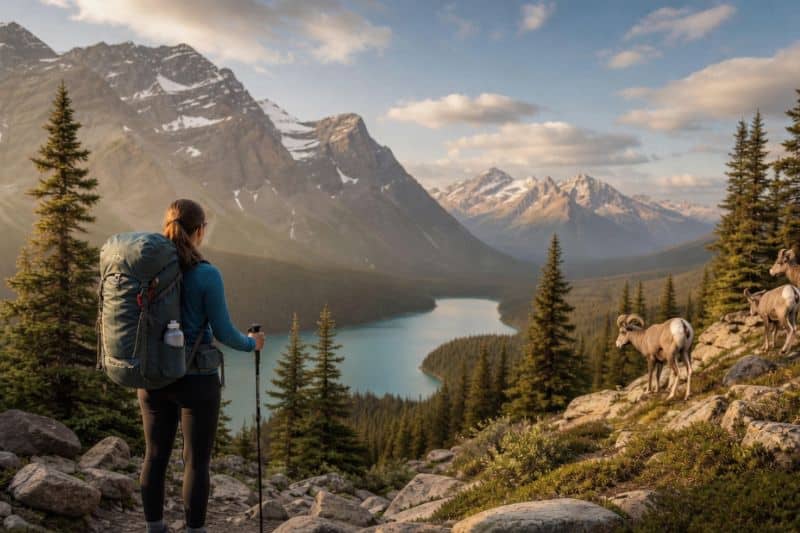
Mountain weather doesn’t care about your forecast. You can start walking in a t-shirt and end up in a blizzard three hours later—even in mid-July.
The temperature swings are brutal. The sun will bake you on the exposed scree slopes, but the moment a cloud rolls in over the glacier, the temperature plummets. Always pack a waterproof hard shell and an insulating mid-layer. If you show up in cotton and a light hoodie, you’re going to have a bad time.
Getting to the Trailhead
You need a trail-capable vehicle. The Trans-Canada Highway is smooth sailing, but the best trailheads in the Rockies are often at the end of rugged, unpaved logging roads (like the road out to the Bugaboos or deep into K-Country).
High clearance is non-negotiable for clearing rocks and deep washouts, and a 4×4 is a lifesaver if mountain weather suddenly turns a dusty road to thick mud. If your current daily driver isn’t up to the task, it might be worth browsing Stampede Auto in Calgary for a used truck or AWD SUV before your hiking season begins.
After a weekend of gravel roads, mud, dust, and gear-packed adventures, your vehicle will probably need some attention too. A professional detailing service can help restore your paint, clean out stubborn interior dirt, and protect your vehicle from the wear that comes with frequent mountain trips. Calgary Car Detail is a solid option in Calgary for giving your vehicle a thorough post-adventure refresh.
Wildlife: You’re in Their House Now
Let’s talk about bears. The Rockies are prime habitat for both black bears and grizzlies. Seeing one from the highway is cool; surprising one on a tight trail is terrifying and dangerous.
- Bear Spray is Mandatory: Don’t just pack it in your bag. Keep it on a chest or hip holster where you can draw it in seconds. Know how to take the safety off.
- Make Noise: “Hey bear!” Call out frequently, especially near blind corners or rushing water where they can’t hear you coming.
- Keep Your Distance: Elk and moose are just as dangerous as bears during rutting and calving seasons. Give them a wide berth.
- Don’t Run: Fleeing from a bear would make them think you are prey and this will trigger their hunting instincts.
Watch a bear handling tutorial before you head out:
Essential Gear
The limestone terrain out here is sharp and unforgiving. Leave the soft, barefoot-style trail runners at home unless you want bruised arches.
You need footwear with stiff rock plates and aggressive lugs. I rely on sturdy approach shoes or mid-height boots for the scree descents. Trekking poles will save your knees on the steep, loose downhills—trust me on this. Finally, carry a real first aid kit, an emergency bivy, and a minimum of 1 gallon3.8 liters of water capacity for full-day pushes.
The Bottom Line
Hiking the Canadian Rockies is legitimately tough, but the payoff is massive. There’s nothing quite like standing on a jagged peak looking out at a sea of glaciated mountains. Come prepared, know your physical limits, and respect the wilderness. If you do it right, these trails will stick with you for the rest of your life.
FAQ
The Canadian Rockies form a massive, jagged spine along the border of Alberta and British Columbia in western Canada. If you’re flying in, Calgary, Alberta is your primary gateway for Banff and Canmore, while Edmonton, Alberta is the closest major hub for Jasper.
I’ll be blunt: yes. Banff and Jasper are world-class tourist destinations, and they have the price tags to match. During the peak summer season (July and August), even basic hotels and rental cabins will drain your wallet, and a simple burger and beer in the main townsites isn’t cheap. You also have to factor in the mandatory Parks Canada passes and potentially bear spray rentals.
Technically, yes. Realistically? You’re going to be out of the water almost as fast as you get in. The iconic turquoise waters of places like Lake Louise, Moraine Lake, and Peyto Lake are glacier-fed.
Even in the dead of August, that water hovers just a few degrees above freezing. It’s an instant, breathless shock to the system. If you want a quick “polar plunge” to ice your screaming joints after a grueling hike, go for it—but know the risks of hypothermia.
If you actually want to soak and relax, skip the glacier lakes and hit the Banff Upper Hot Springs instead.


