
Crampons saved my ankles on a February traverse of Moldoveanu Peak in my home country. The ridge had frozen overnight into bulletproof ice, and my microspikes kept skating sideways with every step. Switched to steel points mid-route, finished the climb without another slip.
That was winter number three of what became an eight-year testing obsession: 23 crampon models across the Tatras, Făgăraș, and Julian Alps.
Took me years to understand there’s no universal crampon. Aggressive steel that grips glacier ice feels like overkill on frozen forest paths, and half the bindings out there won’t fit flexible hiking boots anyway. After rotating through the rest, these eight emerged as the best crampons I’ve tested.
Over an eight-year period, we tested 23 crampon models across the Tatras, Făgăraș, and Julian Alps to find the top 8 crampons for mountain climbing. Trials covered diverse terrains—from bulletproof glacier ice and steep gullies to rocky mixed routes and slushy spring snow—to assess traction, anti-balling performance, and material durability. We rigorously evaluated binding compatibility across both flexible hiking footwear and rigid mountaineering boots, rating each crampon on point geometry, security, weight, and ease of adjustment with cold fingers. Long-term field reliability and overall value were considered to shape our final recommendations.
Learn More »
The Verdict – Our Nr. 1 Choice
I felt confident wearing these on various hikes and felt like my ankle area always remained fully supported, especially when it came to their excellent traction.
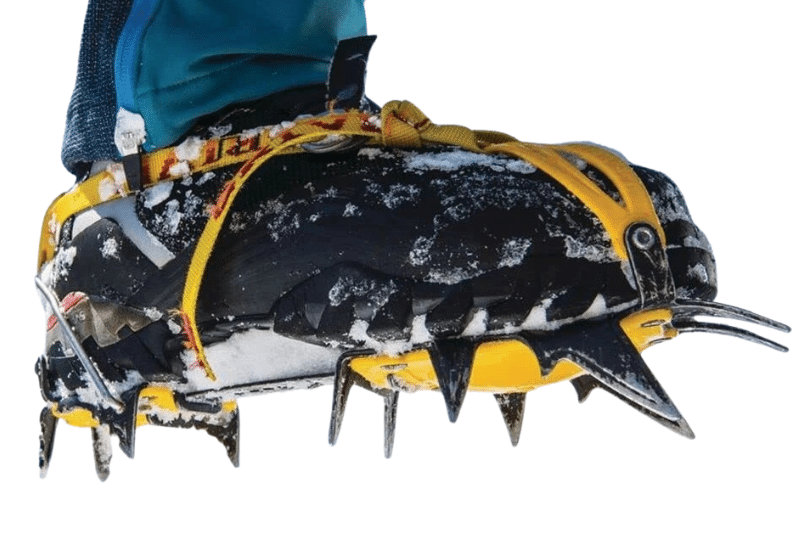
Every crampon on this list earned its spot through actual fieldwork, and you won’t go wrong with any of them for their intended purpose. But my personal favorite remains the Grivel G12 Evo. I’ve put five winters on the same pair across terrain ranging from Făgăraș glacier approaches to technical mixed gullies in the High Tatras.
The Antibott system handles wet spring snow without balling up, which sounds minor until you’ve kicked clumps off your boots every thirty seconds on a long climb. Steel holds an edge through rocky sections that would chew up aluminum. And unlike crampons that only work with specific boot types, the multiple binding options mean these adapt to whatever footwear the objective demands. Overkill for casual winter hiking, but for everything else, they’ve become my default.
Our Top Recommended Crampons
1) Grivel G12 Evo – Best Overall
There’s a reason guides across three continents keep reaching for the G12 Evo. I’ve dragged mine through everything from ridge traverses to frozen couloirs in the High Tatras, and the thing just refuses to quit.
Twelve chromoly steel points arranged in an 8-front, 4-rear configuration. The forward-angled secondary points actually bite into hard neve when you’re French technique-ing up 50-degree slopes (something cheaper crampons struggle with).
At 35.5 oz,1006 g, you’ll notice them in your pack. But that weight comes from robust construction that’s survived years of abuse without the front points going soft.
The Proactive Antibott system genuinely works. Climbing through spring slush in the Julian Alps, I watched others shake snow clumps off their boots every twenty steps while mine stayed clean.
The binding options (New-Matic, Cramp-O-Matic, New-Classic EVO) mean you can match most boots from US 4-13 (EU 36-47). Tool-free adjustment.
For technical terrain up to grade V, these deliver. The secondary points grab on icy rock where lesser crampons skitter.
Key Specs:
- Class: C2 (C3 with Cramp-O-Matic binding)
- Points: 12-point steel
- Weight: 35.5 oz1006 g
- Binding options: New-Matic, Cramp-O-Matic, New-Classic EVO
PROS
CONS
2) Kahtoola K-10 Hiking Crampons – Best for Hiking: 4.8/5
Traction that bridges the gap. The K10s offer mountaineering-level grip on steep, icy trails without giving up the comfort of your flexible hiking boots or trail runners.
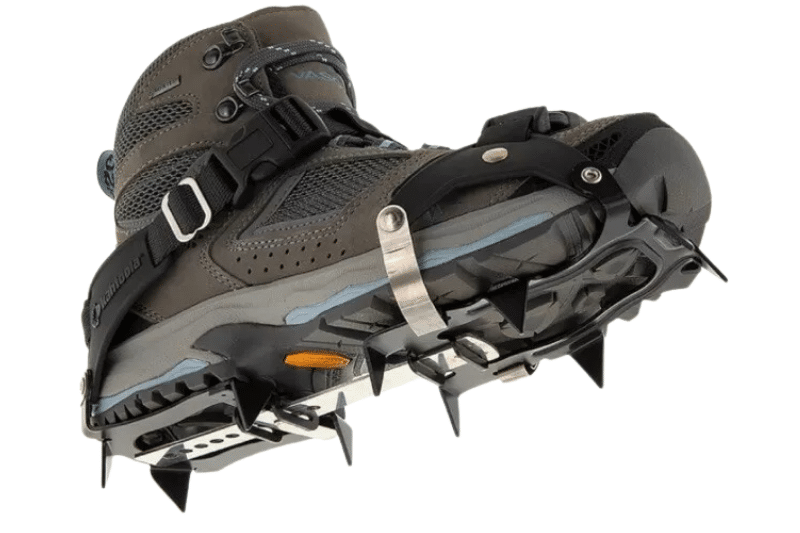
Microspikes fail around 25 degrees, while full mountaineering crampons feel ridiculous on forest trails. Well, the K-10 lives in that gap.
Ten chromoly steel spikes (six forefoot, four heel) at ¾-inch length.1.9 cm length. Aggressive enough to punch through refrozen crust that would have microspikes skating. The leaf spring design flexes with soft-soled hiking boots, even trail runners.
I’ve taken these on Class III scrambles across iced-over granite slabs in the Western Tatras, where traditional crampons would’ve been unnecessary weight but microspikes would’ve killed me.
21.5 oz for the pair.610 g for the pair. Reasonable considering what they do. The chromoly holds an edge through a full winter season without resharpening, and the anti-balling skins prevent snow buildup in wet conditions. Those skins are removable for dry terrain, though swapping them trailside with cold fingers gets fiddly.
The strap-on system takes practice. Spent a frustrating fifteen minutes during my first outing finding the right hole position. But once dialed, they stay put through descents steep enough to make your knees complain.
Key Specs:
- Class: C1
- Points: 10 chromoly spikes
- Weight: 21.5 oz610 g
- Binding options: Leaf spring strap-on
PROS
CONS
3) Black Diamond Contact Strap – Best for Beginners: 4.7/5
Your first mountaineering crampons shouldn’t require a technical boot or a YouTube tutorial on bindings. The Contact Strap nails the entry-level brief.
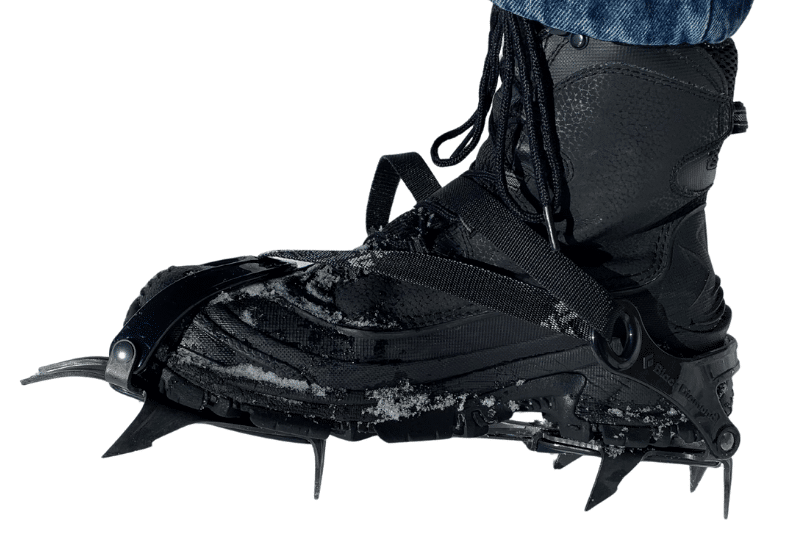
Ten stainless steel points with a rubber toe loop, plastic heel cup, and strap system that fits boots without heel welts. If you own three-season backpacking boots you want to use for winter objectives, these accommodate that flexibility.
28.5 oz808 g sits in reasonable territory. The dual-density ABS anti-balling plates come standard, saving you what some brands charge as an add-on. Tested these across multiple Eastern European summits. Never a failure. Snow doesn’t ball up underneath even in wet conditions.
The buckles run small, hard to manipulate with insulated gloves on a cold belay. That’s my main gripe. The strap system can also freeze in seriously cold temps, so I’d hesitate below 5°F.-15°C.
But for mixed terrain where you’re crossing between snow, rock, and ice? Solid performer that won’t punish mistakes.
Key Specs:
- Class: C1
- Points: 10-point stainless steel
- Weight: 28.5 oz808 g
- Binding options: Strap-on
PROS
CONS
4) Black Diamond Sabertooth Clip – Best for Mountaineering 4.6/5
When your objective includes rock scrambling, glacier travel, and a steep ice gully all in one push, crampon choice gets complicated. The Sabertooth Clip handles that complexity.

Twelve stainless steel points with horizontal frontpoints for variable snow and aggressive secondary points for bulletproof ice. This dual geometry means you’re not swapping crampons mid-route when conditions change. The same setup that climbed the neve approach works on the iced-up exit gully.
The semi-automatic binding uses a flexible toe strap that works with boots lacking toe welts, clipping into the heel welt for secure attachment. The moderate rocker and micro-adjust heel deliver a secure fit across virtually any mountaineering boot with a heel groove.
Dual-density ABS plates front and rear prevent snow balling in wet conditions, something cheaper crampons skip. At 32 oz,907 g, it is light enough for long alpine approaches without feeling flimsy on technical sections.
This sits at the pricier end of all-around crampons. Worth it for Denali, Alpine faces, or terrain diversity that demands zero compromises. Less justified for pure glacier plods where simpler options suffice.
Key Specs:
- Class: C2
- Points: 12-point stainless steel
- Weight: 32 oz910 g
- Binding options: Clip (semi-automatic)
PROS
CONS
5) Blue Ice Harfang – Best for Ski Boots: 4.5/5
At just 13.3 oz,377 g, this hybrid chromoly and aluminum 12-pointer folds down smaller than anything else in your pack. Giving you reliable traction exactly when you need it, and completely disappearing when you don’t.

Every gram matters when you’re skinning uphill for three hours to ski one couloir. The Harfang weighs 13.3 oz377 g without anti-balling plates, nearly 21 oz595 g lighter than a traditional 12-pointer.
The weight savings come from hybrid construction: chromoly steel front and secondary points where durability is important, aluminum rear components where it isn’t, and a UHMWPE textile strap replacing the rigid center bar.
That strap felt strange at first. Climbers expect metal. But the textile works on snow better than expected. Warm, wet spring conditions in the Julian Alps produced zero balling issues during testing.
Automatic wire bail binding pairs with ski touring boots. For alpine ski mountaineering, where crampons deploy for the summit push, then disappear for the descent, this compactness transforms your pack organization.
Two heel braking points instead of four. Fine for moderate mixed terrain, limiting for steeper objectives. The aluminum wears faster on rock (scratches accumulate quickly). And that UHMWPE strap needs break-in; initial use shows settling that stabilizes after a few outings.
Key Specs:
- Class: C2
- Points: 12-point hybrid (chromoly + aluminum)
- Weight: 13.3 oz377 g without ABS
- Binding options: Automatic wire bail binding
PROS
CONS
6) Petzl Vasak LLU – Best for Mixed Terrain: 4.4/5
Why buy multiple pairs of crampons when one system does it all? The Petzl Vasak lets you swap out front sections, linking bars, and bindings to perfectly match your objective.

I was skeptical about paying extra for modular crampons. Then I swapped front sections between an ice gully and a glacier approach without buying a second pair. Five years later, same base unit, different configurations depending on the objective.
The ALPEN ADAPT system lets you disassemble nearly everything: front sections, linking bars, anti-snow plates, bindings. Aggressive points for Saturday’s mixed route, standard horizontals for Sunday’s crevasse field. When my fronts wore down after three seasons of rocky Tatra traverses, I replaced just that section for a fraction of a new-crampon cost.
Twelve steel points with long fronts that handle steep terrain without the calf burn from undersized gear. The bi-position linking bar spans US 4-15 (EU 36-50), widest range I’ve tested. Leverlock Universal binding adjusts with gloved hands, even in cold conditions.
29.7-31.6 oz,842-895 g, depending on configuration, sits heavier, and the narrow webbing frustrates numb fingers. All those interchangeable parts mean decisions. You’ll spend time matching components to objectives. But for climbers working diverse terrain across seasons, the upfront investment eventually pays back.
Key Specs:
- Class: C2 (convertible to C3 with automatic binding)
- Points: 12-point steel
- Weight: 29.7-31.6 oz842-895 g
- Binding options: Leverlock Universal binding
PROS
CONS
7) CAMP Stalker Universal – Best Value: 4.3/5
Not as polished as the Grivel or as versatile as the Vasak, but solid and dependable for climbers watching their gear budget.

A proper 12-point crampon at entry-level pricing that fits any boot you own? Sometimes the math just works.
Chromoly steel across twelve points delivers traction that 10-point competitors can’t match on hard ice. And the angled rear points at 45 degrees help less experienced climbers brake on descents without the technique that steeper designs demand.
I’ve lent these to friends tackling their first winter peaks in the Tatras, and they came back converts. The universal strap-on binding accepts everything from flexible hiking boots to rigid mountaineering footwear, so there are no welt requirements and no compatibility surprises at the trailhead.
At 33.4 oz,947 g, you’ll feel them in your pack (second-heaviest option I tested). But that weight buys robust construction that survives the abuse newer climbers tend to inflict: rock scraping, sloppy storage, occasional drops onto granite.
Key Specs:
- Class: C1
- Points: 12-point chromoly (NiCrMo)
- Weight: 33.4 oz948 g
- Binding options: Universal strap-on
PROS
CONS
8) Hillsound Trail Crampon Ultra – Best for Trail Runners: 4.2/5
Winter trail running lives in a gear gap. Microspikes slip on steeper descents. Real crampons feel absurd under running shoes. The Trail Crampon Ultra threads that needle.

Eighteen stainless steel spikes at varying heights: longer at heel, shorter up front. That asymmetry clicked on iced-over switchbacks in the Bucegi Mountains. Extended heel points dig during braking, while shorter fronts don’t catch mid-stride. Held pace through terrain that would’ve forced walking in anything else.
14.9 oz for the pair.422 g for the pair. Chain-link construction lets spikes float independently rather than transmitting every rock through a rigid frame. Works with trail runners, stays stable on hiking boots, and even functions on stiffer footwear.
The elastomer harness and velcro need zero instruction. Pull on, wrap, go. Complete beginners figure them out in under a minute.
The trade-off shows when conditions change: wooden boardwalks catch the aggressive spikes, dry trail stretches feel clunky, and velcro ices up in slushy snow, making removal annoying. Pure winter tools for pure winter conditions.
Key Specs:
- Class: C1 (traction device)
- Points: 18 stainless steel spikes (420J2)
- Weight: 14.9 oz422 g
- Binding options: Elastomer + velcro
PROS
CONS
What Is a Crampon?
Crampons are traction frames, typically steel or aluminum, that attach to mountaineering or hiking boots via straps, clips, or step-in bindings. Most models feature 10 to 12 downward-facing points arranged to bite into hard snow, neve, and ice when you plant your foot.
Crampons vs Microspikes

Crampons and microspikes overlap on easy terrain but serve different purposes. Microspikes use shorter spikes, typically 0.25 to 0.5 inches,6 to 13 mm, mounted on flexible chain or elastomer harnesses. They work on icy trails and packed paths at angles under 25-30 degrees, weigh 8-12 oz,227-340 g, and fit any footwear.
Crampons have 1-2 inch spikes2.5-5 cm spikes on rigid or semi-rigid metal frames. They handle steep snow, glaciers, and ice up to vertical, weigh 14-35 oz,397-992 g, and require specific boot compatibility depending on binding type.
Maybe you’ve seen hikers in microspikes struggle on frozen traverses. Crampons would have made movement almost casual there. Truth is, only crampons belong on steep snow and glaciated mountains.
Types of Crampons
The C1, C2, C3 is a European grading system that describes crampon flexibility, not quality. Understanding these categories, and how they match boot stiffness prevents the most common buying mistakes.
C-Rating Overview
| Rating | Frame Flexibility | Typical Points | Binding Type | Boot Pairing |
|---|---|---|---|---|
| C1 | Flexible | 10 | Strap-on | B0/B1 hiking boots |
| C2 | Semi-rigid | 12 | Semi-automatic | B2/B3 mountaineering boots |
| C3 | Fully rigid | 12-14 | Automatic | B3 technical boots only |
These ratings exist because crampon stiffness must match boot stiffness. Pairing rigid crampons with flexible boots creates dangerous instability, as the frame can lever off under load.
C1 Crampons – Flexible Walking Designs
Strap-on bindings, flexible frames, typically 10 points. The frame bends as you walk, matching softer boots. I reach for C1 crampons on winter hill walks and moderate snow peaks where the objective involves more walking than climbing.
They accommodate B1 hiking boots that would never work with semi-automatic bindings. Lighter than stiffer alternatives, easier to fit, and adequate for slopes under 40 degrees on consolidated snow. The limitations show on steep or hard ice. Flexible frames lack precision for sustained front-pointing, and strap bindings can shift under torque.
C2 Crampons – The Mountaineering Standard
Semi-rigid frames, 12 points, semi-automatic bindings. The category most mountaineers end up using.
The design balances walking comfort against technical capability. Enough stiffness for front-pointing on 50-degree ice, enough flex to walk without feeling bolted to a plank.
I’ve used C2 crampons across the Fagaras, Julian Alps, and High Tatras without feeling under-equipped on any typical mountaineering objective.
C3 Crampons – Rigid Technical Tools
Fully rigid frames, 12 to 14 points, automatic bindings. Purpose-built for steep ice and mixed mountain climbing, where precision outweighs comfort.
The rigid connection between boot and crampon eliminates flex-related energy loss during front-pointing. On vertical ice, that efficiency adds up: less calf fatigue, more secure placements, better control.
These pair exclusively with B3 boots. Attempting to fit C3 crampons on flexible footwear creates instability that could end badly on technical terrain.
How to Choose Crampons

Crampon selection starts with a question most buyers skip: what terrain will you actually encounter? The answer determines everything else: materials, binding type, point count, weight tolerance.
Best Crampons for Winter Hiking
Frozen forest trails, moderate snow slopes, and icy approaches rarely demand aggressive steel. Lighter 10-point models or hiking crampons with flexible frames handle this terrain without the weight penalty of mountaineering gear.
These work with B1 hiking boots that lack stiffness for technical bindings. I use this setup for early-season Tatra hikes where conditions vary between packed snow and bare rock.
The Kahtoola K-10 handles steeper and harder terrain than microspikes while remaining compatible with flexible footwear. If you’re strictly trail running, the Hillsound Trail Crampon Ultra weighs less and attaches faster, though its shorter spikes and chain-link design won’t handle sustained steep slopes as securely.
Best Crampons for Mountaineering
This is where most climbers end up. Classic alpinism terrain: big snow peaks, glacier crossings, Alpine routes that throw rock and ice and neve at you on the same day. You want 10-12 steel points, bindings that match your boots (semi-automatic if you’ve got heel welts, strap-on if you don’t), and construction that survives mixed terrain without babying.
The Grivel G12 Evo does all of it. Glacier approaches, moderate ice, rocky traverses – I stopped swapping crampons for different objectives once I started using these. The Black Diamond Sabertooth gets you similar versatility in stainless if you’d rather skip the drying ritual after wet climbs, though you’ll pay a bit more.
Best Crampons for Ice Climbing

ascending a frozen waterfall
Different game. Steep couloirs, frozen waterfalls, routes where you’re dry-tooling between ice patches. Flexible frames and hiking bindings won’t cut it here. You need fully rigid construction, aggressive front points, and automatic bindings locked onto stiff B3 boots.
The Petzl Vasak LLU costs more upfront, but the modularity pays off over seasons. The G12 Evo handles technical terrain too – I’ve taken mine up plenty of steep gullies – but you’re committing to one configuration.
Best Crampons for Ski Touring
Ski mountaineering demands weight savings above all else. The Blue Ice Harfang at 13.3 oz377 g weighs nearly 21 oz595 g less than traditional 12-pointers, a difference you’ll feel after hours of skinning. The tradeoff: aluminum rear components wear faster, and only two heel braking points limit steep descent capability.
Crampon Materials: Steel vs Aluminum
Material choice comes down to where you’ll actually use the crampons. Rock contact destroys aluminum quickly, while steel adds weight you’ll feel on long approaches.
Chromoly Steel
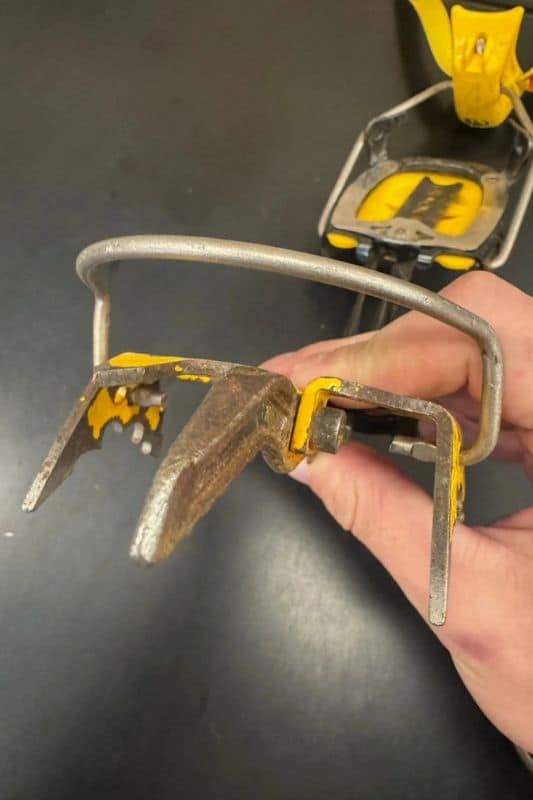
Chromoly steel remains the default for durability, handling repeated rock contact, mixed terrain, and seasons of hard use without the front points folding over. The weight penalty runs 2-4 oz heavier57-113 g heavier than aluminum alternatives, and you’ll need to dry them between trips to prevent surface rust.
One consideration worth noting: engineering studies on steel behavior at low temperatures

The G12 Evo, K-10, and CAMP Stalker all use chromoly construction.
Stainless Steel
It offers similar strength with better corrosion resistance, and no drying ritual is required. Slightly more expensive but worth it in wet climates or for climbers who prefer minimal maintenance. The Sabertooth, Contact Strap, and Trail Crampon Ultra use stainless construction.
Aluminum
Aluminum saves significant weight. My ski touring setup sheds nearly a pound using aluminum components. The tradeoff shows after rocky approaches: points dull and deform faster than steel. Expect 2-3 seasons on rocky terrain before aluminum points need attention, versus 5+ for steel equivalents. For snow-dominant objectives with minimal rock, aluminum works. For mixed terrain, steel lasts longer.
Hybrid Construction
This design splits the difference with steel front points where durability matters and aluminum heels where it doesn’t. The Blue Ice Harfang uses this approach: chromoly where you need bite, aluminum where you need weight savings.
Crampon Binding Types Explained
Your boots dictate binding choice, not preference.
| Binding Type | Heel Welt Required | Toe Welt Required | Best For |
|---|---|---|---|
| Strap-on | No | No | Flexible boots, universal compatibility |
| Semi-automatic | Yes | No | Most mountaineering boots |
| Automatic | Yes | Yes | Technical B3 boots only |
Strap-on bindings work with almost any boot, including flexible hiking footwear without welts. Plastic or nylon cradles wrap the toe and heel, secured by webbing straps. These take the longest to fit and lack the precision of lever systems, but they’re the only option for B0/B1 boots.
I keep a strap-on pair for friends borrowing gear with random footwear. The K-10, Contact Strap, and CAMP Stalker all use strap-on systems with varying levels of refinement.
Semi-automatic bindings require a heel welt on the boot (that raised ledge at the back of mountaineering footwear). A wire bail clips into the welt while a strap secures the toe. Faster than full strap-on, more secure, and compatible with most B2/B3 boots.
This covers the majority of mountaineering applications. The G12 Evo offers semi-automatic as one of its binding options; the Vasak uses the Leverlock Universal system.
Automatic bindings need both heel and toe welts. Metal bails click into both ends of the boot for maximum precision and fastest attachment. Required pairing for rigid B3 boots on technical terrain. Uncomfortable on flat ground and completely incompatible with flexible footwear. The Sabertooth and Harfang use automatic clip bindings.
How Many Crampon Points Do You Need?
Ten-point crampons favor walking and moderate slopes. Lighter at 14-24 oz,397-680 g, less aggressive, adequate for most hiking objectives. The K-10, Contact Strap, and Trail Crampon Ultra fall here.
Twelve-point designs in the 24-35 oz range680-992 g range add front-point capability for steeper terrain and harder ice. The G12 Evo, Harfang, Vasak, and CAMP Stalker all provide 12 points.
Beyond 12 points, you’re into specialized ice climbing tools that feel awkward on approaches.
Crampon Weight: How Much Does It Matter?
You’ll notice weight more on long approaches than during summit pushes. An ultralight hybrid at 13 oz369 g feels noticeably different in your pack than a 35-oz992-g steel workhorse after 10 miles.16 km. But lighter frames tolerate less abuse, thinner designs fail sooner under repeated stress.
| Weight Class | Range | Trade-off |
|---|---|---|
| Ultralight | 13-15 oz369-425 grams | Maximum weight savings, faster wear, limited durability |
| Light | 15-22 oz425-624 grams | Good for hiking crampons, reasonable durability |
| Standard | 28-32 oz794-907 grams | Full-featured mountaineering, good durability |
| Heavy | 33-36 oz936-1021 grams | Maximum durability, robust construction |
Do You Need Anti-Balling Plates?
Anti-balling plates prevent snow from compacting underfoot. Rubber or plastic membranes flex with each step, shedding accumulated snow. I won’t use crampons without functional anti-balling systems after a sketchy March descent where snow buildup nearly sent me off a ridge.
In dry, cold conditions, you can sometimes get away without them. In wet spring snow, warm temperatures, or anything approaching slush, don’t risk it. Worth the slight weight penalty in any conditions involving wet snow.
All models in this roundup include anti-balling except the Trail Crampon Ultra, whose chain-link design naturally sheds snow without plates.
How Much Should You Spend on Crampons?

A well-chosen crampon lasts many seasons, making even premium models reasonable investments over time.
$70-130: Basic 10-point hiking crampons with strap-on bindings. Adequate for occasional winter trails and entry-level use, though materials and durability won’t match pricier options.
$140-210: Robust steel or hybrid crampons with semi-automatic bindings and anti-balling plates included. This represents the best value for most users tackling general mountaineering and glacier travel.
$250+: Premium models targeting technical ice climbing and professional guiding. Modular front points, automatic bindings, and expedition-grade materials. Unnecessary for recreational mountaineers but appropriate for steep ice specialists.
Comparison Table
| Product | Price | Material | Number of Spikes | Bindings | Best For |
|---|---|---|---|---|---|
| Grivel G12 Evo | Check on Amazon» $220 on Backcountry» $220 on REI» | Chromoly steel | 12 | New-Matic, Cramp-O-Matic, New-Classic EVO | All uses |
| Kahtoola K-10 Hiking Crampons | Check on Amazon» $120 on REI» | Chromoly steel | 10 | Leaf spring strap-on | Hiking |
| Black Diamond Contact Strap | Check on Amazon» $190 on Backcountry» $190 on REI» | Stainless steel | 10 | Strap-on | Beginners |
| Black Diamond Sabertooth Clip | Check on Amazon» $230 on Backcountry» $220 on REI» | Stainless steel | 12 | Clip (semi-automatic) | Mountaineering |
| Blue Ice Harfang | Check on Amazon» $210 on Backcountry» $210 on REI» | Hybrid (chromoly + aluminum) | 12 | Automatic wire bail binding | Ski Boots |
| Petzl Vasak LLU | Check on Amazon» $210 on Backcountry» $210 on REI» | Steel | 12 | Leverlock Universal binding | Mixed Terrain |
| CAMP Stalker Universal | Check on Amazon» $160 on Backcountry» $160 on REI» | Chromoly steel (NiCrMo) | 12 | Universal strap-on | Value |
| Hillsound Trail Crampon Ultra | Check on Amazon» $90 on REI» | Stainless steel (420J2) | 18 | Elastomer + velcro | Trail Runners |
How to Size and Fit Crampons
Proper adjustment prevents most field problems. Work through this at home, not on the mountain.
Step 1: Set the Length Bar
Most crampons use a threaded bar or hole-position system connecting front and rear sections. Adjust until the heel and toe pieces contact your boot snugly without large gaps at either end. Too long and the crampon shifts; too short and it won’t engage properly.
Step 2: Adjust Bail Tension
For semi-automatic and automatic bindings, set the heel bail tension. The lever should close with noticeable resistance, firm enough to stay locked, not so tight you’re forcing it. If the lever closes loosely or pops off when you flex your foot, the bail needs tightening.
Step 3: Practice with Gloves
Cold fingers complicate everything. Practice removal and re-fitting with the gloves you’ll actually wear. Familiarity at home translates to confidence on the mountain.
Tip: Very large boots may need extended center bars, available as accessories from most manufacturers.
How to Care for Crampons
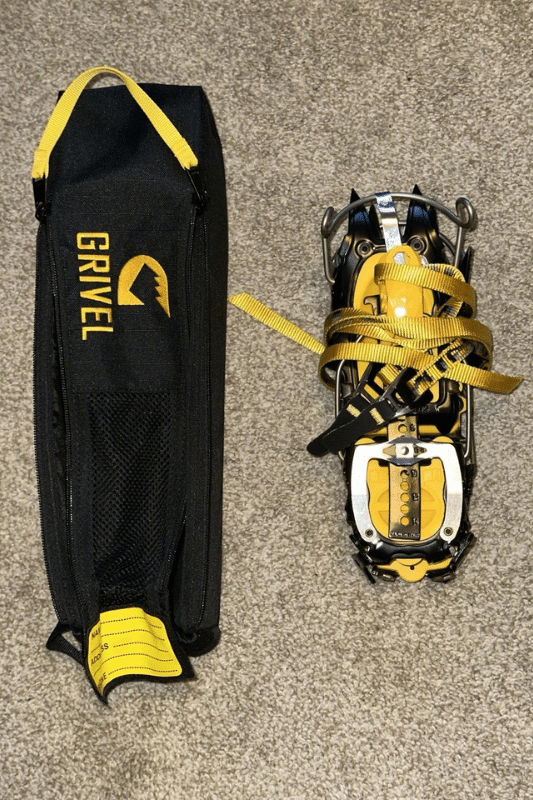
Crampons are simple tools, but neglecting them shortens their lifespan and creates safety issues you won’t notice until you’re relying on them. A few minutes of maintenance after each trip keeps them functional for years.
After Each Use
Knock off debris and dry them before storage. Sounds obvious, but I’ve pulled crampons out of packs weeks later, still caked in mud. Chromoly rusts if you skip this step; stainless and aluminum are more forgiving.
Seasonal Inspection
Once a season, check for cracks near hinge points and binding attachments. Flex the frame gently and look for stress marks. Front points bend before they break, so sight down them for alignment. Anti-balling plates crack and compress over time; replace them when they stop flexing properly.
Sharpening
Points dull gradually, especially with rock contact, and you don’t notice until they’re skating on ice. A mill file restores edges. Maintain the original bevel angle and work in one direction only. I sharpen once a year; friends who climb more rocky terrain do it twice.
Storage
Store them hanging or flat in a dry spot. Point protectors save your other gear from punctures and keep edges sharp. Avoid sealed containers that trap moisture.
When to Retire Crampons
Retire them when you see visible cracks, frames bent beyond straightening, or front points worn to half their original length. If something looks wrong near a stress point, it probably is.
Crampon FAQs
On steep snow and ice, yes. Microspikes help on icy trails, but only true crampons provide security beyond 30-degree slopes or on hardened ice. If you’re unsure whether terrain requires them, carry them anyway. They’re useless in your car.
Quality steel crampons typically last 5-10 seasons with regular use. Points dull, anti-balling plates wear, and frames eventually fatigue, but structural failure is rare with proper care.
Only strap-on (C1) models, and only with stiffer hiking boots. Semi-automatic and automatic bindings require welted mountaineering boots. Check your boots for heel welts before buying.
Properly fitted crampons shouldn’t damage boots. Overtightened bails can stress heel welts over time. Strap-on bindings are gentler on footwear than lever systems. Inspect boot welts periodically for wear.
Yes, but it dulls points and risks slipping on smooth surfaces. Experienced mountaineers often keep crampons on through short rocky sections rather than repeatedly removing them. Chromoly and stainless steel handle rock contact better than aluminum.
Basic flat-footing on moderate snow is intuitive. Front-pointing and self-arrest skills require practice on low-angle terrain or through a mountaineering course before tackling steep objectives.
Extremely rarely. Abuse, like repeated rock contact, deep nicks, and corrosion from wet storage, accelerates failure. Inspect them regularly to catch problems before they become dangerous.
Prices in this article are approximate and updated annually. Check the retailer for current rates.