
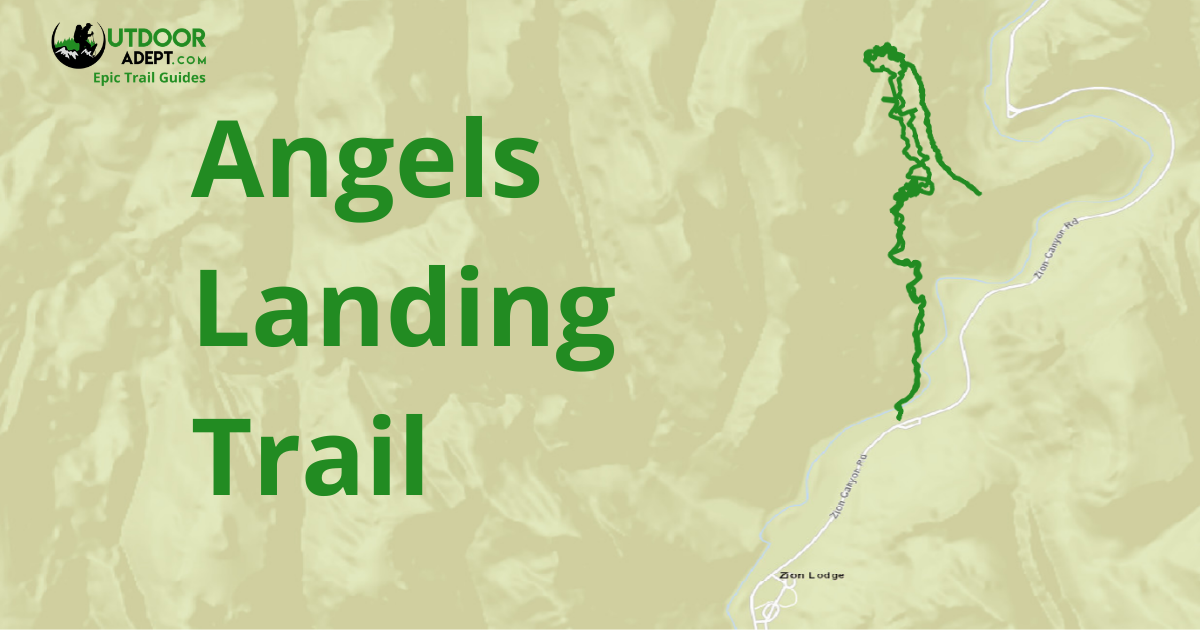
Whether you’re an avid hiker or not, there’s no way you can plan a day trip to Zion National Park without even at least hearing of Angels Landing. Legendary among hikers of all skill levels, Angels Landing Trail is famous for the sheer, ineffable beauty of the view that awaits you at the end, matched only by the difficulty and danger of the hike, itself.
Before you make for that trailhead, read our handy hike guide through for essential information on getting an Angels Landing permit, getting ready for a day hike, and enjoying your outdoor adventure safely.
Additionally, we recommend reading our Complete Hiking Guide for Beginners.
Angels Landing Trail Stats
| Angels Landing Trail | |
|---|---|
| Distance | 5.4 miles8.7 km (round trip) |
| Elevation | 1,500 feet457 meters total climbing |
| Time | ~4 hours |
| State | Utah |
| Season | March to mid November |
| Budget | $50 for US residents $150 for non-US residents |
Why is it called “Angels Landing” Trail?

Back in 1916, a minister named Frederick Vining Fisher on his first trip to Zion Canyon was said to have described the landing as a place where no one but an angel could ever land. Given 10 years before the trail was carved out, that description certainly wasn’t far off the mark.
Angels Landing is about 5,790 feet1,765 meters tall, and making your way to the top of this 5.4-mile8.7-km trail will take you some 1,500 feet457 meters up. While a leisurely hike can take all day, hiking the trail usually takes about four hours.
Who can hike Angels Landing Trail?
Hiking Angels Landing Trail is definitely not for everyone because of the conditioning and advanced skill level you need to make the summit and back safely. Authorities quietly keep a running list of people who have died hiking the trail, some of whom were skilled and experienced hikers.
If, however, you are fit or have the right conditioning, you’re used to high-exposure areas, and, most importantly, have the proper respect for, or awareness of the risks, Angels Landing Trail could be one of your best hiking experiences yet. The trail isn’t for small children, however, and definitely not for anyone with a fear of heights. Bringing pets along is also not allowed.
Our case study found Angels Landing to be the most dangerous trail in the USA.
Why do you need an Angels Landing permit?
Fatal accidents on Angels Landing Trail prompted park authorities to require a permit for hikers, which they can check without a heads up any time during your hike. Make sure you have a copy (hard copy, screenshot, or download) of your permit (including the confirmation email) and an ID on you when you hit the trail.
How do you get an Angels Landing permit?
The legendary status and growing popularity of Angels Landing Trail have also prompted park authorities to issue permits using lottery systems. That means that there’s no real guarantee that you’ll be able to get a permit at the exact time you want it, so it’s a good idea to apply in advance (and to have loads of patience and perseverance).
That also means planning your hike around when you’ll be able to get your permit, and preparing well in advance before you even apply. You apply by visiting recreation.gov (if you need a walkthrough, you can watch one here). Yourself included, you may apply for up to six people at a time.
Seasonal Lottery
This lottery system lets you apply for your permit well ahead of time by choosing as many as seven hiking calendar dates and times. You’ll receive an email confirmation whether or not you’re successful.
Day-Before Lottery
If you feel lucky, you could try applying using this lottery system from 12:01 AM to 3 PM, Mountain Time. You can expect your confirmation email (whether you get the permit or not) on the same day as your application from 4:01 PM onward.
Permit Costs
Applying for an Angels Landing Permit costs $6 whether you use the seasonal or day-before lottery. If your application is successful, you’ll need to pay $3 per person for the permit itself. Expect an email receipt (separate from your confirmation email) for your payments.
While it isn’t part of the permit cost, you’ll also have to pay the Zion National Park entrance fee. The fee for a Standard entrance pass is $20.00–$35.00. For non-US residents an additional $100 per person fee must be paid.
Permit Changes
You won’t be able to change a permit from the day-before lottery system, but you can make limited changes to permits from the seasonal lottery. These changes include removing hikers from your group, e.g. you applied for six people but only four can make it. You’ll be able to get a refund for the people you remove (see next section).
However, you will not be able to add more people to your permit, change your group leader, or change the name on your permit, as permits are non-transferable. You may also not change your permit date.
Refunds
Application fees are non-refundable, but you can get a refund for the $3-per-person fee if you got your permit using the seasonal lottery system and cancel your hike up to two days before your hike date. These canceled permits are then included in the day-before lottery system.
When is the best time to hike Angels Landing Trail?

Having mentioned the hordes of fans Angels Landing Trail has, you’ll probably want to try and time your permit application to avoid crowds. Most activity on the trail takes place on late spring and summer weekends, so the first couple of weeks in March and around November 16th may be the best time for you to go. (Ice and snow have been found on the trail in April, though.)
Winter Hikes
Now while hiking in the winter has its charms, you should know that parts of Angels Landing Trail can have black ice. However experienced or skilled a hiker you are, you also probably wouldn’t want to add snow to the challenges of an already challenging trail. Do check with park authorities before even thinking about a winter hike here.
Sunrise and Sunset
While capturing the rising or setting sun atop Angels Landing is a holy grail for many photographers, please consider how a sunrise shot could mean going up in partial, pre-dawn light, while a sunset shot could end up in an after-dark descent. It can still be light out after 9 PM, but please remember just how dangerous the trail is even in broad daylight, so time your hike carefully.
Morning Hikes
It’s usually a good idea to hike in the morning to avoid not just the crowds but bad weather, as thunderstorms are more likely in the afternoon.
How do you prepare for hiking Angels Landing Trail?

Even the greenest hiker would never dream of hitting the trail unprepared, and checking out our complete hiking guide is a great place to start. Hiking Angels Landing Trail, however, will take extra care and consideration.
Gearing Up
You’ll find a great guide to what to pack for a day hike here, but allow us to highlight these absolute must-haves for this particular trail:
Final Checks
Do note that chances are, you won’t be able to rely on internet connectivity or phone service for those last items on the list. Again, do not forget to have your permit and ID with you, or you just might not be allowed to complete your hike. Make sure your ID is valid and that the name on it matches the name on your permit.
Also, double-check the time of your hike, as you’ll need to be at the trailhead at the time indicated on your permit.
How do you get to Angels Landing Trail?

Many hikers catch the Zion National Park shuttle to the trailhead, so you’ll want to check the shuttle schedule to make sure you get there on time. The schedule does change so be sure you’re up to date, and there are entire weeks in the winter and spring when there is no shuttle service.
Both the Zion Canyon Line (park shuttle) and the Springdale Line (town shuttle) are free to ride and come every 10 to 15 minutes. The park shuttle’s first stop is at the Zion Canyon Visitor Center, but you will ride to stop #6, The Grotto. Be sure to use the restrooms and fill your water bottles at The Grotto Trailhead before starting, as it is the last location with running water.
If you’re on your way back from the trail, try not to catch the last park shuttle, as missing it could mean a five-milean 8-km walk back to the Center.
Driving to the Trail
You can take your own vehicle if you’ll be hiking Angels Landing Trail on a day without shuttle service, and then park at the Zion Human History Museum or the Zion Canyon Visitor Center where the shuttle would have stopped. Take note, however, that you may not find parking at all if you don’t make it to Zion National Park by around 9 AM.
Some hikers end up parking in Springdale then taking the shuttle (when available) into the park. Either way, it’s a good idea to tune into 1610 AM for traffic updates in the area.
What are the different stops on Angels Landing Trail?
From trailhead to summit, here are the landmarks along Angels Landing Trail to help you track your progress and enjoy your ascent.
Grotto Trailhead
The sixth stop on the shuttle route, the Grotto Trailhead is the starting point of choice for most hikers. If you come on the first morning shuttle, you can expect quite a number of fellow hikers here. It won’t be long along this nice, level stretch before you can enjoy the sight of the Virgin River, and Angels Landing itself, beyond.
Refrigerator Canyon

This part of the trail isn’t called “refrigerator” for nothing. This pleasantly cool and shady stretch is home to endangered Mexican Spotted Owls, so do your best to keep noise levels down. It’s also home to white fir, bigtooth maple, and other cool climate plant species.
Walter’s Wiggles
Back in 1926, this section of the trail comprising 21 switchbacks took its name from Zion National Park’s first ever superintendent, Walter Ruesch. Steep as they are, they have made the ascent a lot easier for hikers over the past 100 years.
Scout Lookout
This is where the paved trail ends, and as far as non-permit holders can go. At this point, you can get a look at the chains leading up to the summit, and you’ll see why many hikers choose to turn back here.
Those who do are still rewarded with an incredibly stunning view for making it this far. There are primitive vault toilets here, serving as your absolute final bathroom stop before the summit.
Hogsback (Angels Landing Chains)
You will definitely need your permit and ID before you tackle Hogsback (also known as Angels Landing Spine), where you’ll find the chains leading up to Angels Landing. Bear in mind that falls along the chains are fatal, and (depending on the time of year) there may be ice and snow underfoot along the way. Most of the accidents that happen along the trail occur along the chains.
Also bear in mind that not all of the drop-offs will have the chains as a hand rail, and that there is an unprotected stretch along the way, as well.
Hogsback is the homestretch, though, with the landing itself in sight.
Angels Landing
Get ready to fall deeply, madly in love with the astonishing views of Zion Canyon on the summit all around. (Just don’t fall, as there are no guard rails of any kind up there.)
If you can tear your eyes away from the spectacular vistas, marvel at the trees that have managed to find a foothold there (and envy the birds and other wildlife who are there without having worked as hard as you).
How do you stay safe on the hiking trail?

Ultimately, it’s up to you to make sure you make it up the trail and back again safely. This doesn’t just mean taking the necessary precautions, but also being honest with yourself about your limits, avoiding overconfidence, and knowing when it’s safer to stop or back off.
Watch the Weather
Don’t make the challenges of getting your Angels Landing permit and planning your hike an excuse for pushing on with your hike in bad weather. Checking the weather is one of the most important safety precautions you can take, especially on this trail.
Do not hike if you see a storm brewing, the rocks and the ground are wet or iced, or there’s not enough (or will not be enough) light to hike safely. If the sky looks iffy to you as you’re about to head out from Grotto Trailhead, consult park authorities first.
If you’re already on the trail and the weather seems to be taking a turn for the worse, just stop and don’t continue your hike. If you can, turn right around and start hiking downward. Do take extra care if you happen to be on Hogsback at this time.
Look out for Falling Rocks

Keep your eyes open for rockfalls which are common in Zion National Park and can happen without warning.
If you see one, move fast to keep clear of the cliff. If this isn’t possible (like when you’re near the bottom of the cliff), protect your head with your backpack, find the biggest boulder near you, and take cover behind it. As soon as the rockfall stops, quickly get as far away from the cliff base as you can.
For safety, steer clear of the cliffs and avoid trails that have been closed off.
Using the Angels Landing Chains
Here are some safety tips you’ll want to keep in mind as you make your way up (and down) Hogsback:
- Stay on the path. Do not leave it for any reason.
- Always keep one hand on the chain.
- Try to keep three points of contact.
- Don’t be in a hurry, and don’t be pressured by faster hikers.
- If circumstances allow, let faster hikers overtake you.
- Don’t rush hikers moving more slowly than you.
- Overtake other hikers patiently.
- Give way in sections where only one person can pass at a time.
It may also happen that the heights get to you, even if you don’t have a fear of heights. If that happens along the chains, just stop and take your time in getting your bearings back.
In Case of Emergency
Because cell and data service is unavailable for many people in Zion National Park, try to find the park authorities, e.g. park rangers or volunteers stationed along the trail. In case you are able to connect, you can also get help from the Zion Dispatch Office by calling 911.
How can you help take care of Angels Landing Trail?
Loved by hikers just like you for a full century, Angels Landing Trail depends on hikers just like you to keep it as beautiful as it is now for centuries to come.
Keep the Trail Clean
Except for the trailhead, there are no trash cans all along the trail, so do pack out your trash. It would be great if you picked up and packed out any trash you might find along the way, as well. Take care of your gear so that your hat, towel, or water bottle doesn’t fall out or blow away and become trash by accident.
Keep Away From the Animals
Apart from the spotted owls in Refrigerator Canyon, there are several other animals such as chipmunks, squirrels, and birds along the trail. If you’re lucky, you might even spot the mighty California condor. If you do run into any wildlife, keep away from them and do not feed them. Keep your food and your gear safely packed away so these critters can’t get at it.
Whether your finish line is at Scout Lookout or you brave the chains up Hogsback to the paradise at the summit, Angels Landing Trail is one hike you’ll never forget. If you found our Angels Landing Trail Guide helpful, do check out our guide to the John Muir Trail.
Another trail you may like: GR20 Trail Guide
References:
1. https://www.nps.gov/zion/planyourvisit/angels-landing-hiking-permits.htm
2. https://noahlangphotography.com/blog/angels-landing-trail-zion-national-park
3. https://www.visitutah.com/places-to-go/parks-outdoors/zion/outdoor-experiences/angels-landing
4. https://www.utah.com/destinations/national-parks/zion-national-park/places-to-see/angels-landing/
5. https://www.shedreamsofalpine.com/blog/angels-landing-hike
6. https://www.youtube.com/watch?v=VXwmUrSpDGM
7. https://www.youtube.com/watch?v=AfwdgJdEPJk
8. https://explorewithalec.com/hike-angels-landing/
9. https://eastzionadventures.com/celebrating-100-years-of-adventure-in-zion-national-park/